
Giganotosaurus in 3D - click the head, an arm, the tail, or a leg for a fact (full controls on the Dinosaurs 3D hub).
Giganotosaurus was one of the largest predatory dinosaurs known - turn on the human figure to see how a person compares to its huge skull and long, muscular tail.
It belongs to the same Giganotosaurini tribe as the smaller, earlier Tyrannotitan, found in a different province of the same Patagonian Argentina region several million years before Giganotosaurus.
The measurements in the panel follow published estimates, with ranges shown where sources disagree.
Giganotosaurus 3D Viewer
Rotate the Giganotosaurus below by dragging, zoom in with the scroll wheel, and click a body part to reveal a fact (see the Dinosaurs 3D hub for every control).
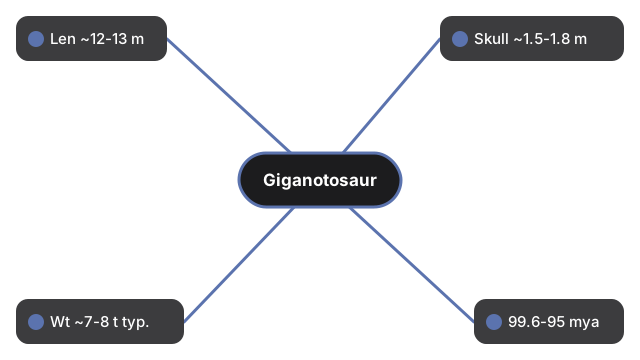
Giganotosaurus carolinii lived in the Late Cretaceous, roughly 99.6 to 95 million years ago (the early Cenomanian), in the Candeleros Formation of Patagonia, Argentina. The holotype skeleton measured about 12 to 13 m long, and a larger referred jawbone (specimen MUCPv-95) suggests some individuals may have reached about 13.2 m. Weight estimates vary widely because no complete skeleton has been found, ranging from about 4.2 to 13.8 tonnes across different studies, with many estimates falling between 7 and 8 tonnes. Its skull alone measured about 1.53 to 1.80 m in the holotype, and up to about 1.95 m in the larger referred specimen - among the largest theropod skulls known, even though Tyrannosaurus rex is generally considered heavier overall.
Rubén Darío Carolini discovered the first fossils near Villa El Chocón, Neuquén Province, Argentina, in 1993. Paleontologists Rodolfo Coria and Leonardo Salgado formally described and named the species in 1995, honoring Carolini in the species name. The holotype specimen, MUCPv-Ch1, is held at the Ernesto Bachmann Municipal Paleontological Museum in Villa El Chocón. As an apex predator, Giganotosaurus likely relied on its bite force and body mass to bring down large prey, potentially including young sauropod dinosaurs that shared its ecosystem.
| Measure | Figure |
|---|---|
| Length | about 12-13 m (holotype); a larger referred specimen suggests up to about 13.2 m |
| Skull length | about 1.53-1.80 m (holotype); up to about 1.95 m in the larger referred specimen |
| Weight | about 4.2-13.8 tonnes (estimates vary widely; many fall between 7-8 tonnes) |
| When it lived | 99.6-95 million years ago (early Cenomanian, Late Cretaceous) |
| Diet | Carnivore (apex predator) |
Colors here are an artistic reconstruction - fossils don't preserve them; the numbers above are real published values, with ranges shown because sources vary.
Frequently Asked Questions
How big was Giganotosaurus?
The holotype skeleton measured about 12 to 13 m long, and a larger referred jawbone (specimen MUCPv-95) suggests some individuals may have reached about 13.2 m. Weight estimates vary widely, from about 4.2 to 13.8 tonnes, because no complete skeleton has been found. Turn on the human figure in the viewer to see the scale against a 1.8 m person.
Was Giganotosaurus bigger than Tyrannosaurus rex?
By length, Giganotosaurus is generally considered at least as long as, and by some estimates longer than, Tyrannosaurus rex - its skull alone reached about 1.53 to 1.95 m, among the largest theropod skulls known. By weight, most studies consider Tyrannosaurus rex the heavier and more heavily built animal, since Giganotosaurus had a comparatively slender, gracile skeleton for its length. The two never met - Giganotosaurus lived in South America about 30 million years before Tyrannosaurus rex appeared in North America.
When and where did Giganotosaurus live?
In the Late Cretaceous, roughly 99.6 to 95 million years ago (the early Cenomanian), in what is now the Candeleros Formation of Patagonia, Argentina. Rubén Darío Carolini found the first fossils near Villa El Chocón in 1993, and paleontologists Rodolfo Coria and Leonardo Salgado formally described and named the species in 1995.
Is the model scientifically accurate?
The proportions follow published figures, but the skin color and texture are an artistic reconstruction - fossils preserve bone, not soft tissue or color. This model is not a fossil-accurate skeleton. The length, skull, weight, and age figures shown are real published values, with ranges cited where sources disagree.
Do I need to install anything to view it?
No. The model renders in your browser with WebGL - no app, no account, and nothing about your visit is sent to a server. The 3D engine loads once and is then cached.