
Baryonyx in 3D - click the head, tail, or a leg for a fact (full controls on the Dinosaurs 3D hub).
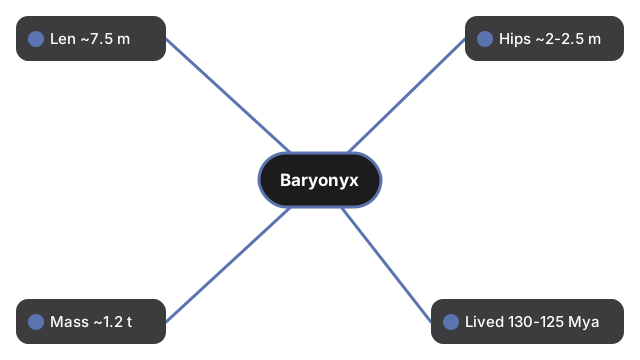
Baryonyx walkeri stretched roughly 7.5 m nose to tail and stood around 2 to 2.5 m tall at the hips - turn on the human figure to see how a person compares to this crocodile-snouted fish-eater.
The measurements in the panel follow the Natural History Museum and the 2010 body-mass revision (Cuff and Rayfield).
Baryonyx 3D Viewer
This page renders Baryonyx (Baryonyx walkeri) as a 3D model - full controls on the Dinosaurs 3D hub - click the head, tail, or a leg to read a fact about that part.
Baryonyx lived in the Early Cretaceous, about 130 to 125 million years ago, in what is now England. Published length and mass estimates vary: a 2010 body-mass study (Cuff and Rayfield) gives about 7.5 m and about 1.2 tonnes (1200 kg), the figures shown here, while earlier estimates from 1986-1997 ran larger, up to about 9.5-10 m and 1.7-2.7 tonnes. Hip height is usually put around 2 to 2.5 m across sources. Its long, low, crocodile-like snout held conical, unserrated teeth suited to catching fish, and its genus name means "heavy claw" for the roughly 31 cm curved claw found on its thumb.
The type specimen was found in 1983 by amateur fossil collector William Walker in a Surrey, England clay pit and excavated by a Natural History Museum-led team, which recovered about 70 percent of the skeleton including the skull. Fish scales and a juvenile Iguanodon bone were found near its stomach region - direct fossil evidence of its diet. It was formally named by Alan Charig and Angela Milner in 1986.
| Measure | Figure |
|---|---|
| Length | about 7.5 m (earlier estimates up to about 9.5-10 m; Cuff and Rayfield 2010) |
| Hip height | about 2 to 2.5 m |
| Weight | about 1.2 tonnes (1200 kg; earlier estimates up to about 2.7 tonnes) |
| When it lived | 130-125 million years ago (Early Cretaceous) |
| Diet | Carnivore (mainly fish, per stomach-region fossil evidence) |
For two more spinosaurids shipped on this site, see the Spinosaurus 3D Viewer, a far larger North African relative known for its tall back sail, or the Suchomimus 3D Viewer, a larger Nigerian relative with a low ridge of neural spines instead of a sail.
Colors here are an artistic reconstruction - fossils don't preserve them; the numbers above are real published values.
Frequently Asked Questions
How big was Baryonyx?
About 7.5 m long and about 1.2 tonnes (1200 kg) per a 2010 body-mass study, with hip height around 2 to 2.5 m. Earlier estimates from 1986-1997 ran larger, up to about 9.5-10 m and 2.7 tonnes. Turn on the human figure in the viewer to see the scale against a 1.8 m person.
Why is it called "heavy claw"?
Baryonyx means "heavy claw" in Greek, named for an unusually large curved claw found on its thumb, about 31 cm long. The claw and the long, low, crocodile-like snout are its most distinctive features.
What did Baryonyx eat?
Mainly fish. Fish scales and a juvenile Iguanodon bone were found near the stomach region of the type specimen - direct fossil evidence of its diet, unusual for a large theropod.
Is the model scientifically accurate?
The proportions follow published figures, but the skin color and soft-tissue profile are an artistic reconstruction - fossils preserve bone, not soft tissue or color. This model is not a fossil-accurate skeleton. The length, weight, and age figures shown are real published values.
Where was Baryonyx found?
The type specimen was found in 1983 by amateur fossil collector William Walker in a clay pit near Surrey, England, and excavated by a Natural History Museum-led team that recovered about 70 percent of the skeleton. It was formally named by Alan Charig and Angela Milner in 1986.
Do I need to install anything to view it?
No. The model renders in your browser with WebGL - no app, no account, and nothing about your visit is sent to a server. The 3D engine loads once and is then cached.