
Austroraptor in 3D - click head, tail, or a leg for a fact (full controls on the Dinosaurs 3D hub).
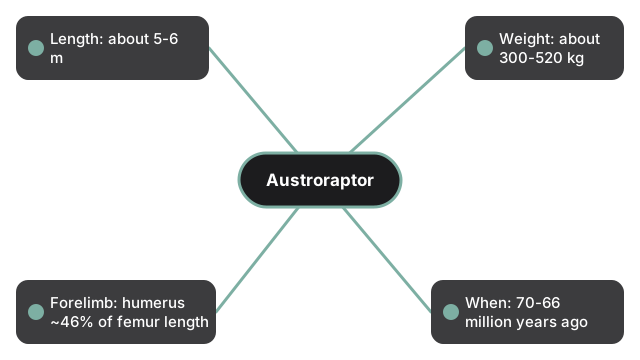
Austroraptor stretched roughly 5-6 m long and weighed an estimated 300-520 kg depending on the study - one of the largest raptors ever found, rivaled in size only by Utahraptor and Achillobator. Turn on the human figure to compare it against a 1.8 m person.
The colors and skin shown here are an artistic reconstruction; fossils preserve bone, not soft tissue or color. The model is also shown in a resting, crouched stance with the legs tucked rather than an active stride - a characteristic of the source sculpt, not a claim about how this dinosaur moved. The measurements in the panel are the ones actually published.
Austroraptor 3D Viewer
This page renders Austroraptor as a 3D model you can spin: drag to rotate, pinch to zoom, add a 1.8 m person for scale, and click a body part for a fact.
Austroraptor cabazai lived in the Late Cretaceous, roughly 70-66 million years ago, in what is now Patagonia, Argentina. At an estimated 5-6 m long and 300-520 kg, it is one of the largest known dromaeosaurids ("raptors") and the largest raptor found anywhere in the Southern Hemisphere - rivaled in size only by Utahraptor and Achillobator. Its forelimb was unusually short for a dromaeosaurid: the upper arm bone (humerus) measured only about 46 percent the length of the thigh bone (femur). Its teeth were also unlike most raptors - small, conical, and unserrated rather than blade-like - a pattern that points to a fish-eating (piscivorous) diet, similar to spinosaurids.
The holotype (MML-195) was found in December 2002 at Bajo de Santa Rosa in the Allen Formation and named in 2008 by Fernando Novas, Diego Pol, Juan Canale, Jorge Porfiri, and Calvo. It belongs to Unenlagiidae, a family of South American raptors closely related to the smaller Buitreraptor. The fossil skeleton found so far does not include a complete pelvis, so - unlike most other dinosaurs on this site - no independently published hip-height figure exists for this species.
| Measure | Figure |
|---|---|
| Length | about 5-6 m |
| Weight | about 300-520 kg (range across studies) |
| Forelimb proportion | humerus about 46% of femur length (unusually short for a dromaeosaurid) |
| When it lived | 70-66 million years ago (Late Cretaceous, Maastrichtian) |
| Diet | Carnivore, likely piscivorous (fish-eating) |
This runs client-side through WebGL - no account to create, and nothing about your visit is transmitted to a server. Skin tone and pattern are an artistic reconstruction; the model is also shown resting with its legs tucked rather than walking, a pose choice of the source sculpt. The numbers above are real published values, with a range given where studies disagree.
See also Velociraptor, another dromaeosaurid ("raptor") on this site.
Frequently Asked Questions
How big was Austroraptor?
An estimated 5-6 m long and 300-520 kg depending on the study - one of the largest raptors ever found, rivaled in size only by Utahraptor and Achillobator. Turn on the human figure in the viewer to see it against a 1.8 m person.
Why were Austroraptor's arms so short?
Its upper arm bone (humerus) measured only about 46 percent the length of its thigh bone (femur) - unusually short for a dromaeosaurid. Only a few other raptors, such as Tianyuraptor and Zhenyuanlong, share similarly reduced forelimbs; the reason is still debated among researchers.
Did Austroraptor really eat fish?
Its teeth suggest so. Unlike most raptors' blade-like serrated teeth, Austroraptor had small, conical, unserrated teeth - a pattern seen in fish-eating dinosaurs such as spinosaurids. No stomach contents have been found, so this diet is inferred from tooth shape, not directly observed.
Is the 3D model scientifically accurate?
The proportions follow the fossil skeleton, but the skin color and texture are an artistic reconstruction, and the pose shown is a resting, crouched stance rather than an active stride. Fossils preserve bone, not soft tissue or color. The length, weight, and age figures shown are real published values.
When and where did Austroraptor live?
In the Late Cretaceous, roughly 70 to 66 million years ago, in what is now Patagonia, Argentina. The holotype fossil was found in December 2002 at Bajo de Santa Rosa in the Allen Formation and was named in 2008.
Do I need to install anything to view it?
No. The model renders in your browser with WebGL - no app, no account, and nothing about your visit is sent to a server. The 3D engine loads once and is then cached.