How to View Albertosaurus in 3D
Albertosaurus 3D Viewer runs a chicken-sized Late Cretaceous European theropod in your browser. Drag to rotate, scroll or pinch to zoom, toggle a 1.8 m person for scale, and click a body region for a fossil-sourced fact.
Open the Albertosaurus page and take the camera
Open the Albertosaurus 3D Viewer and wait for the facts panel to fill. When the status line says you can drag, orbit Albertosaurus with the pointer and zoom with the scroll wheel or a two-finger pinch. Fullscreen expands the wrapper so the controls stay visible beside the scene. After first paint a license-clean CC0 1.0 glTF may swap in automatically from the CDN; if that load fails the page stays on the procedural theropod silhouette with zero regression.
Use the four Albertosaurus controls under the canvas
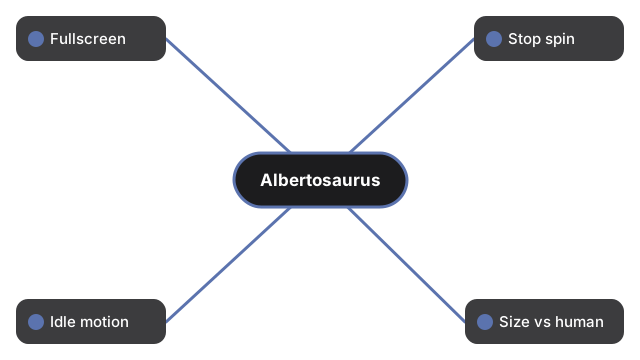
Under the Albertosaurus canvas, four controls handle view and scale:
- Fullscreen - fills the display while keeping the buttons visible
- Stop rotation / Auto-rotate - freezes or resumes auto-spin
- Idle motion - adds subtle body sway; tap again for Stand still
- Size vs human - shows a 1.8 m person at the honest panel length ratio used by the viewer (9 m)
Read the Albertosaurus facts panel and click a body part
The Albertosaurus facts panel lists length about 9 m panel baseline (largest known Dry Island Bonebed individual estimated past 10 m), hip height about 3.4 m at the hip (panel baseline), mass about 1.8-2.7 t (panel baseline 2.2 t), the Late Cretaceous window about 76-70 million years ago from Alberta, Canada, carnivore diet, partial skull found by Joseph Burr Tyrrell in 1884 and named Albertosaurus sarcophagus by Henry Fairfield Osborn in 1905. Albertosaurus was more closely related to Gorgosaurus (albertosaurine branch) than to Tyrannosaurus rex. The Dry Island Bonebed holds at least 26 individuals - a mass-death assemblage consistent with possible gregarious behavior, not proven pack-hunting. A short click - not a drag - on a body region surfaces a short fossil fact. Soft-tissue color is an artistic reconstruction. When the CC0 1.0 glTF by Manicaeks via OpenGameArt loads, the status text notes a real model with that credit - a stylized reconstruction, not a laser scan. This model is not a fossil-accurate skeleton.
What the Albertosaurus how-to guide is not
The Albertosaurus how-to guide is a controls walkthrough for the in-browser viewer only - it does not place the model in your room (no AR), it does not invent a single mass outside the published 1.8-2.7 t range, it does not conflate Albertosaurus with Tyrannosaurus rex or Gorgosaurus, it does not invent soft-tissue color accuracy, it does not invent game score or win states, and it does not claim the optional glTF is a scientifically exact reconstruction. For the size story see Albertosaurus size comparison. For trade-offs versus phone AR apps see Albertosaurus 3D viewer vs AR apps.
Why trust these tools
- Ten-plus years of web tooling. The freetoolonline editorial team has shipped browser-based utilities since 2015. The goal has never changed: get you to a working output fast, without an install.
- No install, no sign-up. Open a tool and get a working output in seconds - nothing to download and no account to create. Tools that need heavy processing run it on our service, so even a low-powered machine gets the job done.
- Analytics stops at the page view. We measure which pages get visited, not what you type or upload inside a tool. There is nothing to sign in to and no profile is attached to your input.
- Open-source core components. The processing engines underneath (libheif, libde265, pdf-lib, terser, clean-css, ffmpeg.wasm, and others) are public and audit-able. We link to each one in its tool page's footer.
- Free, with or without ads. All tools are fully functional without sign-up. The Disable Ads button in the header is always available if you need a distraction-free run.