
Utahraptor in 3D - click the head, tail, an arm, or a leg for a fact (full controls on the Dinosaurs 3D hub).
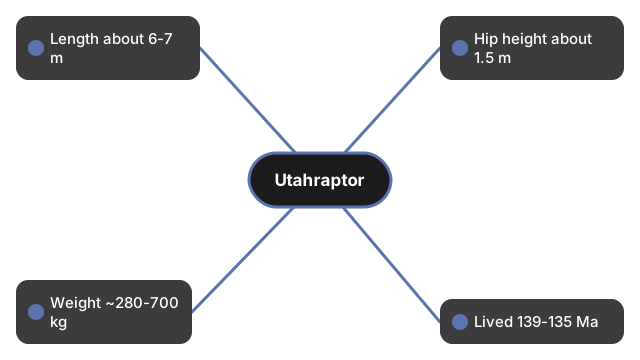
Utahraptor stood about 1.5 m tall at the hip and stretched roughly 6 to 7 m from snout to tail - turn on the human figure to see it dwarfed the already-shipped Velociraptor and Deinonychus, making it the largest raptor known to have existed.
Colors are an artistic reconstruction (fossils don't preserve them). Utahraptor's own bones carry no feather fossils, so the model skips feathers entirely rather than guess; Microraptor is the usual reference point paleontologists use for what dromaeosaurid feathering might have looked like at smaller body sizes. Published figures fill the measurement panel.
Utahraptor 3D Viewer
freetoolonline.com editorial team
Spin this Utahraptor by dragging, zoom with scroll or pinch, and tap a body part to surface a fact about it (full control reference on the Dinosaurs 3D hub).
Utahraptor lived in the Early Cretaceous, roughly 139 to 135 million years ago, in what is now the Cedar Mountain Formation (Yellow Cat Member) near Moab, Utah, USA. Published figures put an adult at about 6 to 7 m long and roughly 1.5 m tall at the hip - the largest dromaeosaurid ("raptor") known, dwarfing the already-shipped Velociraptor and Deinonychus. Weight estimates vary widely by method and specimen: the original 1993 description put smaller individuals around 280-360 kg, while later mass estimates for the largest known individuals run to roughly 500-700 kg. A large, sickle-shaped foot claw up to 24 cm long - the largest recorded for any dromaeosaurid - tipped the second toe of each foot. As an ambush predator, it hunted large herbivores such as ankylosaurs and iguanodontians.
The genus was named in 1993 by James Kirkland, Robert Gaston, and Donald Burge. Its species name, originally spelled "ostrommaysi", credited two people: paleontologist John Ostrom (who separately described Deinonychus in 1969) and Chris Mays, a research funder. A 2001 quarry yielded a jumbled "Utahraptor block" - the remains of at least seven individuals packed together, one adult, four juveniles, and a hatchling only about 1 m long - suggesting these animals may have lived or hunted in social groups with some form of parental care.
| Measure | Figure |
|---|---|
| Length | about 6-7 m |
| Hip height | about 1.5 m |
| Weight | about 280-700 kg (280-360 kg by the original 1993 description; up to about 500-700 kg by later estimates for the largest individuals) |
| When it lived | 139-135 million years ago (Early Cretaceous, Berriasian-Valanginian) |
| Diet | Carnivore - an ambush predator that hunted large herbivores such as ankylosaurs and iguanodontians |
| Described | 1993 by James Kirkland, Robert Gaston, and Donald Burge; Cedar Mountain Formation, Yellow Cat Member (Utah, USA) |
Colors here are an artistic reconstruction - fossils don't preserve them; no feather fossils are directly known from Utahraptor itself, so feathering is left unrendered rather than assumed for this genus. The numbers above are real published values, and ranges are shown because sources and estimation methods vary. Utahraptor's size record only holds in the Northern Hemisphere - the largest raptor found in the Southern Hemisphere is Argentina's Austroraptor, at 5-6 m still shorter than this genus.
Frequently Asked Questions
How big was Utahraptor?
About 6 to 7 m long and roughly 1.5 m tall at the hip - the largest dromaeosaurid ("raptor") known, dwarfing the already-shipped Velociraptor and Deinonychus. Weight estimates depend on the specimen and method: about 280-360 kg by the original 1993 description, or up to roughly 500-700 kg by later estimates for the largest individuals. Turn on the human figure in the viewer to see the scale against a 1.8 m person.
Is Utahraptor the same dinosaur as Jurassic Park's Velociraptor?
No. Utahraptor is a real, separate genus described in 1993, the same year the film released, and it is far larger than either the real Velociraptor or the film's on-screen "Velociraptor" (which was really sized on Deinonychus). Utahraptor's own claim to fame is being the biggest raptor ever found, not a movie inspiration.
What did Utahraptor eat?
It was a carnivore, and evidence points to it being an ambush predator that hunted large herbivores such as ankylosaurs and iguanodontians rather than chasing down prey over long distances.
Did Utahraptor live in groups?
A 2001 quarry discovery, nicknamed the "Utahraptor block", held the jumbled remains of at least seven individuals together - one adult, four juveniles, and a hatchling only about 1 m long. That mix of ages in one place hints at social behavior or parental care, though it is not direct proof of pack hunting.
Where does the name Utahraptor come from?
The genus is named for Utah, where its fossils were found in the Cedar Mountain Formation near Moab. James Kirkland, Robert Gaston, and Donald Burge named it in 1993; the species was originally called "ostrommaysi", honoring paleontologist John Ostrom - who also named Deinonychus - and Chris Mays, who helped fund the research.
Is the model scientifically accurate?
The proportions follow published fossil figures, but the skin color and texture are an artistic reconstruction - fossils preserve bone, not soft tissue or color. No feather fossils are known from Utahraptor itself, so feathers are not rendered. The length, weight, and age figures shown are real published values, with ranges cited because sources and estimation methods vary.