
Drag to rotate the Mamenchisaurus, scroll or pinch to zoom, and click a body part - the head, neck, body, leg, or tail - to read what fossils tell us about it. The panel beside the model carries the real figures.
Mamenchisaurus is famous for an extreme neck-to-body ratio - in the most fully documented species the neck is longer than 9 m, roughly half of total length. A separate, fragmentary species is often cited for a record-length neck; this page keeps those two stories apart.
The colors and skin here are an artistic reconstruction; fossils preserve bone, not soft tissue or color. The measurements in the panel are the real published ones.
Mamenchisaurus 3D Viewer
This page renders a Mamenchisaurus as a 3D model you can spin in the browser - drag to rotate, scroll or pinch to zoom, toggle a 1.8 m person beside it for scale, and click the head, neck, body, a leg, or the tail to read a fact about that part.
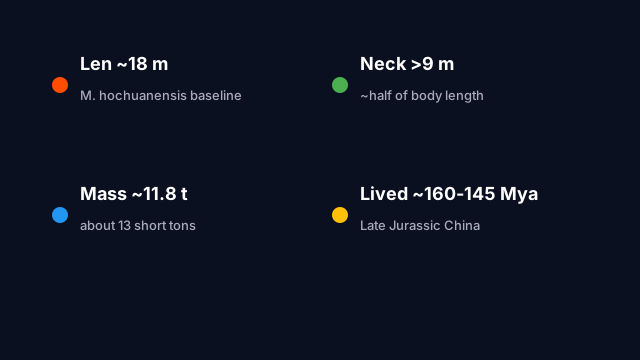
Mamenchisaurus lived mainly in the Late Jurassic of China (Sichuan Basin and Yunnan), about 160 to 145 million years ago for the more commonly cited species. Named by C.C. Young (Yang Zhongjian) in 1954, the genus is famous for an extreme neck. This page uses M. hochuanensis as the baseline body (about 18 m long, about 11.8 tonnes, neck longer than 9 m) and treats the longer M. sinocanadorum neck claim as a separate, fragmentary-fossil fact.
| Measure | Figure |
|---|---|
| Length (M. hochuanensis baseline) | about 18 m |
| Neck length (M. hochuanensis) | longer than 9 m - roughly half of total body length; 18-19 elongated cervical vertebrae |
| Weight (M. hochuanensis) | about 11.8 tonnes (about 13 short tons) |
| Record neck claim (M. sinocanadorum) | about 15 m neck cited from a few bones (vertebrae + one rib, found 1987) - not blended into the baseline body |
| When it lived | about 160-145 million years ago for most species (Late Jurassic China; genus span can reach Early Cretaceous) |
| Diet | Herbivore |
Everything runs on your device with WebGL - no account, nothing sent to a server. Soft-tissue color is an artistic reconstruction; this model is not a fossil-accurate skeleton. Compared with the whip-tailed Diplodocus 3D Viewer and the taller-shouldered Brachiosaurus 3D Viewer, Mamenchisaurus is the extreme-neck Chinese sauropod with a two-tier honesty note on which species the numbers come from.
Frequently Asked Questions
How big was Mamenchisaurus?
For the most fully documented mid-size species M. hochuanensis, published figures put length at about 18 m and mass at about 11.8 tonnes, with a neck longer than 9 m - roughly half of total body length. A separate species, M. sinocanadorum, is often cited for a neck about 15 m long, but that claim rests on only a few bones. Turn on the human figure to compare with a 1.8 m person.
Did Mamenchisaurus have the longest neck of any animal?
The longest-neck claim usually refers to M. sinocanadorum and is based on a handful of vertebrae plus one rib found in 1987. CT scans of those vertebrae found roughly 69-77 percent of the bone volume was air. This page does not blend that fragmentary record into the M. hochuanensis baseline body shown in the facts panel.
When and where did Mamenchisaurus live?
Most species lived in the Late Jurassic of China, about 160-145 million years ago, in the Sichuan Basin and Yunnan (formations such as the Upper Shaximiao and Shishugou). The genus was named by C.C. Young (Yang Zhongjian) in 1954; the type species is M. constructus.
Is the model scientifically accurate?
The proportions follow published size figures for M. hochuanensis, but the skin color and soft-tissue outline are an artistic reconstruction - fossils preserve bone, not soft tissue or color. This model is not a fossil-accurate skeleton. The length, neck, weight, and age figures shown are real published values, with the sinocanadorum record kept as a separate honesty note.
Do I need to install anything to view it?
No. The model renders in your browser with WebGL - no app, no account, and nothing about your visit is sent to a server. The 3D engine loads once and is then cached. When available, a free-licensed glTF model may swap in after first paint.