
Drag to rotate the Titanoboa, scroll or pinch to zoom, and click a body part - the head, a flipper, or the tail - to read what fossils tell us about it. The panel beside the model carries the real figures.
Titanoboa was a marine reptile, not a dinosaur - it swam rather than walked, so the model floats on a water plane with paddle-shaped flippers and a finned tail. Length estimates range roughly 11 to 17 m.
The colors and skin here are an artistic reconstruction; fossils preserve bone, not soft tissue or color. The measurements in the panel are the real published ones.
Titanoboa 3D Viewer
This page renders a Titanoboa as a 3D model you can spin in the browser - drag to rotate, scroll or pinch to zoom, toggle a 1.8 m person beside it for scale, and click a body region to read a fact.
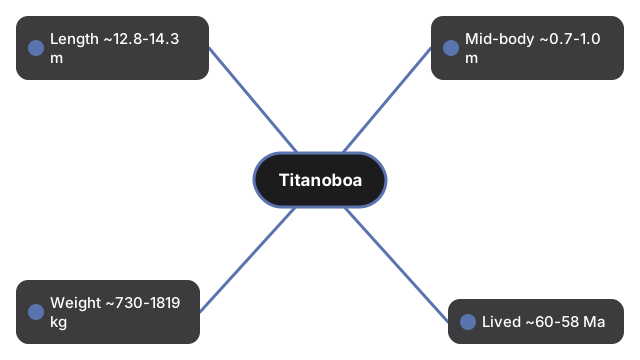
Titanoboa was a giant boid snake, not a dinosaur. It lived about 60-58 million years ago in the Cerrejon Formation of Colombia. Head and colleagues named T. cerrejonensis in 2009. Mean adult length is about 12.8 m (up to about 14.3 m); mass about 1135 kg (range about 730-1819 kg).
| Measure | Figure |
|---|---|
| Length | about 12.8 m mean (up to about 14.3 m; Head et al. 2009) |
| Mid-body height | about 0.7-1.0 m (proportionate estimate for scale) |
| Weight | about 1135 kg mean (about 730-1819 kg range; Head et al. 2009) |
| When it lived | about 60-58 million years ago (Paleocene) |
| Diet | Carnivore (aquatic predator) |
Everything runs on your device with WebGL - no account, nothing sent to a server. Soft-tissue color is an artistic reconstruction; this model is not a fossil-accurate skeleton. Compare with the marine reptile Mosasaurus 3D Viewer (also not a dinosaur).
Frequently Asked Questions
How big was Titanoboa?
Head et al. 2009 estimated about 12.8 m mean adult length (up to about 14.3 m) and about 1135 kg mean mass (about 730-1819 kg). Turn on the human figure for scale.
Is Titanoboa a dinosaur?
No. It was a giant boid snake that lived after non-avian dinosaurs went extinct. This section also covers other non-dinosaurs such as Mosasaurus when readers search for them here.
When and where did it live?
Paleocene of northeastern Colombia, about 60-58 million years ago (Cerrejon Formation). Named by Head and colleagues in 2009.
What does the name mean?
Titanoboa means titanic boa. The species name cerrejonensis honors the Cerrejon coal mines where the fossils were found.
Is the model scientifically accurate?
Length and mass follow published ranges, but skin color and soft tissue are artistic. Fossils are mainly vertebrae and ribs; this is not a fossil-accurate skeleton.
Do I need to install anything to view it?
No. The model renders in your browser with WebGL - no app, no account, and nothing about your visit is sent to a server. When available, a free-licensed glTF model may swap in after first paint.