
Spinosaurus in 3D - click the head, tail, or a leg for a fact (full controls on the Dinosaurs 3D hub).
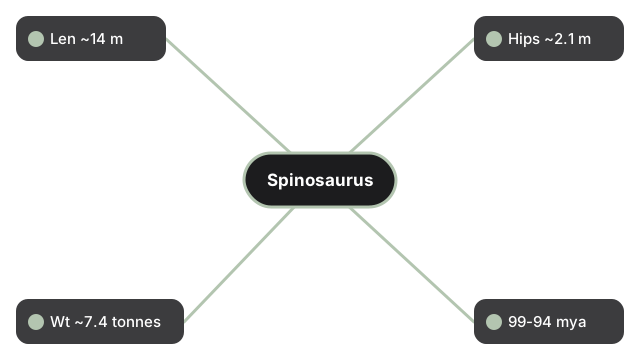
Spinosaurus aegyptiacus stood about 2.1 m tall at the hips and stretched about 14 m from snout to tail - earlier estimates ranged up to about 15 m - turn on the human figure to see how a person compares to this sail-backed predator.
The measurements in the panel follow the Natural History Museum and Sereno et al. 2022.
Spinosaurus 3D Viewer
This page renders Spinosaurus (Spinosaurus aegyptiacus) as a 3D model - full controls on the Dinosaurs 3D hub - click the head, tail, or a leg to read a fact about that part.
Spinosaurus lived in the Late Cretaceous, about 99 to 94 million years ago, in what is now North Africa. Published length and mass estimates vary; the figures shown here follow the Natural History Museum and Sereno et al. 2022: about 14 m long and about 7.4 tonnes (7400 kg), with earlier studies sometimes citing lengths up to about 15 m. Its distinctive sail of elongated neural spines rose over the back - up to about 1.65 m in some reconstructions - and its long narrow snout held crocodile-like conical teeth suited to a carnivorous diet mainly of fish. A sail alone does not mean a spinosaur: Ouranosaurus, which lived somewhat earlier in the Early Cretaceous, carried a similar neural-spine sail but was a beaked, plant-eating iguanodontian, not a fish-eating theropod.
Fossils from Egypt were first found in 1912 and described by Ernst Stromer in 1915. Whether Spinosaurus spent most of its time in water remains debated among researchers; many studies describe a semi-aquatic lifestyle, but a fully aquatic existence is not settled science.
| Measure | Figure |
|---|---|
| Length | about 14 m (earlier estimates up to about 15 m; NHM; Sereno et al. 2022) |
| Hip height | about 2.1 m |
| Weight | about 7.4 tonnes (7400 kg; NHM; Sereno et al. 2022) |
| When it lived | 99-94 million years ago (Late Cretaceous) |
| Diet | Carnivore (mainly fish) |
For two more spinosaurids shipped on this site, see the Baryonyx 3D Viewer, a smaller English relative named for its oversized thumb claw, or the Suchomimus 3D Viewer, a Nigerian relative with a low ridge of neural spines in place of Spinosaurus's tall sail.
The skin tone, sail, and pattern are an artistic reconstruction, because fossils do not preserve color or soft tissue, and this model is not a fossil-accurate skeleton; the numbers above are real published values.
Frequently Asked Questions
How big was Spinosaurus?
About 14 m long and about 7.4 tonnes (7400 kg), with hip height about 2.1 m, following the Natural History Museum and Sereno et al. 2022. Earlier estimates sometimes cited lengths up to about 15 m. Turn on the human figure in the viewer to see the scale against a 1.8 m person.
What was the sail on its back?
A row of elongated neural spines supported a sail-like structure over the back - up to about 1.65 m tall in some reconstructions. Its exact function is debated; hypotheses include display, thermoregulation, or stability in water.
Was Spinosaurus fully aquatic?
Not settled science. Many researchers describe a semi-aquatic lifestyle suited to catching fish, but whether it lived mostly in water remains debated. This viewer does not claim a fully aquatic existence as fact.
Is the model scientifically accurate?
The proportions follow published figures, but the skin color, sail shape, and soft-tissue profile are an artistic reconstruction - fossils preserve bone, not soft tissue or color. This model is not a fossil-accurate skeleton. The length, weight, and age figures shown are real published values.
Do I need to install anything to view it?
No. The model renders in your browser with WebGL - no app, no account, and nothing about your visit is sent to a server. The 3D engine loads once and is then cached.