
Drag to rotate the Wendiceratops, scroll or pinch to zoom, and click a body part - the frill, the nasal horn, or a hind leg - to read what fossils tell us about it. The panel beside the model carries the real figures.
Wendiceratops was a Late Cretaceous centrosaurine from Alberta, Canada, known for an erect nasal horn and a pair of forward-curving frill hooks; turn on the human figure to see how a person compares to its body.
The colors and skin here are an artistic reconstruction; fossils preserve bone, not soft tissue or color. This model is not a fossil-accurate skeleton. The measurements in the panel follow published estimates, with ranges shown where sources disagree.
Wendiceratops 3D Viewer
This page renders a Wendiceratops as a 3D model you can spin in the browser - drag to rotate, scroll or pinch to zoom, toggle a 1.8 m person beside it for scale, and click the frill, the nasal horn, or a hind leg to read a fact about that part.
Fossil hunter Wendy Sloboda found the bonebed in 2010 at the Pinhorn Provincial Grazing Reserve in southern Alberta, Canada. Paleontologists David C. Evans and Michael J. Ryan formally named and described Wendiceratops pinhornensis in 2015, combining Sloboda's name with the Greek "ceratops" (horned face). The bonebed sits in the lower Oldman Formation and dates to about 79 to 78.7 million years ago, in the Late Cretaceous - making it one of the oldest known large-horned centrosaurine ceratopsids, close to the base of the group that includes Triceratops.
Unlike Triceratops, Wendiceratops did not carry large brow horns. Instead it had a tall, erect horn on its nose, about 11.5 cm high with a 9 cm base, and a distinctive pair of frill spikes (the second and third epiparietals) that curve obliquely forward and upward into hooks rather than pointing straight back like most other centrosaurines. More than 200 bones have been recovered from the bonebed, including both adult and juvenile individuals.
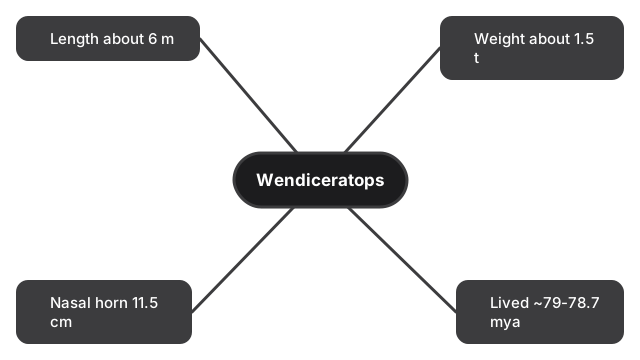
| Measure | Figure |
|---|---|
| Length | about 6 m (20 ft) |
| Weight | about 1.5 t (some sources cite just over 1 t) |
| Nasal horn | about 11.5 cm tall, 9 cm at the base |
| When it lived | about 79-78.7 Mya (Late Cretaceous, Campanian) |
| Diet | Herbivore |
| Described | Named by David C. Evans and Michael J. Ryan, 2015, from a bonebed found in 2010 by Wendy Sloboda, Oldman Formation, Alberta, Canada |
Everything runs on your device with WebGL, so the model works without an account and without sending anything to a server. The skin tone and pattern are an artistic reconstruction, because fossils do not preserve color or soft tissue; this model is not a fossil-accurate skeleton. For sibling ceratopsians on this site, see the Triceratops 3D Viewer or the Chasmosaurus 3D Viewer. A few million years after Wendiceratops, the armored nodosaurid Panoplosaurus grazed the same Late Cretaceous Alberta landscape from the neighboring Dinosaur Park Formation, defended by dense body armor instead of a horned frill.
Frequently Asked Questions
How big was Wendiceratops?
Published estimates put it at about 6 m (20 ft) long and roughly 1.5 tonnes, with some sources citing a bit over 1 tonne. Turn on the human figure in the viewer to compare scale against a 1.8 m person.
Did Wendiceratops have brow horns like Triceratops?
No. Wendiceratops lacked large brow horns. Its most distinctive feature was a tall, erect nasal horn (about 11.5 cm high) plus a pair of frill spikes that curve forward into hooks, rather than pointing straight back as in most centrosaurines.
When and where was it found?
Fossil hunter Wendy Sloboda found the bonebed in 2010 at the Pinhorn Provincial Grazing Reserve in southern Alberta, Canada. David C. Evans and Michael J. Ryan formally named and described Wendiceratops pinhornensis in 2015, from the lower Oldman Formation, dated to about 79 to 78.7 million years ago.
Why is Wendiceratops important to ceratopsian evolution?
It is one of the oldest known large-horned centrosaurine ceratopsids, close to the base of the group that later includes Triceratops. Its hook-shaped frill spikes and prominent nasal horn help researchers trace how ceratopsid horn and frill ornamentation evolved over time.
Is the model scientifically accurate?
The proportions follow published length and mass estimates, but frill shape, horn size, skin color, and soft-tissue outline are an artistic reconstruction - fossils preserve bone, not color or muscle shape. This model is not a fossil-accurate skeleton.
Do I need to install anything to view it?
No. The model renders in your browser with WebGL - no app, no account, and nothing about your visit is sent to a server. When available, a free-licensed glTF model may swap in after first paint.