
Carnotaurus in 3D - click the head, an arm, the tail, or a leg for a fact (full controls on the Dinosaurs 3D hub).
Carnotaurus hunted in what is now Patagonia near the very end of the age of dinosaurs - turn on the human figure to see how a person compares to its deep skull, paired brow horns, and famously short arms.
Colors are an artistic reconstruction (fossils don't preserve them) - fossils preserve bone and, for this species, real skin impressions, but not color. This model is not a fossil-accurate skeleton. The measurements in the panel follow published estimates, with ranges shown where sources disagree.
Carnotaurus 3D Viewer
Drag to spin the Carnotaurus model below, zoom with the wheel, and click a body part to pull up a fact (every control is listed on the Dinosaurs 3D hub).
Carnotaurus lived near the very end of the Cretaceous, roughly 69 to 66 million years ago, in what is now Chubut Province, Argentina. Wikipedia's synthesis of the literature cites a length of about 7.5 to 8 m for the single known skeleton, though other estimates drawn from the same holotype run as high as about 9 m; weight estimates commonly range from about 1.3 to 2.1 tonnes. A pair of thick, conical horns sat above its eyes - a feature no other theropod on this site carries - and its forelimbs were even smaller and more reduced than a Tyrannosaurus rex's, with tiny, barely functional fingers.
Jose Bonaparte named Carnotaurus sastrei in 1985 from a single well-preserved skeleton found in the La Colonia Formation of Chubut Province, Argentina. That specimen is unusual among large theropods because it preserves real skin impressions - a mosaic of small, non-overlapping bumpy scales, with no sign of feathers. The same skeleton is missing its tail and lower legs, so any full-body model, including this one, has to infer those parts from close relatives in the same family.
| Measure | Figure |
|---|---|
| Length | about 7.5-8 m (other estimates from the same skeleton run up to about 9 m) |
| Weight | about 1.3-2.1 tonnes |
| When it lived | 69-66 million years ago (Late Cretaceous, Maastrichtian) |
| Diet | Carnivore |
| Described | 1985, by Jose Bonaparte; La Colonia Formation, Chubut Province, Argentina |
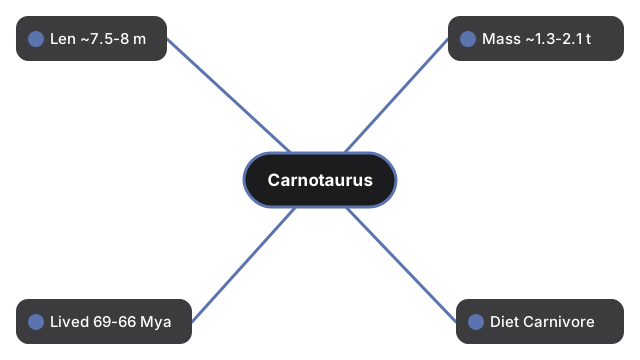
Colors here are an artistic reconstruction - fossils don't preserve them; the tail and lower legs in particular were never recovered from the known skeleton and are inferred from related abelisaurids, so treat those parts as an educated estimate rather than a direct fossil reading. The numbers above are real published values, with ranges shown because sources vary.
Frequently Asked Questions
How big was Carnotaurus?
About 7.5-8 m long based on the single known skeleton, though other estimates drawn from that same skeleton run as high as about 9 m; weight estimates commonly range from about 1.3 to 2.1 tonnes. Turn on the human figure in the viewer to see the scale against a 1.8 m person.
Why does Carnotaurus have horns?
A pair of thick, conical horns sat above its eyes - a feature no other theropod on this site carries. Their exact use is not settled, but they sit on a short, deep, laterally compressed skull unlike the longer skulls of Tyrannosaurus rex or Giganotosaurus.
Were its arms really that small?
Yes. Carnotaurus had even smaller, more reduced forelimbs than Tyrannosaurus rex, with tiny fingers that were likely not very functional. It is one of the most extreme examples of forelimb reduction known among large theropods.
Is the model scientifically accurate?
The proportions follow the single known skeleton, but the skin color is an artistic reconstruction - fossils do not preserve color. The tail and lower legs were never recovered from that skeleton and are inferred from close relatives, so this model is not a fossil-accurate skeleton. The length, weight, and age figures shown are real published values, with ranges cited where sources disagree.
When and where did Carnotaurus live?
Near the very end of the Cretaceous, roughly 69 to 66 million years ago, in what is now Chubut Province, Argentina. Jose Bonaparte named Carnotaurus sastrei in 1985 from a single skeleton found in the La Colonia Formation.
Do I need to install anything to view it?
No. The model renders in your browser with WebGL - no app, no account, and nothing about your visit is sent to a server. The 3D engine loads once and is then cached.