
Ankylosaurus in 3D - click the head, an armor plate, the tail club, or a leg for a fact (full controls on the Dinosaurs 3D hub).
Ankylosaurus was a low, heavily armored plant-eater built like a living tank - turn on the human figure to see how a person compares to its broad, armor-plated body and club-tipped tail.
It shared the Hell Creek Formation with the nodosaurid Denversaurus at the very end of the Cretaceous - same place and time, different defense: a bony club on this tail versus Denversaurus's broad, unclubbed armor plates.
The measurements in the panel follow published estimates, with ranges shown where sources disagree.
Ankylosaurus 3D Viewer
Drag to spin the Ankylosaurus model below, zoom with the wheel, and click a body part to pull up a fact (every control is listed on the Dinosaurs 3D hub).
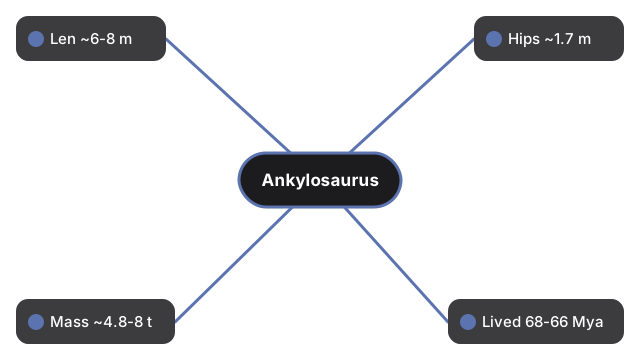
Ankylosaurus lived in the Late Cretaceous, about 68 to 66 million years ago, in what is now western North America. Wikipedia's synthesis of the scientific literature describes it as possibly the largest known ankylosaurid, estimated at about 6 to 8 m long and about 4.8 to 8 tonnes. A 2004 study by paleontologist Kenneth Carpenter, comparing the largest known skull, estimated that specimen at about 6.25 m long and about 1.7 m at the hip; a smaller-skulled specimen was estimated at about 5.4 m and about 1.4 m at the hip - the size varies by specimen because no complete skeleton has ever been found. Bony knobs and plates called osteoderms, ranging from about 1 to 35.5 cm across, covered the back and flanks, with fused half-rings of armor protecting the neck.
The tail ended in a bony club, known from a single specimen measuring about 60 cm long, 49 cm wide, and 19 cm tall, made of two large osteoderms fused together with a row of smaller ones at the midline. Paleontologist Barnum Brown led the expedition that discovered the first Ankylosaurus fossils in 1906 in Montana's Hell Creek Formation, and formally described the genus in 1908.
| Measure | Figure |
|---|---|
| Length | about 6-8 m overall (Wikipedia synthesis); largest-skulled specimen studied about 6.25 m (Carpenter, 2004) |
| Hip height | about 1.7 m for the largest-skulled specimen, about 1.4 m for a smaller-skulled specimen (Carpenter, 2004) |
| Weight | about 4.8-8 tonnes |
| When it lived | 68-66 million years ago (Late Cretaceous) |
| Diet | Herbivore |
The skin tone, armor color, and pattern are an artistic reconstruction, because fossils do not preserve color or soft tissue, and this model is not a fossil-accurate skeleton; the numbers above are real published values, and ranges are shown because sources vary and no complete skeleton has ever been recovered.
Frequently Asked Questions
How big was Ankylosaurus?
Published estimates vary because no complete skeleton has ever been found. Wikipedia's synthesis of the scientific literature puts it at about 6 to 8 m long and about 4.8 to 8 tonnes. A 2004 study by Kenneth Carpenter estimated the largest known skull's owner at about 6.25 m long and about 1.7 m at the hip. Turn on the human figure in the viewer to see the scale against a 1.8 m person.
What was the tail club for?
The bony club, known from a single specimen about 60 cm long and 49 cm wide, sat at the end of a stiffened tail and was likely swung as a defensive weapon against predators or in fights between Ankylosaurus themselves. Fossils cannot fully settle how it was used, so this model does not claim one single proven function.
When and where did Ankylosaurus live?
In the Late Cretaceous, about 68 to 66 million years ago, in what is now western North America. Barnum Brown discovered the first fossils in 1906 in Montana's Hell Creek Formation and formally described the genus in 1908.
Is the model scientifically accurate?
The proportions follow published figures, but the skin color and soft-tissue outline are an artistic reconstruction - fossils preserve bone, not soft tissue or color. This model is not a fossil-accurate skeleton, and no complete skeleton has ever been found, so the armor layout shown is a plausible reconstruction. The length, weight, and age figures shown are real published values, with ranges cited where sources disagree.
Do I need to install anything to view it?
No. The model renders in your browser with WebGL - no app, no account, and nothing about your visit is sent to a server. The 3D engine loads once and is then cached. When available, a free-licensed glTF model may swap in after first paint.