
Drag to rotate the Ostafrikasaurus, scroll or pinch to zoom, and click a body part - the head, a limb, or the tail - to read what fossils tell us about it. The panel beside the model carries the real figures.
Ostafrikasaurus is a Late Jurassic Tendaguru spinosaurid named from teeth alone - turn on the human figure to compare a person with this speculative full-body reconstruction, not with a measured skeleton.
The colors and skin here are an artistic reconstruction; fossils preserve bone, not soft tissue or color. This model is not a fossil-accurate skeleton. The only securely published measurement for this taxon is the holotype tooth size; body length and mass are not known from fossils.
Ostafrikasaurus 3D Viewer
This page renders Ostafrikasaurus as a 3D model you can spin in the browser - drag to rotate, scroll or pinch to zoom, toggle a 1.8 m person beside it for scale, and click the head, a limb, or the tail to read a fact about that part.
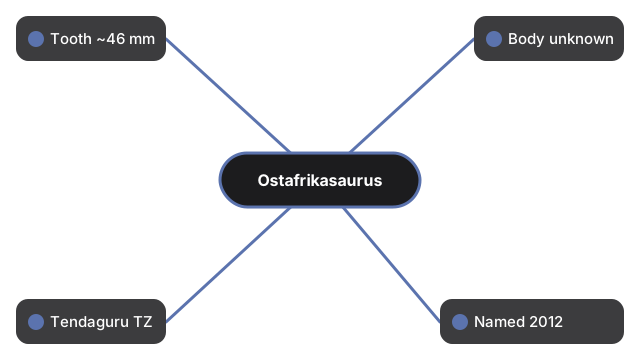
Ostafrikasaurus crassiserratus is a spinosaurid theropod from the Tendaguru Formation of Tanzania. Eric Buffetaut named it in 2012 from isolated teeth collected during early twentieth-century German expeditions. The holotype tooth is about 46 mm long and has unusually coarse serrations for a spinosaurid. No skull, limb, or vertebral bones are referred to the genus, so any full-body length or mass figure is a speculative reconstruction, not a published skeletal measurement.
| Measure | Figure |
|---|---|
| Holotype tooth | about 46 mm long (Buffetaut 2012) |
| Body length | not known from fossils (tooth-only taxon; full-body size is speculative) |
| Body mass | not known from fossils |
| When it lived | Late Jurassic Tendaguru beds, Tanzania (age of the tooth-bearing levels is debated around the Jurassic-Cretaceous boundary) |
| Diet | Carnivore (inferred from serrated spinosaurid-type teeth) |
Everything runs on your device with WebGL - no account, nothing sent to a server. Soft-tissue color is an artistic reconstruction; this model is not a fossil-accurate skeleton. Compare with the better-known spinosaurids Spinosaurus 3D Viewer and Baryonyx 3D Viewer, which rest on far more complete skeletons.
Frequently Asked Questions
How big was Ostafrikasaurus?
Body length and mass are not known. The taxon rests on isolated teeth; the holotype crown is about 46 mm long (Buffetaut 2012). Any full-body size shown here is a speculative reconstruction for scale, not a published skeletal measurement. Turn on the human figure to compare a person with that reconstruction, not with a measured skeleton.
What kind of dinosaur was Ostafrikasaurus?
It is treated as a spinosaurid theropod - a long-snouted carnivore group that includes Spinosaurus and Baryonyx - based on tooth shape. The teeth have unusually coarse serrations compared with many later spinosaurids. No postcranial bones are referred to the genus.
When and where did Ostafrikasaurus live?
The teeth come from the Tendaguru Formation in what is now Lindi Region, Tanzania. They were collected during German East Africa expeditions between about 1909 and 1912. Eric Buffetaut named Ostafrikasaurus crassiserratus in 2012. The precise age of the tooth-bearing levels around the Late Jurassic to earliest Cretaceous boundary is still debated.
Is the model scientifically accurate?
No full skeleton exists for this taxon. The on-screen body is a speculative spinosaurid reconstruction used so you can explore the animal in 3D. Skin color and soft tissue are artistic. The securely published figure on this page is the holotype tooth length of about 46 mm; body length and mass are not presented as measured facts.
Do I need to install anything to view it?
No. The model renders in your browser with WebGL - no app, no account, and nothing about your visit is sent to a server. The 3D engine loads once and is then cached. When available, a free-licensed glTF model may swap in after first paint.