
Diplodocus in 3D - click the head, neck, body, leg, or tail for a fact (full controls on the Dinosaurs 3D hub).
Diplodocus stretched about 24 to 26 m from snout to whip-tip in the D. carnegii reference specimen - one of the longest dinosaurs known - even though its neck sat lower and more level than the steep, giraffe-like rise of Brachiosaurus. Turn on the human figure to see how a person compares to its low-slung, long-tailed frame.
The measurements in the panel follow the published D. carnegii reference specimen.
Diplodocus 3D Viewer
The Diplodocus model below rotates as you drag - zoom in and click any body part for a quick fact, or see the Dinosaurs 3D hub for the full control list.
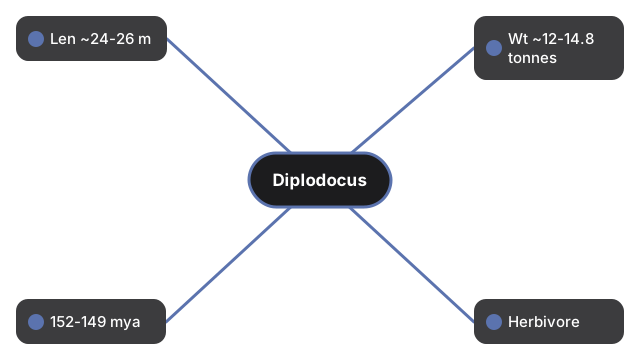
Diplodocus lived in the Late Jurassic, about 152 to 149 million years ago, in what is now the western United States. For the well-studied reference specimen D. carnegii, published figures put the animal at about 24 to 26 m long and about 12 to 14.8 tonnes. A long, more level neck and a whip-like tail built from roughly 80 caudal vertebrae make it the longest (not the tallest) sauropod in this viewer series - it fed lower and more broadly than the steeply upright Brachiosaurus.
The genus was named by Othniel Charles Marsh in 1878, from fossils first collected in 1877. The most complete specimen, CM 84, was found in 1899 near Sheep Creek, Wyoming, and John Bell Hatcher described it as the species Diplodocus carnegii in 1901. Its small, forward-pointing peg teeth were suited to stripping leaves off branches rather than chewing tough plant matter.
| Measure | Figure |
|---|---|
| Length (D. carnegii) | about 24-26 m |
| Weight (D. carnegii) | about 12-14.8 tonnes |
| When it lived | 152-149 million years ago (Late Jurassic) |
| Diet | Herbivore |
| Tail vertebrae | about 80, whip-like |
Colors here are an artistic reconstruction - fossils don't preserve them; the numbers above are real published values.
See also Apatosaurus and Brontosaurus, fellow long-necked diplodocid sauropods.
Frequently Asked Questions
How big was Diplodocus?
For the well-studied reference specimen D. carnegii, published figures put it at about 24 to 26 m long and about 12 to 14.8 tonnes. Turn on the human figure in the viewer to see the scale against a 1.8 m person.
Was Diplodocus taller than Brachiosaurus?
No. Diplodocus was the longer animal but carried its neck lower and more level, while Brachiosaurus had longer front legs that lifted its chest and neck into a steep, giraffe-like posture. Diplodocus is the longest (not tallest) sauropod shown in this viewer series.
What was the whip-like tail for?
The tail had roughly 80 caudal vertebrae and tapered to a thin tip. Researchers have proposed it could have been snapped like a bullwhip for defense or signaling, though the exact use is still studied.
When and where did Diplodocus live?
In the Late Jurassic, about 152 to 149 million years ago, mainly in what is now the western United States. Othniel Charles Marsh named the genus in 1878; the well-known specimen CM 84 was found near Sheep Creek, Wyoming, in 1899 and described as Diplodocus carnegii by John Bell Hatcher in 1901.
Is the model scientifically accurate?
The proportions follow published figures, but the skin color and soft-tissue outline are an artistic reconstruction - fossils preserve bone, not soft tissue or color. This model is not a fossil-accurate skeleton. The length, weight, and age figures shown are real published values for the D. carnegii reference specimen.
Do I need to install anything to view it?
No. The model renders in your browser with WebGL - no app, no account, and nothing about your visit is sent to a server. The 3D engine loads once and is then cached.