
Drag to rotate the Kentrosaurus, scroll or pinch to zoom, and click a body part - the head, a plate, a tail spike, or a leg - to read what fossils tell us about it. The panel beside the model carries the real figures.
Kentrosaurus stretched about 4-4.5 m from snout to tail and carried at least seven pairs of tail spikes - turn on the human figure to see how a person compares to this smaller, spikier cousin of Stegosaurus.
The colors and skin here are an artistic reconstruction; fossils preserve bone, not soft tissue or color. This model is not a fossil-accurate skeleton. The measurements in the panel follow published figures from the Tendaguru fossil beds, with ranges shown where sources disagree.
Kentrosaurus 3D Viewer
This page renders a Kentrosaurus as a 3D model you can spin in the browser - drag to rotate, scroll or pinch to zoom, toggle a person beside it for scale, and click the head, a plate, a tail spike, or a leg to read a fact about that part.
Kentrosaurus lived in the Late Jurassic, about 152 to 151 million years ago, in what is now Tanzania. Thousands of its bones were excavated between 1909 and 1912 by German expeditions at the Tendaguru fossil beds; most of the surviving material, roughly 350 specimens, is held at the Museum fur Naturkunde in Berlin (many original specimens were destroyed in the Second World War). The genus was named by Edwin Hennig in 1915; the name means "spiky lizard."
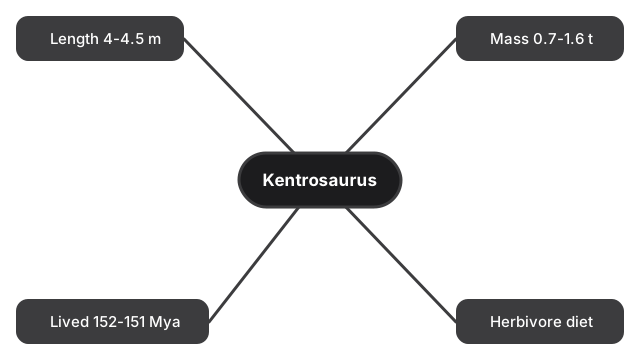
Kentrosaurus was smaller than its better-known relative Stegosaurus but more heavily armed for its size: plates run along the neck and front half of the back, then give way to at least seven pairs of long, paired spikes over the hips and tail. Published length estimates for typical adults run about 4 to 4.5 m, with the largest individual specimens reported up to about 5.5 m; mass estimates span a wide range, roughly 700 to 1,600 kg, reflecting how differently researchers have modeled its build.
| Measure | Figure |
|---|---|
| Length | about 4-4.5 m for typical adults; largest known specimens reported up to about 5.5 m |
| Weight | about 700-1,600 kg (estimates vary widely by study) |
| When it lived | 152-151 million years ago (Late Jurassic) |
| Diet | Herbivore |
| Named | Hennig, 1915; excavated 1909-1912 at Tendaguru, Tanzania |
Everything runs on your device with WebGL, so the model works without an account and without sending anything to a server. The skin tone, plate color, and pattern are an artistic reconstruction, because fossils do not preserve color or soft tissue, and this model is not a fossil-accurate skeleton; the numbers above are real published values, and ranges are shown because sources vary. Kentrosaurus is a distinct genus from the already-viewable Stegosaurus 3D Viewer - a different animal from a different continent, with more tail spikes per body length.
Frequently Asked Questions
How big was Kentrosaurus?
Typical adults are commonly cited around 4-4.5 m long, with the largest known specimens reported up to about 5.5 m. Mass estimates vary widely between studies, roughly 700-1,600 kg. Turn on the human figure in the viewer to see the scale against a person.
How is Kentrosaurus different from Stegosaurus?
Kentrosaurus was smaller and came from a different continent - its fossils were excavated in Tanzania, while Stegosaurus fossils come from North America. Kentrosaurus also carried more spikes relative to its body length: plates run along the neck and front back, then give way to at least seven pairs of long paired spikes over the hips and tail.
When and where did Kentrosaurus live?
In the Late Jurassic, about 152 to 151 million years ago, in what is now Tanzania. Thousands of bones were excavated between 1909 and 1912 by German expeditions at the Tendaguru fossil beds. The genus was named by Edwin Hennig in 1915.
Is the model scientifically accurate?
The proportions follow published figures, but the skin color and soft-tissue outline are an artistic reconstruction - fossils preserve bone, not soft tissue or color. This model is not a fossil-accurate skeleton. The length, weight, and age figures shown are real published values, with ranges cited where sources disagree.
Do I need to install anything to view it?
No. The model renders in your browser with WebGL - no app, no account, and nothing about your visit is sent to a server. The 3D engine loads once and is then cached. When available, a free-licensed glTF model may swap in after first paint.