
Iguanodon in 3D - click the head, an arm's thumb spike, the tail, or a leg for a fact (full controls on the Dinosaurs 3D hub).
Iguanodon was a large plant-eating dinosaur that could walk on two legs or drop to all fours, with a horse-like beaked snout and a large conical spike on each hand - turn on the human figure to see how a person compares to its body.
The measurements in the panel follow published estimates, with ranges shown where sources disagree.
Iguanodon 3D Viewer
Below is a rotating Iguanodon - drag to turn it, zoom in close, and click on a body part to read a fact (controls are detailed on the Dinosaurs 3D hub).
Iguanodon lived in the Early Cretaceous, about 126 to 113 million years ago, in what is now Europe. Published length estimates for the reference species Iguanodon bernissartensis run from about 9 m up to 13 m depending on source and individual, with a commonly cited typical figure around 10 m; weight estimates range from about 3 to 5 tonnes. It could walk bipedally or drop to all fours, had a horse-like beaked skull with tooth batteries for grinding tough vegetation, and carried a large conical spike on each hand.
English geologist Gideon Mantell named the genus in 1825 from teeth found in 1822 in a quarry at Cuckfield, Sussex - one of the first three dinosaur genera ever formally named, alongside Megalosaurus (1824) and Hylaeosaurus (1833), years before the word "dinosaur" existed. Mantell's early reconstruction placed the hand spike on the animal's nose as a horn; that error was only corrected after the 1878 discovery of about 38 near-complete skeletons together in a coal mine at Bernissart, Belgium, which showed the spike's real position on the hand. Its exact use - defense, foraging, or fighting between rivals - is still debated.
| Measure | Figure |
|---|---|
| Length | about 9-13 m (reference species I. bernissartensis typically cited around 10 m) |
| Hip height | about 2-3 m when on all fours; standing bipedal figures run higher |
| Weight | about 3-5 tonnes |
| When it lived | 126-113 million years ago (Early Cretaceous, Barremian-Aptian) |
| Diet | Herbivore (tough Early Cretaceous vegetation, ground with dental batteries) |
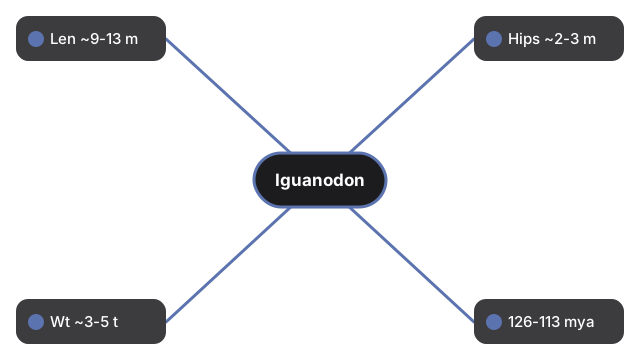
Colors here are an artistic reconstruction - fossils don't preserve them; the numbers above are real published values, and ranges are shown because sources vary by specimen and species.
Frequently Asked Questions
How big was Iguanodon?
Published estimates for the reference species Iguanodon bernissartensis vary by source and individual - typically cited around 10 m long, with a range from about 9 up to 13 m for large individuals, and weight from about 3 to 5 tonnes. Turn on the human figure in the viewer to see the scale against a 1.8 m person.
What was the thumb spike for?
Each hand carried a large conical spike where the thumb would be. Its exact use is debated - proposed explanations include defense against predators, foraging (breaking open plant material), or fighting between rivals. No single explanation is proven, and this model does not claim one.
Did Iguanodon really have a horn on its nose?
No - that was an early mistake. Gideon Mantell, who named the genus in 1825 from isolated teeth and bones, first reconstructed the thumb spike as a horn on the animal's nose. The error was corrected only after the 1878 discovery of about 38 near-complete skeletons together in a coal mine at Bernissart, Belgium, which showed the spike's real position on the hand.
When and where did Iguanodon live?
In the Early Cretaceous, about 126 to 113 million years ago, in what is now Europe. It was one of the first three dinosaur genera ever formally named - alongside Megalosaurus (1824) and Hylaeosaurus (1833) - years before the word "dinosaur" was coined in 1842.
Is the model scientifically accurate?
The proportions follow published figures, but the skin color and soft-tissue outline are an artistic reconstruction - fossils preserve bone, not soft tissue or color. This model is not a fossil-accurate skeleton. The length, weight, and age figures shown are real published values, with ranges cited because sources vary by specimen and species.
Do I need to install anything to view it?
No. The model renders in your browser with WebGL - no app, no account, and nothing about your visit is sent to a server. The 3D engine loads once and is then cached. When available, a free-licensed glTF model may swap in after first paint.