
Drag to rotate the Barosaurus, scroll or pinch to zoom, and click a body part - the head, neck, body, leg, or tail - to read what fossils tell us about it. The panel beside the model carries the real figures.
Barosaurus stretched about 24 to 27 m from snout to tail-tip - a close relative of Diplodocus, but with a longer neck and a shorter tail. Turn on the human figure to see how a person compares to its long, low-slung frame.
The colors and soft outline here are an artistic reconstruction; fossils preserve bone, not soft tissue or color. This model is not a fossil-accurate skeleton. The measurements in the panel follow the commonly cited published range for the genus.
Barosaurus 3D Viewer
This page renders a Barosaurus as a 3D model you can spin in the browser - drag to rotate, scroll or pinch to zoom, toggle a 1.8 m person beside it for scale, and click the head, neck, body, a leg, or the tail to read a fact about that part.
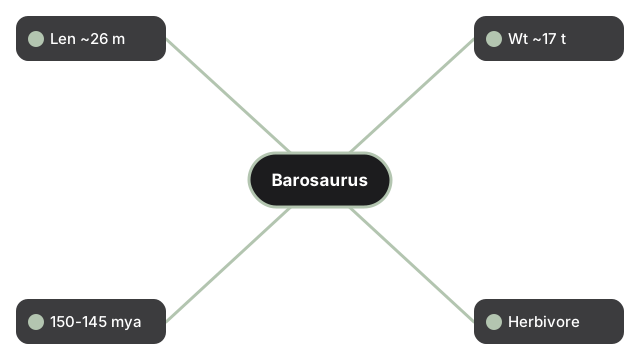
Barosaurus lived in the Late Jurassic, around 150 to 145 million years ago, in what is now the western United States. Published figures put an adult at about 24 to 27 m long and about 12 to 20 tonnes; this viewer uses 26 m and 17 t as representative values within that range. It was a close relative of Diplodocus, but with a longer neck - 16 neck vertebrae to Diplodocus's 15, with some individual neck bones up to 50 percent longer - and a proportionally shorter tail.
The genus was named by Othniel Charles Marsh in 1890. The first fossils were found in 1889 near Mission (then Postville), South Dakota, by local postmistress Isabella R. Ellerman, and excavated the following year by John Bell Hatcher, a field collector working for Marsh at Yale during the "Bone Wars" era. The holotype, YPM 429, consists of six tail vertebrae. Small, forward-pointing peg teeth were suited to stripping leaves off branches rather than chewing tough plant matter.
Much larger figures - up to about 45 m and 60 tonnes - sometimes circulate for "Barosaurus," but the fossil material behind those numbers is now generally attributed to a different sauropod, Supersaurus, not Barosaurus. Barosaurus is also the subject of a well-known mounted pose at the American Museum of Natural History, showing it reared up on its hind legs to defend a juvenile from a predator; some sources suggest this could put its head roughly 15 m high, though that remains a debated behavioral inference rather than a directly measured fact.
| Measure | Figure |
|---|---|
| Length | about 24-27 m |
| Weight | about 12-20 tonnes |
| When it lived | 150-145 million years ago (Late Jurassic) |
| Diet | Herbivore |
| Neck vertebrae | 16 (vs 15 in Diplodocus) |
Everything runs on your device with WebGL, so the model works without an account and without sending anything to a server. The skin tone and pattern are an artistic reconstruction, because fossils do not preserve color or soft tissue, and this model is not a fossil-accurate skeleton; the numbers above are real published values.
Frequently Asked Questions
How big was Barosaurus?
Published figures put an adult Barosaurus at about 24 to 27 m long and about 12 to 20 tonnes. Turn on the human figure in the viewer to see the scale against a 1.8 m person.
How is Barosaurus different from Diplodocus?
The two are close relatives, but Barosaurus had a longer neck - 16 neck vertebrae to Diplodocus's 15, with some individual neck bones up to 50 percent longer - and a proportionally shorter tail.
Could Barosaurus really rear up on its hind legs?
A well-known mounted display at the American Museum of Natural History shows Barosaurus reared up to defend a juvenile from a predator, and some sources suggest this could put its head roughly 15 m high. This is a debated behavioral inference, not a directly measured fact.
When and where did Barosaurus live?
In the Late Jurassic, around 150 to 145 million years ago, mainly in what is now the western United States. Othniel Charles Marsh named the genus in 1890 from fossils found in 1889 near Mission, South Dakota, and excavated by John Bell Hatcher.
Is the model scientifically accurate?
The proportions follow published figures, but the skin color and soft-tissue outline are an artistic reconstruction - fossils preserve bone, not soft tissue or color. This model is not a fossil-accurate skeleton. The length, weight, and age figures shown are real published values.
Do I need to install anything to view it?
No. The model renders in your browser with WebGL - no app, no account, and nothing about your visit is sent to a server. The 3D engine loads once and is then cached.