
Drag to rotate the Suchomimus, scroll or pinch to zoom, and click a body part - the long snout, the low back ridge, or a hind leg - to read what fossils tell us about it. The panel beside the model carries the real figures.
Suchomimus was an Early Cretaceous fish-eater from Niger, best known for its long crocodile-like snout and a low ridge of short spines running along its back - turn on the human figure to see how a person compares to its lean, low-slung body.
The colors and skin here are an artistic reconstruction; fossils preserve bone, not soft tissue or color. This model is not a fossil-accurate skeleton. The measurements in the panel follow published estimates, with ranges shown where sources disagree.
Suchomimus 3D Viewer
This page renders Suchomimus (Suchomimus tenerensis) as a 3D model you can spin in the browser - drag to rotate, scroll or pinch to zoom, toggle a 1.8 m person beside it for scale, and click the snout, back ridge, or a hind leg to read a fact about that part.
Suchomimus is a spinosaurid, the same family as the already-shown Baryonyx and Spinosaurus, but it is distinct from both. Its back carries a low ridge of short neural spines, not the tall sail seen on Spinosaurus, and it grew larger than the British Baryonyx - roughly 9.5 to 11 m long, against Baryonyx's roughly 7.5 m. It also comes from a different place and time: the Elrhaz Formation of the Tegama Group in the Republic of Niger, around 121 to 112 million years ago, versus Baryonyx's Wealden Formation in England and Spinosaurus's Bahariya Formation in Egypt.
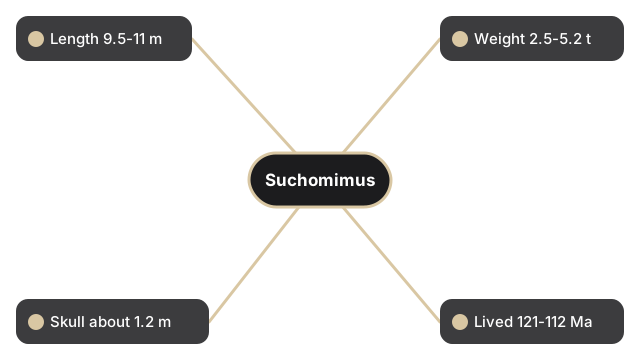
Paul Sereno led the expedition that found the fossils in 1997; he and twelve co-authors formally named the animal Suchomimus tenerensis in 1998, a name meaning "crocodile mimic." Its skull was about 1.2 m long, low and narrow like a crocodile's, lined with numerous small conical, unserrated teeth suited to gripping slippery prey rather than slicing meat - fish scales and fish-eating anatomy point to a mostly piscivorous diet. Length and mass estimates vary widely: the holotype may represent a subadult, so some studies put adult size as high as 11 to 12 m, while mass estimates run from about 2.5 to 5.2 tonnes depending on the method used.
| Measure | Figure |
|---|---|
| Length | about 9.5 to 11 m (some studies up to 11-12 m) |
| Weight | about 2.5 to 5.2 tonnes depending on the estimate |
| Skull length | about 1.2 m, low and crocodile-like |
| When it lived | 121-112 million years ago (Early Cretaceous) |
| Diet | Piscivore (mainly fish) |
| Described | Named by Paul Sereno and colleagues, 1998, from fossils found in 1997, Elrhaz Formation, Tegama Group, Republic of Niger |
Everything runs on your device with WebGL, so the model works without an account and without sending anything to a server. The skin tone and pattern are an artistic reconstruction, because fossils do not preserve color or soft tissue, and this model is not a fossil-accurate skeleton; the numbers above are real published values.
Frequently Asked Questions
How big was Suchomimus?
Published estimates put it at about 9.5 to 11 m long and roughly 2.5 to 5.2 tonnes. The holotype may represent a subadult, so some studies argue for an adult size as large as 11 to 12 m. Turn on the human figure in the viewer to see the scale against a 1.8 m person.
What was the low ridge on its back for?
A row of short neural spines forms a low ridge along the back - shorter than the tall sail seen on the related Spinosaurus. Researchers are not certain of its function; possibilities include display or temperature regulation, similar to the ideas proposed for taller-sailed relatives.
How is Suchomimus different from Baryonyx and Spinosaurus?
All three are spinosaurids with long, croc-like, fish-eating snouts, but they differ. Suchomimus carries a low ridge of short spines, while Spinosaurus carries a tall sail of much taller spines. Suchomimus is also larger than Baryonyx (roughly 9.5-11 m against about 7.5 m). Each comes from a different place and time: Suchomimus from the Elrhaz Formation in Niger (121-112 million years ago), Baryonyx from the Wealden Formation in England, and Spinosaurus from the Bahariya Formation in Egypt.
What did Suchomimus eat?
Its long, low, crocodile-like skull and numerous small, conical, unserrated teeth are suited to gripping slippery prey rather than slicing meat, pointing to a mostly piscivorous (fish-eating) diet - the same feeding strategy inferred for its close relatives Baryonyx and Spinosaurus.
Is the model scientifically accurate?
The proportions follow published figures, but the skin color and soft-tissue outline are an artistic reconstruction - fossils preserve bone, not soft tissue or color. This model is not a fossil-accurate skeleton. The length, weight, skull length, and age figures shown are real published values.
Do I need to install anything to view it?
No. The model renders in your browser with WebGL - no app, no account, and nothing about your visit is sent to a server. The 3D engine loads once and is then cached. When available, a free-licensed glTF model may swap in after first paint.