
Pachyrhinosaurus in 3D - click the frill, the nasal boss, or a leg for a fact (full controls on the Dinosaurs 3D hub).
Pachyrhinosaurus carried a solid bony frill at the back of its skull like its relative Triceratops, but instead of long brow horns it had a thick, flattened bony boss over the nose and a smaller one above the eyes - turn on the human figure to see how the whole animal compares to a person.
Skin tone is invented for the model since fossils only preserve bone. Frill and boss sizes do match the real skeleton, with the panel's numbers coming from published sources.
Pachyrhinosaurus 3D Viewer
Rotate the Pachyrhinosaurus with a drag, zoom in with scroll or pinch, and click the frill, the nasal boss, or a leg to read a fact (full control reference on the Dinosaurs 3D hub).
Pachyrhinosaurus lived in the Late Cretaceous, roughly 73.5 to 71 million years ago, in what is now western North America. Unlike its relative Triceratops, it had no long brow horns - instead, thick, flattened bony bosses covered the nose and the area above the eyes, with small spikes along the frill margin in some individuals. Estimates vary by species and source; the commonly cited range for the type species, P. canadensis, puts adults at about 6 to 8 m long and roughly 3 to 4 metric tons.
Canadian paleontologist Charles M. Sternberg named the genus in 1950 from an incomplete skull (holotype NMC 8867) unearthed in 1945-1946 at the Horseshoe Canyon Formation in Alberta. A related species, P. lakustai, comes from a dense bonebed at Pipestone Creek, Alberta - first found by Al Lakusta in 1974 - where a 2024 excavation turned up one of the largest known Pachyrhinosaurus skulls, nicknamed "Big Sam", about 138 cm long with a 43 cm nasal boss.
| Measure | Figure |
|---|---|
| Length | about 6-8 m (commonly cited range for P. canadensis) |
| Weight | about 3-4 metric tons (range across sources; some cite lower estimates around 1.8 t) |
| When it lived | 73.5-71 million years ago (Late Cretaceous, Campanian-Maastrichtian) |
| Diet | Herbivore |
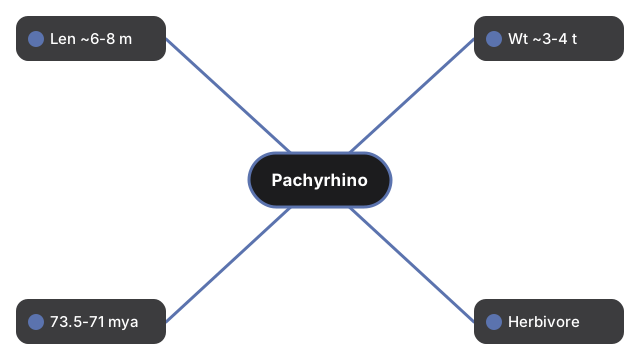
Colors here are an artistic reconstruction - fossils don't preserve them; the numbers above are real published values, with a range given where sources disagree.
See also Triceratops and Styracosaurus, fellow horned centrosaurine/chasmosaurine ceratopsians.
Frequently Asked Questions
How big was a real Pachyrhinosaurus?
The commonly cited range for the type species, P. canadensis, is about 6-8 m long and roughly 3-4 metric tons, though some sources give lower weight estimates around 1.8 t. Turn on the human figure in the viewer to see the scale against a person.
Why does it not have horns like Triceratops?
Pachyrhinosaurus is a close relative of Triceratops, but instead of long brow horns it evolved thick, flattened bony bosses over the nose and above the eyes, with small spikes along the frill margin in some individuals. Paleontologists think the boss served a similar display or combat role to other ceratopsian horns.
Is the model scientifically accurate?
The frill, boss, and body proportions follow the fossil skeleton, but the skin color and texture are an artistic reconstruction - fossils preserve bone, not soft tissue or color. The length, weight, and age figures shown are real published values.
When and where did Pachyrhinosaurus live?
In the Late Cretaceous, roughly 73.5 to 71 million years ago, in what is now western North America. The genus was named in 1950 by Charles M. Sternberg from a skull collected in 1945-1946 in Alberta's Horseshoe Canyon Formation.
What was "Big Sam"?
Big Sam is the nickname for one of the largest known Pachyrhinosaurus skulls, belonging to the related species P. lakustai, uncovered during a 2024 excavation at the Pipestone Creek bonebed in Alberta. The skull measures about 138 cm long with a 43 cm nasal boss.
Do I need to install anything to view it?
No. The model renders in your browser with WebGL - no app, no account, and nothing about your visit is sent to a server. The 3D engine loads once and is then cached.