
Drag to rotate the Dracovenator, scroll or pinch to zoom, and click a body part - the head, an arm, a leg, or the long tail - to read what fossils tell us about it. The panel beside the model carries the real figures.
Dracovenator was a basal neotheropod from Early Jurassic South Africa - turn on the human figure to see how a roughly 6 m animal compares with a person. The upper Elliot Formation yields the type material.
The colors and skin pattern here are an artistic reconstruction; fossils preserve bone, not soft tissue or color. The measurements in the panel are published figures with ranges where sources disagree.
Dracovenator 3D Viewer
This page renders a Dracovenator as a 3D model you can spin in the browser - drag to rotate, scroll or pinch to zoom, toggle a 1.8 m person beside it for scale, and click the head, a leg, or the tail to read a fact about that part.
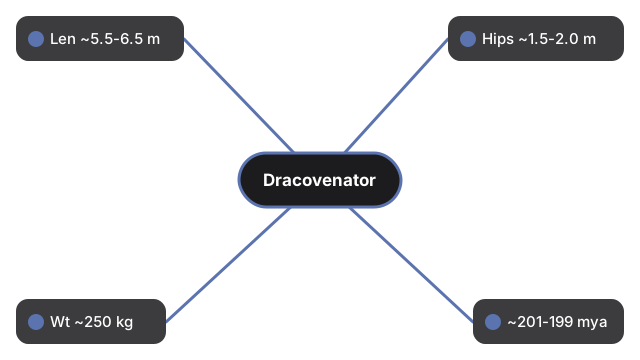
Dracovenator lived about 201-199 million years ago in the Early Jurassic of South Africa (upper Elliot Formation, Eastern Cape). Yates named the genus in 2005 from skull material collected by Kitching and Huma. Length estimates are about 5.5-6.5 m and mass about 250 kg; this page uses 6.0 m and 250 kg as panel baselines.
| Measure | Figure |
|---|---|
| Length | about 5.5-6.5 m (panel baseline 6.0 m) |
| Hip height | about 1.5-2.0 m (panel 1.8 m) |
| Weight | about 250 kg (commonly cited) |
| When it lived | about 201-199 million years ago (Early Jurassic) |
| Diet | Carnivore |
Everything runs on your device with WebGL - no account, nothing sent to a server. Soft-tissue color is an artistic reconstruction; this model is not a fossil-accurate skeleton. Compare with the later Asian tyrannosaurid Tarbosaurus 3D Viewer and the North American Coelophysis 3D Viewer.
Frequently Asked Questions
What kind of dinosaur was Dracovenator?
A basal neotheropod - an early meat-eating dinosaur from the Early Jurassic of South Africa, known mainly from skull material.
How long was it?
Published reconstructions commonly place adults near 5.5-6.5 m. This page uses 6.0 m as the panel baseline.
How heavy was it?
Mass is commonly cited near 250 kg. The panel shows that figure and the note states it as a commonly cited value.
When and where did it live?
Early Jurassic South Africa, about 201-199 million years ago (upper Elliot Formation, Eastern Cape). Yates named it in 2005.
Is the color accurate?
No. Soft tissue and color are not preserved. Skin and color here are artistic reconstruction.