
Drag to rotate Abelisaurus, scroll or pinch to zoom, and click the skull, a forelimb, or a hind leg to read a short fossil fact. The panel beside the model carries the published figures.
Abelisaurus was a Late Cretaceous abelisaurid theropod from Argentina, known mainly from a partial skull; turn on the human figure to see how a person compares to the reconstructed body used here.
Fossils preserve bone, not soft tissue or color. The full-body shape on this page follows related abelisaurids such as Carnotaurus and Majungasaurus. This is an artistic reconstruction, not a fossil-accurate skeleton. Panel figures use mid-range values within published length and mass ranges.
Abelisaurus 3D Viewer
This page renders Abelisaurus as a 3D model you can spin in the browser: drag to rotate, scroll or pinch to zoom, toggle a 1.8 m person beside it for scale, and click the skull, a short forelimb, or a hind leg to read a fact about that part. Nothing installs and nothing uploads.
What the controls do
Six body regions answer to a tap, and four buttons under the model change how the scene moves. The side panel needs no click to start: it carries the published length, mass, era, and diet as soon as the scene loads.
- Tap the skull, neck, torso, tail, short arm, or a hind leg and the panel swaps to a note for that part. A rotation drag never trips one by accident; clicking empty canvas restores the full fact sheet
- Four buttons pause or resume the slow turn, add idle motion, open fullscreen, and toggle the scale figure, each relabelling itself as you press it
- Idle motion alternates the hind legs like a slow walk in place, bobs the body with each step, and widens the chest with a faint breathing motion even at a standstill
- The 1.8 m scale figure is sized from the length the panel reports rather than dropped in at a fixed height, so it stands against the body at an honest ratio from any angle
- The view opens three-quarters around the body at a distance picked for its build, and the zoom and tilt limits keep it from flipping past upright
What is known about Abelisaurus
Abelisaurus is known from a partial skull from the Anacleto Formation of Argentina. Named by Bonaparte and Novas in 1985, it was the first abelisaurid to receive a formal name. Published length and mass estimates span a wide range, so the viewer poses the animal at mid-range values.
| Measure | Figure |
|---|---|
| Length | about 7.2-11 m (panel ~7.4 m) |
| Weight | about 1.4-3 t (panel ~2 t) |
| When it lived | about 83-80 Mya (Late Cretaceous) |
| Diet | Carnivore |
| Fossil record | Partial skull only; body inferred from related abelisaurids |
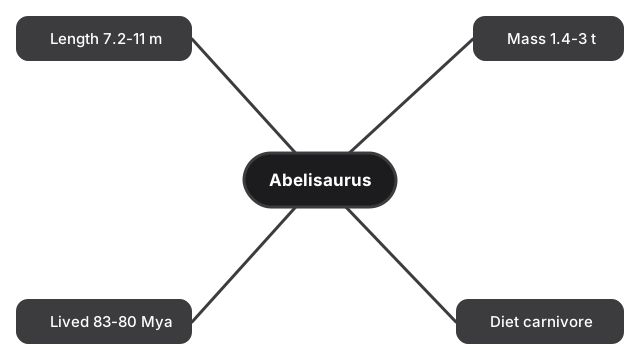
How the model is posed, lit, and rendered
A curved spine carries a shaped skull with a hinged, slightly open jaw and serrated teeth; the hind legs stand digitigrade on their toes and the short forelimbs sit tucked, the way abelisaurids are known to have carried them. The silhouette follows how a running theropod is now reconstructed - back roughly level, long tail held clear of the ground to counterbalance the body over the hips, neck curving up to carry the head forward - not the older hunched, tail-dragging pose. Forward-facing eyes, a claw on each toe, and two on the short arm complete the build, and a warm key light high to one side with a cooler fill from behind gives the body modeled shading rather than a flat cutout, above an earth-toned ground surface.
Rendering runs on your device with WebGL and needs no account. On a phone or low-core machine the viewer drops antialiasing to keep the scene moving. With WebGL switched off the page says so in plain words and leaves the fact table above readable; with scripting blocked, a short note explains the 3D view needs JavaScript. The engine is a one-time 0.7 MB cached download shared by every later dinosaur viewer here. If a free-licensed detailed model is published for this species it swaps in without a page reload, scaled and grounded to the same frame; otherwise the procedural model stays.
What the fossil records and what is estimated
Fossils do not preserve color or soft tissue, so the skin tone and pattern are an artistic reconstruction, and each part note draws its own line between preserved bone and informed estimate rather than presenting the whole animal as equally certain.
The skull shape follows the bone while lips and color stay interpretive; the finger count on the short arm is what the fossil hand records; stance and speed read from limb-bone thickness plus preserved trackways; the neck's vertebra count and length come from the fossil while its held posture stays debated; the torso is volume estimated from the rib and hip bones plus their muscle-attachment scars. Some abelisaurids are thought to have used the tail as a weapon or for propulsion, and the short arm is read as strongly muscled even though it is stubby. When the swapped-in file is a real digitised specimen scan, the panel says so and marks the length, mass, and era figures as real published values.
How the abelisaurid siblings differ
Close abelisaurid relatives share the same deep, short skull, yet each carried its own head ornament - paired brow horns on Carnotaurus, a single skull-roof horn on Majungasaurus - so the sibling viewers show noticeably different faces on a similar frame: the Carnotaurus 3D Viewer and the Majungasaurus 3D Viewer.
Frequently Asked Questions
Why is the body reconstructed if only a skull is known?
Abelisaurus fossils include a partial skull, not a complete skeleton. Museums and researchers routinely restore missing parts from close relatives. This viewer follows that practice using abelisaurid anatomy from genera such as Carnotaurus and Majungasaurus, and the copy states that limitation plainly.
How big was Abelisaurus?
Published estimates vary because the skeleton is incomplete. Length is often cited around 7.2 to 11 m and mass around 1.4 to 3 t. The facts panel uses about 7.4 m and about 2 t as mid-range values within those ranges. Turn on the human figure to compare against a 1.8 m person.
When and where did it live?
In the Late Cretaceous, about 83 to 80 million years ago, in what is now Argentina (Anacleto Formation).
How is Abelisaurus related to Carnotaurus or Majungasaurus?
All three are abelisaurid theropods with deep skulls and very short forelimbs. Carnotaurus is from South America and has paired brow horns; Majungasaurus is from Madagascar with a single skull-roof horn. Abelisaurus is older and known mainly from skull material from Argentina.
Is the model scientifically accurate?
The numbers follow published ranges, but the full-body shape and colors are artistic. This model is not a fossil-accurate skeleton or a verified color restoration.
Do I need to install anything to view it?
No. The model renders in your browser with WebGL - no app, no account. When available, a free-licensed glTF model may swap in after first paint.