
Edmontosaurus in 3D - click the head, a leg, or the tail for a fact (full controls on the Dinosaurs 3D hub).
Edmontosaurus was a large duck-billed herbivore that, unlike its crested relative Parasaurolophus, carried no bony crest on its head - turn on the human figure to see how a person compares to its body.
Colors are an artistic reconstruction (fossils don't preserve them), though rare mummified Edmontosaurus specimens do preserve skin impressions. This model is not a fossil-accurate skeleton. The measurements in the panel follow published estimates, with ranges shown where sources disagree.
Edmontosaurus 3D Viewer
Below is a rotating Edmontosaurus - drag to turn it, zoom in close, and click on a body part to read a fact (controls are detailed on the Dinosaurs 3D hub).
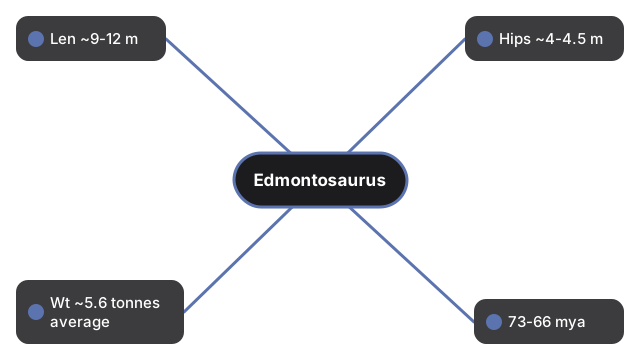
Edmontosaurus lived in the Late Cretaceous, about 73 to 66 million years ago, in what is now western North America. Typical adults measured about 9 to 12 m long and averaged roughly 5.6 tonnes, though a few exceptionally large individuals are estimated at up to 15 tonnes or more. Unlike its crested relative Parasaurolophus, Edmontosaurus had no bony head crest; it used a broad, toothless beak to crop leaves and shoots.
Edmontosaurus is known from more mummified specimens with preserved skin impressions than almost any other dinosaur, including the 1908 American Museum of Natural History "Trachodon mummy" and the 1999 "Dakota" specimen, both showing skin texture over much of the body. Large bonebeds, including one Wyoming site estimated to hold thousands of individuals, suggest it lived and moved in large herds. The type species, E. regalis, was named in 1917 by Canadian paleontologist Lawrence Lambe from Alberta's Horseshoe Canyon Formation; a second species, E. annectens, had been described earlier, in 1892, by Othniel Charles Marsh as Claosaurus annectens, from Wyoming's Lance Formation.
| Measure | Figure |
|---|---|
| Length | about 9-12 m (a few exceptional individuals larger) |
| Standing height | about 4-4.5 m |
| Weight | about 5.6 tonnes average; largest known individuals estimated up to 15 tonnes or more |
| When it lived | 73-66 million years ago (Late Cretaceous, Campanian-Maastrichtian) |
| Diet | Herbivore (leaves and shoots, cropped with a broad beak) |
The skin tone and pattern are an artistic reconstruction, because fossils preserve bone, not soft tissue or color, even on the mummified specimens; this model is not a fossil-accurate skeleton, and the numbers above are real published values.
Frequently Asked Questions
How big was Edmontosaurus?
Typical adults measured about 9 to 12 m long and averaged roughly 5.6 tonnes, though a few exceptionally large individuals are estimated at up to 15 tonnes or more. Turn on the human figure in the viewer to see the scale against a 1.8 m person.
Did Edmontosaurus have a crest like Parasaurolophus?
No. Edmontosaurus had no bony head crest, unlike its hadrosaur relative Parasaurolophus. It had a broad, toothless beak used to crop leaves and shoots from vegetation.
What makes Edmontosaurus fossils unusual?
Edmontosaurus is known from more mummified specimens with preserved skin impressions than almost any other dinosaur, including the 1908 American Museum of Natural History "Trachodon mummy" and the 1999 "Dakota" specimen. Large bonebeds also suggest it lived in big herds.
When and where did Edmontosaurus live?
In the Late Cretaceous, about 73 to 66 million years ago, in what is now western North America. The type species, E. regalis, was named in 1917 by Canadian paleontologist Lawrence Lambe from Alberta's Horseshoe Canyon Formation.
Is the model scientifically accurate?
The proportions follow published figures, but the skin color and soft-tissue outline are an artistic reconstruction - fossils preserve bone, not soft tissue or color, even on the mummified specimens. This model is not a fossil-accurate skeleton. The length, weight, and age figures shown are real published values, with ranges cited because sources vary.
Do I need to install anything to view it?
No. The model renders in your browser with WebGL - no app, no account, and nothing about your visit is sent to a server. The 3D engine loads once and is then cached. When available, a free-licensed glTF model may swap in after first paint.