
Drag to rotate the Acrocanthosaurus, scroll or pinch to zoom, and click a body part - the head, an arm, the tail, or a leg - to read what fossils tell us about it. The panel beside the model carries the real figures.
Acrocanthosaurus 3D Viewer
This page renders an Acrocanthosaurus as a 3D model you can spin in the browser. Drag to rotate, scroll or pinch to zoom, toggle a 1.8 m person beside it for scale, and click the head, an arm, the tail, or a leg to read a fact about that part. Everything runs on your device - no account, no upload.
How to steer the model
Each button beneath the scene names your next action: the spin button reads Stop rotation while the model turns and Auto-rotate once you pause it. Idle motion is a stand-and-sway, not a walk across the scene - the legs swing and the body bobs in a slow rhythm while the animal stays put, so the pose stays in front of you. Fullscreen keeps everything working at the larger size: the facts panel rides along as a translucent dark overlay and the buttons stay within reach, so the note for the part you last clicked keeps reading and the spin still stops and starts.
Dragging and zooming stay within sensible limits: the tilt stops short of flipping the animal over, and the scroll or pinch zoom holds between a close pass at the skull and a full-body framing, so the Acrocanthosaurus never slips off screen or turns upside down. On a phone or a modest laptop the viewer notices the touch screen or the smaller processor and eases off the graphics load, so the model keeps turning smoothly instead of stuttering. And because a spin only counts as a tap when your finger barely moves, dragging to rotate never pops open a body-part note. The motion also carries a gentle glide: each drag, scroll, or pinch nudges a target position, and the camera eases toward it a fraction each frame rather than snapping, so a flick of the wheel or a quick spin coasts to rest instead of stopping dead.
Reading the facts panel
Click a body part and the side panel swaps to that region's note; click an empty patch of the scene and the full fact sheet comes back. That lets you move between the skull, the arms, and the tail without losing the overview.
Each note also separates what the fossil records from what an artist inferred: the head note says the skull shape follows the bone while the lips and color are reconstruction, the arm note points out that the finger count is read from the preserved fossil hand, and the tail note explains how it counterbalanced the body over the hips and, in some theropods, doubled as a weapon - so a click tells you how confident each detail really is.
What Acrocanthosaurus was
Acrocanthosaurus atokensis was a large theropod from the Early Cretaceous of North America, roughly 125 to 100 million years ago, and was among the apex predators of its ecosystem in what is now the south-central United States. Its vertebrae bear unusually tall neural spines along the neck, back, and hips - researchers interpret those spines as anchoring a low muscular ridge along the dorsal line, not a tall sail like Spinosaurus. Some allow the spines a display role as well, but that stays interpretive, because fossils keep the bone and not the soft-tissue outline.
Who named it and where it was found
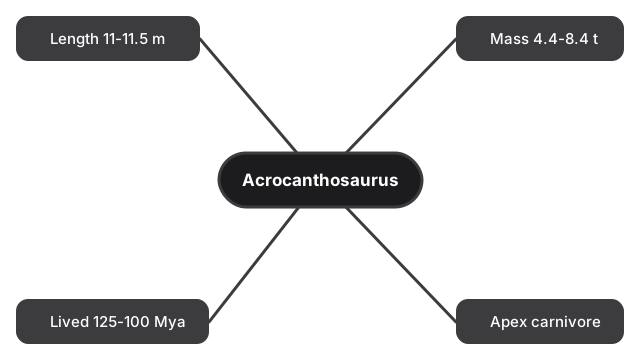
J. Willis Stovall and Wann Langston named the genus in 1950. Specimen NCSM 14345 ("Fran") comes from the Antlers Formation of Oklahoma and is among the most complete skeletons known for the genus; the animal is also recorded from the Twin Mountains Formation of Texas, not only Oklahoma, so its known range spanned both present-day states. Published length and mass estimates vary across studies; the table below gives those ranges and the mid-range values the facts panel uses.
Size, mass, and age at a glance
| Measure | Figure |
|---|---|
| Length | about 11-11.5 m (panel ~11.5 m) |
| Weight | about 4.4-8.4 t (panel ~6.2 t) |
| When it lived | about 125-100 Mya (Early Cretaceous) |
| Diet | Carnivore (apex predator) |
| Group | Large carcharodontosaurid theropod |
What runs on your device, and what the model is not
The viewer draws with WebGL. It downloads the 3D engine and model once, checks the model, and caches both, so a return visit brings the scene up quickly. The shape you see first is drawn from simple geometry the moment the engine is ready, so the frame is never blank; a verified, more detailed model of this species takes its place when one is published, and otherwise that first drawing stays. With WebGL turned off, the reference table above and the facts panel still work, so the length, mass, and timeline stay readable. The skin tone and pattern are an artistic reconstruction, because fossils do not preserve color or soft tissue; this model is not a fossil-accurate skeleton.
Other large theropods in this collection
For a sibling large theropod, see the Giganotosaurus 3D Viewer or the Allosaurus 3D Viewer.
Frequently Asked Questions
How big was Acrocanthosaurus?
Most published length estimates fall around 11 to 11.5 m. Mass estimates vary from about 4.4 to 8.4 tonnes depending on the reconstruction method; this viewer uses 11.5 m and 6.2 t as mid-range panel values within those ranges. Turn on the human figure to compare scale against a 1.8 m person.
What were the high neural spines for?
The tall neural spines along the neck, back, and hips likely anchored neck and back muscles, creating a low ridge along the dorsal line. They may also have had a display role, but fossils do not preserve the soft-tissue outline, so the exact look remains interpretive.
How is Acrocanthosaurus different from a Spinosaurus sail?
Spinosaurus is famous for a very tall, sail-like dorsal structure supported by elongated neural spines. Acrocanthosaurus spines are elevated but generally interpreted as supporting muscle and a low ridge rather than a thin, high sail. The two animals lived in different places and times and are not close relatives.
When and where was Acrocanthosaurus found?
In the Early Cretaceous, about 125 to 100 million years ago, in what is now Oklahoma and Texas (Antlers and Twin Mountains formations). Stovall and Langston named the genus in 1950; the well-known specimen NCSM 14345 ("Fran") was excavated from the Antlers Formation in Oklahoma.
Is the model scientifically accurate?
The proportions follow published length and mass ranges, but the skin color, the low dorsal ridge, and soft-tissue outline are an artistic reconstruction - fossils preserve bone, not color or muscle shape. This model is not a fossil-accurate skeleton.
Do I need to install anything to view it?
No. The model renders in your browser with WebGL - no app, no account, and nothing about your visit is sent to a server. The 3D engine loads once and is then cached.