Spinosaurus Size Comparison
The Spinosaurus 3D Viewer shows a sail-backed theropod at its published figures: length about 14 m, hip height about 2.1 m, weight about 7.4 tonnes. Turn on Size vs human and a 1.8 m person appears at the true length ratio, so the theropod scale gap is readable at a glance.
Spinosaurus published figures
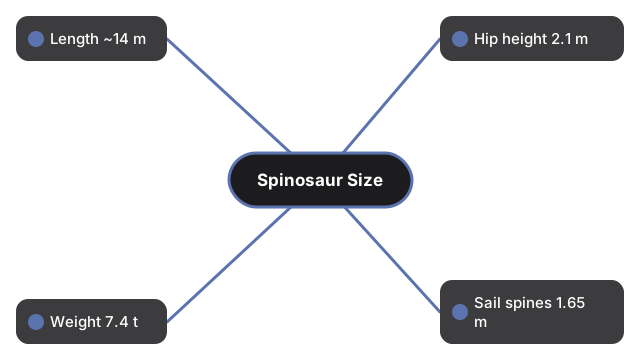
These figures follow the Natural History Museum entry and Sereno et al. 2022, with a range where sources disagree:
| Measure | Figure | Vs a 1.8 m person |
|---|---|---|
| Length | about 14 m (earlier estimates sometimes up to about 15 m; NHM / Sereno et al. 2022) | ~7.8x a person end-to-end at the 14 m figure |
| Hip height | about 2.1 m | ~1.2x adult standing height |
| Weight | about 7.4 tonnes / 7400 kg | shown as 7.4 t on the facts panel |
| Sail spines | elongated neural spines up to about 1.65 m | a dorsal sail rises over the back on the model |
| When it lived | 99-94 million years ago | Late Cretaceous; fossils from Egypt (1912 finds; named by Stromer, 1915) |
What the Spinosaurus facts panel lists
The facts panel beside the canvas carries exactly five rows: Length 14 m, Weight 7.4 t, When it lived 99-94 Mya (Late Cretaceous), Diet Carnivore (mainly fish), and Described 1912, Egypt (named by Stromer, 1915). Hip height is not one of those rows - the about 2.1 m figure is a page measure used in the table above, not a panel row. Under the table the panel adds a species note (the sail of elongated neural spines, the crocodile-like snout and conical teeth) and a disclosure line naming the model and its license.
The model that loads on the Spinosaurus page
The page paints a shaped Spinosaurus immediately so nothing waits on a download, then quietly upgrades it. After that first paint the viewer fetches a real, free-licensed 3D model for the species, checks it against a published checksum, caches it in the browser, and swaps it in - at which point the status line changes to "Showing a real 3D model of this species." The current model is credited to Tuomo Untinen under CC-BY-SA 3.0 via OpenGameArt, and the facts panel names that credit once the swap lands. If the download or the graphics step fails for any reason, the first-paint model simply stays on screen, so the page never breaks while waiting.
How the Size vs human toggle scales the person
The Spinosaurus model is drawn to a fixed on-screen length so the whole animal fits the canvas: 12 world units stand for the published 14 m. The scale figure is then sized by that same units-per-metre factor, which is why the comparison is honest - the person and the animal share one ruler derived from LENGTH, not from hip height. Press Size vs human under the canvas to show the figure; the button flips to Hide human to remove it again. The comparison is proportional, not a decorative sticker.
The four Spinosaurus controls under the canvas
Drag with the pointer to orbit the Spinosaurus, and scroll or pinch with two fingers to zoom. When the scene is ready the status line reads "Drag to rotate, scroll or pinch to zoom, click a body part for a fact." Four buttons sit under the canvas:
- Fullscreen - expands the viewer wrapper so the scene grows while the buttons stay visible
- Stop rotation - freezes the slow auto-spin; the label flips to Auto-rotate to resume it
- Idle motion - adds subtle breathing and leg sway; the label flips to Stand still
- Size vs human - shows the 1.8 m scale figure; the label flips to Hide human
Clicking a body part opens a part note
A short click swaps the species sheet for a note about the part under the pointer. The viewer separates a click from a drag by distance: if the pointer moved less than 8 pixels it counts as a click, so a slow orbit never fires a part note by accident. On this theropod the clickable parts are the head, neck, body, arm, leg and tail, each with its own note - the head note says the skull shape follows the fossil while the fleshy profile is an artist reconstruction. Click empty space to return to the fact sheet.
What a person would see beside a Spinosaurus
A person standing alongside would meet a hip line just above their own head: at about 2.1 m at the hip, the Spinosaurus hip sits a little over a 1.8 m adult. From snout to tail the animal spans about 14 m, roughly 7.8 times that person end to end. Turn on the scale figure and orbit beside a hind leg to see how the long narrow snout and the dorsal sail tower past it.
The browser viewer against phone AR and a museum
These rows compare what the Spinosaurus viewer actually ships against a typical phone AR app, a museum hall visit, and a still photo:
| Aspect | In-browser 3D viewer | Phone AR app | Museum / static image |
|---|---|---|---|
| Install / download | 0 MB app install; three.js is vendored and cached after first load | Often 50 to 500 MB store download | Travel time; or 0 MB for a photo |
| Time to first view | Seconds on one page load; the engine loads after first paint | Minutes for install, permissions and tracking setup | Hours for a visit; instant for a photo |
| Place in a physical room | No - orbit on a flat screen only | Yes, true placement when tracking works | Hall scale in person; none in a photo |
| Desktop without a phone | Yes, any current browser with WebGL | Usually no | Photo yes; museum no |
| Published figures on hand | Yes - about 14 m length, hip about 2.1 m, about 7.4 t, 99-94 Mya | Varies by app | Labels vary; a photo rarely carries the full sheet |
| Reconstruction honesty | Skin and sail color flagged as artistic; a fully aquatic lifestyle is not settled | Often sells a single settled lifestyle story | Bones are real; color is still interpretive |
When the browser viewer fits and when it does not
Pick the browser viewer when you want drag-orbit on a sail-backed theropod, the scale figure at the honest length ratio, and part notes on the head, a leg or the tail without installing anything. Nothing about the visit is sent to a server, which suits a classroom laptop or a quick desktop check of the Late Cretaceous numbers. A phone AR app wins when you need the silhouette on your own floor - this viewer never claims room placement. A museum wins for walking beside mounted bone at hall scale. A static image wins only when one shareable frame is enough.
What the Spinosaurus size numbers are not
These numbers are published estimates with an honest length range, not settled science: earlier work put the animal nearer 15 m, and mass estimates move with the skeleton reconstruction used. Skin and sail color are an artistic reconstruction, because fossils do not preserve soft tissue or color. Whether Spinosaurus was fully aquatic is still debated, so the viewer describes a semi-aquatic lifestyle as argued rather than proven. The page is a viewer and a size sheet - it does not place the model in your room, does not claim colour accuracy, and carries no score or win state.
Other dinosaurs to compare
Spinosaurus is one of the longest theropods in the collection, so the contrasts are useful: for a shorter but heavily armoured herbivore see the Stegosaurus 3D Viewer, and for the classic apex-predator silhouette see the Tyrannosaurus Rex 3D Viewer. Measured directly against that apex predator, this page's Spinosaurus runs longer overall at about 14 m but stands lower at the hip and weighs less (about 2.1 m and 7.4 tonnes), while the Tyrannosaurus rex size comparison reports a shorter animal that is taller at the hip and heavier (about 12.3 m, 3.7 m hip height, and 8.9 tonnes).
Frequently asked questions
Can you rotate and zoom the Spinosaurus model yourself, or does it just auto-play?
Drag to orbit the Spinosaurus and use the scroll wheel or a pinch gesture to zoom; a separate Stop rotation toggle turns the auto-spin on or off, an Idle motion toggle adds or removes breathing and leg sway, and Fullscreen expands the canvas - all independent of the Size vs human control described above.
What happens when you click the sail, a leg, or another body part?
A short click swaps the species fact sheet for a note about the part under the pointer - head, neck, body, arm, leg, and tail each carry their own note. The viewer tells a click from a drag by distance: moving the pointer less than 8 pixels counts as a click, so a slow orbit will not misfire a part note. Click empty space to bring the fact sheet back.
Was Spinosaurus really a swimming dinosaur?
It is not settled science. Many studies argue for a semi-aquatic lifestyle given the long snout, conical teeth, and dense limb bones, but whether Spinosaurus was fully aquatic is still debated among paleontologists - this page treats it as an open question, not a confirmed fact.
Does viewing the Spinosaurus model send anything to a server?
No - the viewer renders entirely in the browser using WebGL. Orbiting, zooming, toggling Size vs human, and clicking parts all happen client-side; there is no account, no upload, and nothing about the visit is sent to a server.
What did Spinosaurus eat, and how does the model show that?
Spinosaurus was a carnivore that fed mainly on fish, matched by conical, non-serrated teeth and a long narrow snout built for grabbing rather than shearing meat - a different hunting shape from a typical land-predator theropod.
Where do the Spinosaurus length and weight figures come from?
The published figures follow the Natural History Museum entry and Sereno et al. 2022 - about 14 m long and about 7.4 tonnes - shown as a range because earlier studies sometimes cited a length up to about 15 m, so the page states the range rather than inventing one precise number.
Why trust these tools
- Ten-plus years of web tooling. The freetoolonline editorial team has shipped browser-based utilities since 2015. The goal has never changed: get you to a working output fast, without an install.
- No install, no sign-up. Open a tool and get a working output in seconds - nothing to download and no account to create. Tools that need heavy processing run it on our service, so even a low-powered machine gets the job done.
- Analytics stops at the page view. We measure which pages get visited, not what you type or upload inside a tool. There is nothing to sign in to and no profile is attached to your input.
- Open-source core components. The processing engines underneath (libheif, libde265, pdf-lib, terser, clean-css, ffmpeg.wasm, and others) are public and audit-able. We link to each one in its tool page's footer.
- Free, with or without ads. All tools are fully functional without sign-up. The Disable Ads button in the header is always available if you need a distraction-free run.