
Drag to rotate the Hybodus, scroll or pinch to zoom, and click a body part - the snout, a dorsal fin spine, or the tail - to read what fossils tell us about it. The panel beside the model carries the real figures.
Hybodus was a shark - a hybodont fish, not a dinosaur. Turn on the human figure to see how a roughly 2 m animal compares with a person. Distinctive dorsal fin spines and mixed tooth types are hallmarks of the group.
The colors and skin pattern here are an artistic reconstruction; fossils preserve hard parts, not soft tissue or color. The measurements in the panel are published figures with ranges where sources disagree.
Hybodus 3D Viewer
This page renders a Hybodus as a 3D model you can spin in the browser - drag to rotate, scroll or pinch to zoom, toggle a 1.8 m person beside it for scale, and click a body region to read a fact.
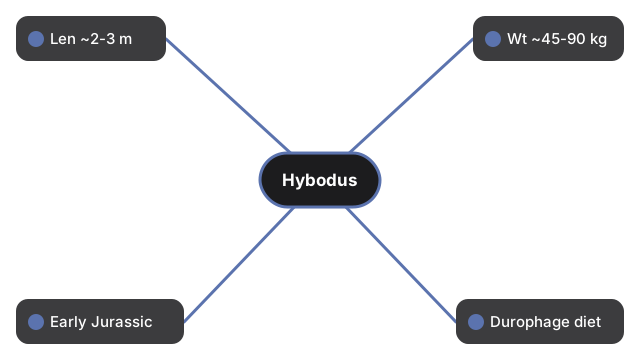
Hybodus was a hybodont shark, not a dinosaur. Core species such as H. reticulatus and H. hauffianus are known from the Early Jurassic of Europe; the name has also been applied more broadly across the Mesozoic. Typical length is about 2 m, with larger H. hauffianus specimens near 3 m. Mass is poorly constrained; secondary popular estimates land near 45-90 kg.
| Measure | Figure |
|---|---|
| Length | about 2 m typical; up to about 3 m for large H. hauffianus (panel baseline 2 m) |
| Weight | poorly constrained; secondary estimates about 45-90 kg (panel baseline 70 kg) |
| When it lived | Early Jurassic for core species (about 201-175 Mya); name historically used more widely |
| Diet | Carnivore / durophage (heterodont teeth: pointed front, crushing rear) |
Everything runs on your device with WebGL - no account, nothing sent to a server. Soft-tissue color is an artistic reconstruction; this model is not a fossil-accurate skeleton. Compare with the Ichthyosaurus 3D Viewer (a marine reptile, also not a dinosaur).
Frequently Asked Questions
How big was Hybodus?
Most species are reconstructed near 2 m long. Larger H. hauffianus specimens reach about 3 m. Mass is poorly constrained; secondary estimates near 45-90 kg appear in popular summaries. Turn on the human figure for scale.
Is Hybodus a dinosaur?
No. It was a hybodont shark - a cartilaginous fish. This site also hosts other non-dinosaurs when readers search for them here.
When and where did it live?
Core species such as H. reticulatus and H. hauffianus are Early Jurassic of Europe (about 201-175 Mya). The name has been applied more widely across the Mesozoic and is treated as a wastebasket genus needing reexamination.
What made Hybodus distinctive?
Two dorsal fins with stout spines, and heterodont teeth - pointed teeth in front for grasping soft prey and flatter crushing teeth behind for harder food.
Is the model scientifically accurate?
Size follows published figures with ranges, but skin color and soft tissue are artistic. This is not a fossil-accurate skeleton.
Do I need to install anything to view it?
No. The model renders in your browser with WebGL - no app, no account, and nothing about your visit is sent to a server. When available, a free-licensed glTF model may swap in after first paint.