
Ichthyosaurus in 3D - click the head, a flipper, or the tail for a fact (full controls on the Dinosaurs 3D hub).
Ichthyosaurus was a marine reptile, not a dinosaur - a dolphin-shaped hunter that gave birth to live young at sea rather than laying eggs on land. Published length estimates for the genus range roughly 1 to 3.3 m.
Colors are an artistic reconstruction (fossils don't preserve them). The measurements in the panel are the real published ones.
Ichthyosaurus 3D Viewer
Turn the Ichthyosaurus with a drag, zoom closer with scroll, and click a body part to get a fact about it - the Dinosaurs 3D hub lists every control.
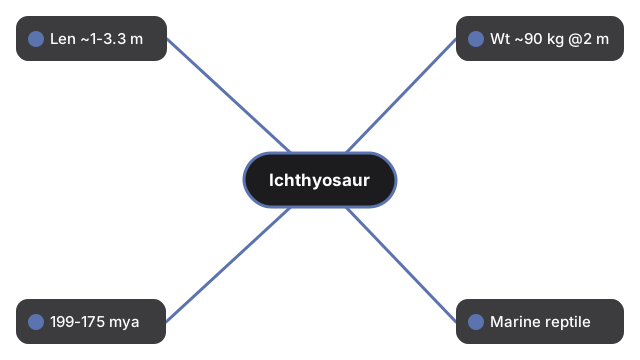
Ichthyosaurus lived in the Early Jurassic, roughly 199 to 175 million years ago, and hunted fish and cephalopods with large eyes and sharp conical teeth. Published length estimates for the genus range from about 1 to 3.3 m, with individual figures commonly cited up to around 3 m (about 10 ft); weight for a roughly 2 m individual is estimated at about 90 kg, though figures vary by species and growth stage. It was not a dinosaur - it belonged to a separate group of marine reptiles that gave birth to live young at sea rather than laying eggs on land - so the model shows a streamlined, dolphin-shaped body with a dorsal fin, paired paddle flippers, and a crescent-shaped tail fluke.
The first near-complete Ichthyosaurus skeleton was found around 1811-1812 by 12-year-old Mary Anning and her brother Joseph, along the Blue Lias cliffs at Lyme Regis, Dorset, England. The genus was formally named by Charles Konig in 1818 and described in detail by Henry De la Beche and William Conybeare in 1821; specimens are displayed in the Natural History Museum's Fossil Marine Reptiles Gallery in London.
| Measure | Figure |
|---|---|
| Length | about 1-3.3 m across the genus (commonly cited up to ~3 m / 10 ft) |
| Weight | about 90 kg for a ~2 m individual (varies by species and growth stage) |
| When it lived | 199-175 million years ago (Early Jurassic) |
| Group | Marine reptile (Ichthyosauria), not a dinosaur |
| Diet | Carnivore (fish and cephalopods) |
Colors here are an artistic reconstruction - fossils don't preserve them; the numbers above are real published values, with a range given where sources disagree.
See also Mosasaurus, another marine reptile from a different lineage.
Frequently Asked Questions
Was Ichthyosaurus a dinosaur?
No. Ichthyosaurus was a marine reptile - a member of the Ichthyosauria - that lived alongside dinosaurs but is a separate group. This viewer includes it because it is one of the most-searched prehistoric animals.
How big was Ichthyosaurus?
Published length estimates for the genus range from about 1 to 3.3 m, with individual figures commonly cited up to around 3 m (about 10 ft). Weight for a roughly 2 m individual is estimated at about 90 kg, though figures vary by species and growth stage. Turn on the human figure in the viewer to judge the scale.
Did Ichthyosaurus lay eggs?
No. Fossil evidence shows Ichthyosaurus gave birth to live young at sea (viviparous), tail-first, rather than laying eggs on land like most reptiles - a genuinely distinctive trait among prehistoric marine reptiles.
Is the model scientifically accurate?
The body shape - a streamlined, dolphin-like torso, a dorsal fin, paired paddle flippers, and a crescent tail fluke - follows the fossil skeleton, but the skin color and texture are an artistic reconstruction. Fossils preserve bone, not color. The figures shown are real published values.
Where was Ichthyosaurus first found?
Near Lyme Regis, Dorset, England. Around 1811-1812, 12-year-old Mary Anning and her brother Joseph found the first near-complete skeleton along the Blue Lias cliffs there; the genus was formally named by Charles Konig in 1818 and described in detail by Henry De la Beche and William Conybeare in 1821.
Do I need to install anything to view it?
No. The model renders in your browser with WebGL - no app, no account, and nothing about your visit is sent to a server. The 3D engine loads once and is then cached.