
Dacentrurus in 3D - click the head, a back plate, the tail, or a leg for a fact (full controls on the Dinosaurs 3D hub).
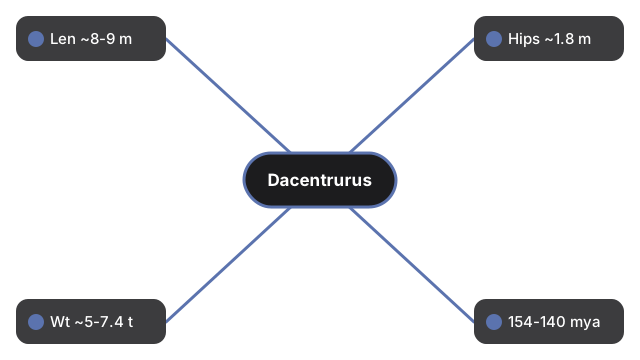
Dacentrurus stood about 1.8 m tall at the hips and stretched roughly 8-9 m from snout to tail tip in the commonly cited figures - turn on the human figure to see how a person compares to this plated plant-eater.
The measurements in the panel follow published figures, with ranges shown where sources disagree.
Dacentrurus 3D Viewer
The Dacentrurus below rotates as you drag - zoom with the wheel and click the head, a back plate, the tail, or a leg to pull up a fact (every control is on the Dinosaurs 3D hub).
Dacentrurus lived in the Late Jurassic, roughly 154 to 140 million years ago, and its fossils come from England, France, Portugal, and Spain - making it one of the few stegosaurs known from mainland Europe. It was the first stegosaur ever described from a European skeleton: Richard Owen named the holotype Omosaurus armatus in 1875 from a find near Swindon, England, and Frederick Augustus Lucas renamed the genus Dacentrurus in 1902 after discovering the name Omosaurus was already used for a different fossil reptile.
Published size estimates disagree. Commonly cited figures put adults around 8-9 m long and 5-7.4 tonnes, with a hip height of about 1.8 m, while the holotype itself measured only about 7 m and some estimates range up to 10 m. A pelvis roughly 1.5 m wide has been used to argue Dacentrurus was among the largest known stegosaurs, despite older texts describing it as small. Like Stegosaurus, it carried plates along its back and paired spikes near the tip of its tail (a thagomizer) - a broader, classic stegosaur build rather than the long neck of its closer relative Miragaia.
| Measure | Figure |
|---|---|
| Length | about 8-9 m in commonly cited figures (holotype about 7 m; some estimates up to about 10 m) |
| Hip height | about 1.8 m |
| Weight | about 5-7.4 tonnes in recent estimates (older sources cite up to about 5 tonnes) |
| When it lived | 154-140 million years ago (Late Jurassic, mainly Kimmeridgian) |
| Diet | Herbivore |
Colors here are an artistic reconstruction - fossils don't preserve them; the numbers above are real published values, and ranges are shown because sources vary.
See also Stegosaurus and Kentrosaurus, fellow plated stegosaurids.
Frequently Asked Questions
How big was Dacentrurus?
Commonly cited figures put adults around 8-9 m long and 5-7.4 tonnes, with a hip height of about 1.8 m. The holotype itself measured only about 7 m, and some estimates range up to about 10 m - sources disagree on the size of this genus. Turn on the human figure in the viewer to see the scale against a 1.8 m person.
Was Dacentrurus really one of the largest stegosaurs?
A pelvis roughly 1.5 m wide has been used to argue Dacentrurus was among the largest known stegosaurs, overturning older texts that described it as a smaller animal. This model shows the commonly cited length and mass range rather than a single invented number, because published estimates still disagree.
Where and when did Dacentrurus live?
In the Late Jurassic, roughly 154 to 140 million years ago (mainly the Kimmeridgian stage). Fossils have been found in England, France, Portugal, and Spain, making it one of the few stegosaurs known from mainland Europe.
Why is it called Dacentrurus instead of Omosaurus?
Richard Owen first named the holotype Omosaurus armatus in 1875 from a skeleton found near Swindon, England - the first stegosaur ever described from a European specimen. In 1902, Frederick Augustus Lucas renamed the genus Dacentrurus after finding that Omosaurus had already been used for a different, unrelated fossil reptile.
Is the model scientifically accurate?
The proportions follow published figures, but the skin color and soft-tissue outline are an artistic reconstruction - fossils preserve bone, not soft tissue or color. This model is not a fossil-accurate skeleton. The length, weight, and age figures shown are real published values, with ranges cited where sources disagree.
Do I need to install anything to view it?
No. The model renders in your browser with WebGL - no app, no account, and nothing about your visit is sent to a server. The 3D engine loads once and is then cached. When available, a free-licensed glTF model may swap in after first paint.