
Drag to rotate the Titanosaurus, scroll or pinch to zoom, and click a body part - the neck, the body, a leg, or the long tail - to read what fossils tell us about it. The panel beside the model carries the real figures.
Titanosaurus was a titanosaurian sauropod from Late Cretaceous India - turn on the human figure to see how a roughly 10.5 m animal compares with a person. The Lameta Formation yields the historic type material.
The colors and skin pattern here are an artistic reconstruction; fossils preserve bone, not soft tissue or color. The measurements in the panel are published figures with ranges where sources disagree.
Titanosaurus 3D Viewer
This page renders a Titanosaurus as a 3D model - drag or pinch to rotate and zoom, toggle a 1.8 m person for scale, and click the neck, body, or a leg for a fact.
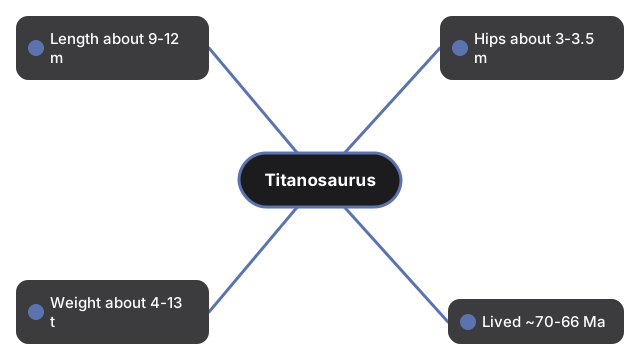
Titanosaurus lived about 70-66 million years ago in Late Cretaceous India (Lameta Formation). Lydekker named it in 1877 - the first titanosaur - though many treat the genus as a nomen dubium (non-diagnostic holotype). Length estimates are about 9-12 m and mass about 4-13 tonnes; this page uses 10.5 m and 5.5 t as panel baselines.
| Measure | Figure |
|---|---|
| Length | about 9-12 m (panel baseline 10.5 m) |
| Standing height | about 3-3.5 m at the hips (panel 3.2 m) |
| Weight | about 4-13 tonnes (panel baseline 5.5 t) |
| When it lived | about 70-66 million years ago (Late Cretaceous) |
| Diet | Herbivore |
Everything runs on your device with WebGL - no account, nothing sent to a server. Soft-tissue color is reconstructed; not a fossil-accurate skeleton. Compare with the armored French Ampelosaurus 3D Viewer and the taller-shouldered Brachiosaurus 3D Viewer. Magyarosaurus was first named a Titanosaurus species (1915) before its own genus in 1932 - one of the smallest known sauropods, from island dwarfism.
Frequently Asked Questions
Was Titanosaurus a real dinosaur?
Yes. Lydekker named Titanosaurus indicus in 1877 from Indian Late Cretaceous fossils. Many researchers treat the genus as a nomen dubium because the holotype is not distinctive enough to diagnose further finds.
How long was it?
Published reconstructions from the fragmentary remains commonly place adults near 9-12 m. This page uses 10.5 m as the panel baseline.
How heavy was it?
Mass estimates span about 4-13 tonnes across sources. The panel shows 5.5 t as a mid-range figure and the note states the wide published range.
When and where did it live?
Late Cretaceous India, about 70-66 million years ago (Lameta Formation).
Is the color accurate?
No. Soft tissue and color are not preserved. Skin and color here are artistic reconstruction.