
Apatosaurus in 3D - click the head, neck, body, leg, or tail for a fact (full controls on the Dinosaurs 3D hub).
Apatosaurus was a stockier, more heavily built relative of Diplodocus, carrying deeper neck vertebrae and a heavier frame on a similarly long, low-swung neck and whip-like tail. Turn on the human figure to see how a person compares to its massive, ground-hugging frame.
The measurements in the panel follow the published reference figures cited below.
Apatosaurus 3D Viewer
Below is a rotating Apatosaurus - drag to turn it, zoom in close, and click on a body part to read a fact (controls are detailed on the Dinosaurs 3D hub).
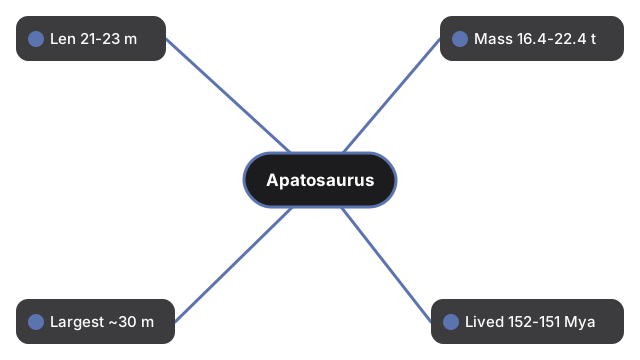
Apatosaurus lived in the Late Jurassic, about 152 to 151 million years ago, in what is now the western United States. Othniel Charles Marsh named the genus in 1877 from an immature partial skeleton found in the Morrison Formation. Published figures place a reference individual at about 21 m long and about 22.4 tonnes, though other sources give a wider average range of 21 to 23 m and 16.4 to 22.4 tonnes, and the largest known specimens reached roughly 30 m and 33 tonnes. Compared to the more slender Diplodocus, Apatosaurus carried proportionally deeper, thicker neck vertebrae on a heavier-built body.
Apatosaurus has a famous naming history: Marsh described a second, larger skeleton in 1879 as a new genus, Brontosaurus. In 1903 paleontologists concluded the two were the same animal and the name Apatosaurus took priority, retiring Brontosaurus for over a century. A 2015 study of diplodocid anatomy concluded the two skeletons were distinct enough to reinstate Brontosaurus as its own genus, so the two names now refer to different, closely related animals again.
| Measure | Figure |
|---|---|
| Length | about 21 m (NHM reference); 21-23 m average across sources |
| Weight | about 22.4 tonnes (NHM reference); 16.4-22.4 tonnes average across sources |
| Largest known specimens | up to about 30 m / 33 tonnes |
| When it lived | 152-151 million years ago (Late Jurassic) |
| Diet | Herbivore |
Colors here are an artistic reconstruction - fossils don't preserve them; the numbers above are real published values.
See also Brontosaurus and Diplodocus, fellow diplodocid sauropods.
Frequently Asked Questions
How big was Apatosaurus?
A reference figure from the Natural History Museum puts it at about 21 m long and about 22.4 tonnes. Other sources give a wider average range of 21 to 23 m and 16.4 to 22.4 tonnes, with the largest known specimens reaching roughly 30 m and 33 tonnes. Turn on the human figure in the viewer to see the scale against a 1.8 m person.
Is Apatosaurus the same as Brontosaurus?
They were once considered the same. Marsh named Apatosaurus in 1877 and a second, larger skeleton Brontosaurus in 1879; in 1903 scientists concluded they were the same genus and retired the name Brontosaurus. A 2015 study of diplodocid anatomy found enough differences to reinstate Brontosaurus as a distinct, closely related genus, so today the two names refer to different animals again.
How is Apatosaurus different from Diplodocus?
Both are diplodocid sauropods with long whip-like tails and low-swung necks, but Apatosaurus was more heavily built, with proportionally deeper and thicker neck vertebrae supporting a heavier frame than the more slender Diplodocus.
When and where did Apatosaurus live?
In the Late Jurassic, about 152 to 151 million years ago, mainly in what is now the western United States. Othniel Charles Marsh named the genus in 1877 from an immature partial skeleton found in the Morrison Formation.
Is the model scientifically accurate?
The proportions follow published figures, but the skin color and soft-tissue outline are an artistic reconstruction - fossils preserve bone, not soft tissue or color. This model is not a fossil-accurate skeleton. The length, weight, and age figures shown are real published values.
Do I need to install anything to view it?
No. The model renders in your browser with WebGL - no app, no account, and nothing about your visit is sent to a server. The 3D engine loads once and is then cached.