
Drag to rotate Psittacosaurus, scroll or pinch to zoom, and click the beak, a forelimb, or a hind leg to read a short fossil fact. The panel beside the model carries the published figures.
Psittacosaurus was a Late Cretaceous Early Cretaceous ceratopsian from Asia, often restored as a small biped without the large frill of later horned dinosaurs; turn on the human figure to see how a person compares to the reconstructed body used here.
Fossils preserve bone, not soft tissue or color. The full-body shape on this page follows related relatives such as Protoceratops and Triceratops. This is an artistic reconstruction, not a fossil-accurate skeleton. Panel figures use mid-range values within published length and mass ranges.
Psittacosaurus 3D Viewer
This page renders Psittacosaurus as a 3D model you can spin in the browser - drag to rotate, scroll or pinch to zoom, toggle a 1.8 m person beside it for scale, and click the beak, a forelimb, or a hind leg to read a fact about that part.
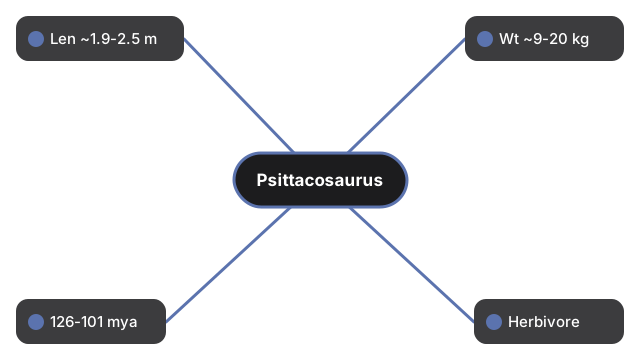
Psittacosaurus was an early ceratopsian from Early Cretaceous Asia. Henry Fairfield Osborn named the genus in 1923. Published length estimates commonly fall around 1.9 to 2.5 m and mass around 9 to 20 kg; this viewer uses about 2 m and about 20 kg as mid-range values within those ranges. Unlike Triceratops, it lacked a large frill and horns, and many reconstructions show it as a small biped.
| Measure | Figure |
|---|---|
| Length | about 1.9-2.5 m (panel ~2 m) |
| Weight | about 9-20 kg (panel ~20 kg) |
| When it lived | about 126-101 Mya (Early Cretaceous) |
| Diet | Herbivore |
Everything runs on your device with WebGL, so the model works without an account and without sending anything to a server. The skin tone and pattern are an artistic reconstruction, because fossils do not preserve color or soft tissue; this model is not a fossil-accurate skeleton. Some fossils preserve bristle-like tail integument, which this stylized viewer does not model strand by strand. For sibling ceratopsians, see the Protoceratops 3D Viewer or the Triceratops 3D Viewer.
Frequently Asked Questions
How big was Psittacosaurus?
Published estimates vary by species and age, but adults are often cited around 1.9 to 2.5 m long and about 9 to 20 kg. The facts panel uses about 2 m and about 20 kg as mid-range values. Turn on the human figure to compare against a 1.8 m person.
Did it have a frill or horns like Triceratops?
No. Psittacosaurus is an early ceratopsian with a parrot-like beak but without the large frill and horns seen in later relatives such as Triceratops.
When and where did it live?
In the Early Cretaceous, about 126 to 101 million years ago, in what is now Asia (Mongolia, China, and related formations).
Did Psittacosaurus have feathers or quills?
Some fossils preserve bristle-like integument, especially on the tail. That evidence supports some kind of filamentous covering in life, but color and exact arrangement are not known. This viewer uses a simplified scaly reconstruction and does not draw individual quills.
Is the model scientifically accurate?
The numbers follow published ranges, but the body proportions, colors, and surface detail are artistic. This model is not a fossil-accurate skeleton or a verified color restoration.
Do I need to install anything to view it?
No. The model renders in your browser with WebGL - no app, no account. When available, a free-licensed glTF model may swap in after first paint.