
The Moon has no air to blur a sunset - so when its edge slides in front of a distant star, the star does not fade out, it simply vanishes, almost instantly. Astronomers have used exactly how fast that vanishing happens to measure the true size of the star itself. Press play to watch a star disappear behind the Moon's dark limb and reappear on the far side, then turn on Grazing to see it skim the Moon's mountains and blink instead.
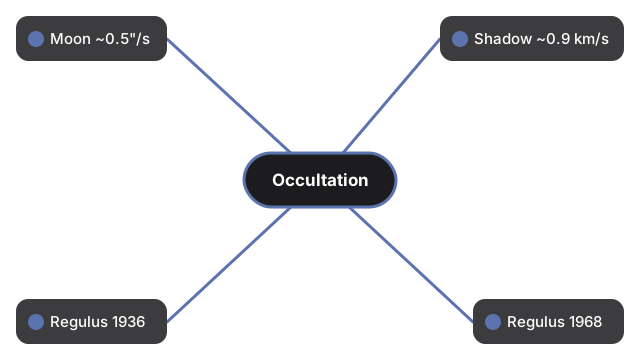
Published figures: the Moon crosses the sky against the background stars at about 0.5 arcsecond per second, a shadow speed on the ground of roughly 0.9 kilometer per second. Timing the star Regulus during a 1936 lunar occultation gave an estimated angular diameter of about 0.0018 arcsecond, later refined to about 0.0013 arcsecond.
Drag to orbit and scroll or pinch to zoom. Change the speed, toggle Grazing, or pause the motion.
Lunar Occultation 3D Explorer
Every month the Moon quietly passes in front of dozens of background stars, and for a moment each one simply switches off. Because the Moon carries no atmosphere to soften the edge, a star's light does not fade the way it would setting behind a hazy horizon on Earth - it cuts off in a fraction of a second, then returns just as abruptly on the far side. That sharp cutoff turns out to be useful: how quickly a star vanishes reveals its own true angular size, far too small to measure any other simple way. This explorer plays out a lunar occultation at a speed you can actually watch, and lets you compare a clean central pass with a grazing one.
The clean case is simple - a star's light disappears the instant the Moon's near edge, or limb, reaches it, and reappears the instant the far limb uncovers it. A grazing occultation, where the star's path just clips the Moon's edge instead of crossing its middle, is more interesting: the star ducks behind lunar mountains and peeks through valleys along that edge, blinking on and off several times in a few seconds. Observer groups coordinated by the International Occultation Timing Association still record these graze events today, spacing themselves along the predicted path on the ground to trace the Moon's own limb profile from the pattern of blinks. Observers also prefer timing a star against the Moon's dark, unlit limb rather than its sunlit side, simply because there is no glare to compete with.
- A model Moon lit from one side, with a clear dark limb
- A star that disappears and reappears at the real relative angular rate, sped up to be watchable
- A Grazing toggle that swaps a clean pass for a multi-blink skim along procedural lunar mountains
- A speed slider and Play and Pause control over the motion
- Runs fully in the browser with the vendored three.js engine - no account, no upload
Students see why an airless world hides a star so cleanly; amateur astronomers get a preview of what a real graze expedition looks for; anyone who has read about historic occultation timing can see the geometry behind it.
| Figure | Value | Source note |
|---|---|---|
| Moon's motion vs stars | about 0.5 arcsec per second | As seen from Earth's center |
| Shadow speed on the ground | about 0.9 km per second | Varies with geometry, roughly 0.4-0.9 km/s |
| Regulus angular diameter, 1936 | about 0.0018 arcsec | Arnulf, diffraction-fringe timing |
| Regulus angular diameter, 1968 | about 0.0013 arcsec | Brown, Narrabri intensity interferometer |
Everything renders on your device with WebGL. The 3D engine loads once (about 0.7 MB) and is cached; no scene data is sent to a server.
This is an educational visualization, not a real ephemeris or a lunar elevation map - the Moon's mountain profile shown in Grazing mode is illustrative, the motion is heavily sped up, and sizes and distances are not to scale.
For a step-by-step walkthrough, read the Lunar Occultation 3D Explorer step-by-step guide. The Space 3D collection also includes Lunar Eclipse 3D and Moon Libration 3D, which cover different ways the Moon interacts with light and viewing angle.
Frequently Asked Questions
What is a lunar occultation?
The moment the Moon's disk passes in front of a background star (or planet) as seen from Earth, hiding it from view until the Moon moves on.
Why does the star disappear instantly instead of fading?
The Moon has essentially no atmosphere to scatter or dim the star's light gradually, so the star's disappearance and reappearance are both very abrupt.
How fast does the Moon move against the stars?
About 0.5 arcsecond per second as seen from Earth's center, which corresponds to a shadow speed on the ground of roughly 0.9 kilometer per second.
What is a grazing occultation?
An occultation where the star's path just clips the Moon's edge rather than crossing its middle, so the star ducks behind lunar mountains and shows through valleys, blinking on and off several times.
Why do observers prefer the Moon's dark limb?
Timing against the unlit, dark side of the Moon avoids glare from sunlit lunar terrain, making faint stars far easier to time precisely.
Can occultation timing measure a star's size?
Yes. Timing how long Regulus took to disappear during a 1936 lunar occultation gave an estimated angular diameter of about 0.0018 arcsecond, later refined to about 0.0013 arcsecond with an interferometer.
Is this scene to scale?
No. The Moon's mountain profile in Grazing mode is illustrative rather than a real elevation map, the motion is heavily sped up, and sizes and distances are not to scale.