
A comet tail does not simply trail behind the comet like smoke behind a car. Near the Sun a comet grows two tails, and both point away from the Sun. The straight blue ion tail is gas swept back by the solar wind; the broad yellow dust tail is grains pushed by sunlight and curved along the orbit. On the outbound leg the tails actually lead the way. Press play and watch them swing to stay anti-sunward.
Published literacy: a comet has an ion tail (Type I, blue and straight, ionized gas swept back by the solar wind and glowing where CO+ fluoresces near 4,200 angstrom) and a dust tail (Type II, yellow and curved, dust pushed by sunlight). Both stream away from the Sun, and they lengthen as the comet nears perihelion, starting to show around the orbit of Mars.
Drag to orbit and scroll or pinch to zoom. Change the speed, hide the comet-to-Sun line, or pause the motion.
Comet Tail Types 3D Explorer
The most common misconception about comets is that their tail trails behind them like a wake. In truth a bright comet usually shows two tails, and both stream away from the Sun no matter which way the comet is heading. This explorer sends a comet around the Sun on a stretched orbit and draws the two tails as they form and swing, so you can see that on the way out they point ahead of the comet, not behind it.
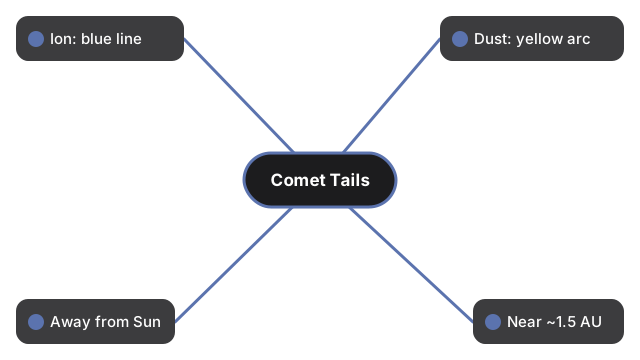
The two tails are made by two different forces. The ion tail, or Type I tail, is gas boiled off the nucleus and ionized by sunlight, then swept straight back by the solar wind - a stream of charged particles racing out from the Sun at hundreds of kilometres per second. Because the wind is so much faster than the comet, this tail is narrow, straight, and points almost exactly away from the Sun; it glows blue because carbon monoxide ions fluoresce near 4,200 angstrom. The dust tail, or Type II tail, is tiny grains gently pushed outward by the pressure of sunlight itself. Each grain then coasts on its own orbit, a little less bound to the Sun than the nucleus, so this tail is broad, pale yellow from reflected sunlight, and noticeably curved. Both grow as the comet nears the Sun, typically becoming visible around the orbit of Mars.
- A comet on a stretched orbit with the Sun at one focus
- A straight blue ion tail that always points nearly straight away from the Sun
- A broad, curved yellow dust tail that lags along the orbit
- Tails that grow near the Sun and shrink far from it
- A comet-to-Sun line and a speed slider to follow the geometry
- Runs fully in the browser with the vendored three.js engine - no account, no upload
Students correct the trailing-tail idea; teachers separate the solar wind from radiation pressure; sky watchers learn what the two tails of a bright comet are telling them.
| Figure | Value | Source note |
|---|---|---|
| Ion tail (Type I) | blue, straight | Solar wind, CO+ near 4,200 angstrom |
| Dust tail (Type II) | yellow, curved | Radiation pressure on grains |
| Tail direction | away from the Sun | Both tails |
| Tails appear near | about 1.5 AU | Orbit of Mars |
Everything renders on your device with WebGL. The 3D engine loads once (about 0.7 MB) and is cached; no scene data is sent to a server.
This is an educational visualization - the tails are drawn geometrically rather than by a gas solver, and the tail lengths and the comet and Sun sizes are illustrative and sped up; it is not to scale.
For a step-by-step walkthrough, read the Comet Tail Types 3D Explorer step-by-step guide. The Space 3D collection also includes Comet Orbit 3D and Solar Wind and Heliosphere 3D.
Frequently Asked Questions
Why does a comet have two tails?
Two forces act on the material the comet sheds. The solar wind sweeps ionized gas into a straight ion tail, while sunlight pushes dust grains into a broad curved dust tail.
Which way do the tails point?
Both point away from the Sun, not behind the comet. The ion tail points almost exactly anti-sunward, so on the outbound leg the tails lead the comet.
Why is the ion tail straight and the dust tail curved?
The solar wind is so fast that it sweeps the ions straight back. Dust grains move slower and each follows its own orbit, so the dust tail lags and curves as the comet rounds the Sun.
Why is the ion tail blue and the dust tail yellow?
The ion tail glows because carbon monoxide ions fluoresce blue near 4,200 angstrom. The dust tail simply reflects sunlight, which looks pale yellow-white.
When does a comet grow its tails?
As it nears the Sun and heats up, roughly from the orbit of Mars inward. The tails lengthen toward perihelion and fade again as the comet heads back out.
Is this scene to scale?
No. The tails are drawn geometrically rather than by a gas solver, and the tail lengths and the comet and Sun sizes are illustrative and sped up.