
Watch Jupiter's four Galilean moons orbit with published period ratios - click Io, Europa, Ganymede, or Callisto to read real diameters and distances from NASA JPL.
Inner three moons (Io, Europa, Ganymede) sit near a 4:2:1 Laplace resonance - Callisto orbits farther out and is not locked into that chain.
Drag to orbit the view and scroll or pinch to zoom. Pause freezes the relative motion so you can compare spacing and read the facts panel without chasing a moon.
Galilean Moons 3D Explorer
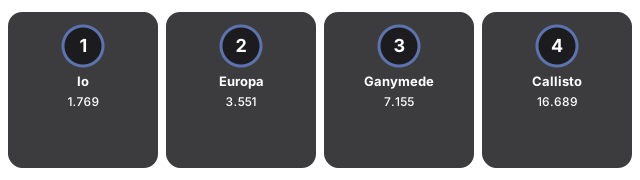
Watch Io, Europa, Ganymede, and Callisto orbit Jupiter with published periods of 1.769, 3.551, 7.155, and 16.689 Earth days - click a moon to read its NASA JPL diameter and mean distance.
Drag to orbit the view, scroll or pinch to zoom, and use Pause orbits to freeze the period ratios. The overview table lists all four moons together so you can compare the Laplace lock on the inner three against Callisto farther out.
The facts panel reports mean diameter and distance from Jupiter for each moon, plus how many Io periods fit into that moon's orbit - the near 1:2:4 pattern for Io, Europa, and Ganymede (about 4:2:1 mean motions).
- Four Galilean moons with NASA JPL periods 1.769 / 3.551 / 7.155 / 16.689 days
- Mean diameters about 3,643 / 3,122 / 5,268 / 4,821 km (Io / Europa / Ganymede / Callisto)
- Mean distances about 422,000 / 671,000 / 1,070,000 / 1,883,000 km from Jupiter
- Click each moon (or Overview table) for the facts panel readout
- Play/Pause keeps the true period ratios while you inspect spacing
- Runs fully in the browser with the vendored three.js engine - no account, no upload
Students see why textbooks call this a 4:2:1 resonance, astronomy clubs get a quick refresher before a Jupiter observing night, and curious readers meet the four moons Galileo spotted in 1610.
| Moon | Period (days) | Mean diameter (km) | Mean distance (km) |
|---|---|---|---|
| Io | 1.769 | 3,643 | 422,000 |
| Europa | 3.551 | 3,122 | 671,000 |
| Ganymede | 7.155 | 5,268 | 1,070,000 |
| Callisto | 16.689 | 4,821 | 1,883,000 |
Everything renders on your device with WebGL. The 3D engine loads once (about 0.7 MB) and is cached; no scene data is sent to a server.
The scene is an educational visualization of the four Galilean moons - it does not integrate n-body gravity, does not include Jupiter's dozens of smaller satellites, and compresses orbit radii and moon sizes so all four fit one view. The period, diameter, and distance figures in the panel are NASA JPL published values.
For a step-by-step walkthrough, read the Galilean Moons 3D Explorer step-by-step guide. When you need session fit and limits, see when to use Galilean Moons 3D Explorer. The Space 3D collection also includes the Orbital Resonance 3D Explorer and the Solar System 3D Explorer.
Frequently Asked Questions
What does the Galilean Moons 3D Explorer show?
Jupiter plus its four largest moons - Io, Europa, Ganymede, and Callisto - orbiting with published periods and diameters from NASA JPL, clickable so the facts panel fills for each moon.
What are the orbital periods?
Io 1.769 Earth days, Europa 3.551 days, Ganymede 7.155 days, and Callisto 16.689 days - the NASA JPL Galilean moons lithograph figures used throughout this page.
What is the 4:2:1 Laplace resonance?
Io, Europa, and Ganymede lock so that for every Ganymede orbit, Europa completes about two and Io about four. Callisto is farther out and is not part of that three-body lock.
Which moon is largest?
Ganymede, with a mean diameter of about 5,268 km - larger than the planet Mercury and the largest moon in the solar system. Callisto is next at about 4,821 km.
Where do the numbers come from?
NASA JPL education materials on the Galilean moons (orbital periods, mean distances, and mean radii that convert to the diameters shown). The page cites those published figures and does not invent intermediate values.
Is this an n-body gravity simulation of Jupiter's moons?
No. It is an educational visualization that places four moons on circular orbits with the published period ratios. Distances and sizes are compressed for readability; the period, diameter, and distance figures in the panel are real.