
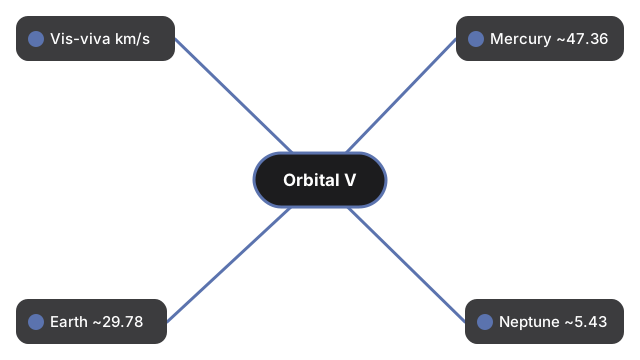
Watch orbital speed change along an eccentric ellipse with Vis-viva: faster near periapsis, slower near apoapsis. Presets show Mercury ~47.36 km/s, Earth ~29.78 km/s, and Neptune ~5.43 km/s mean speeds.
Vis-viva: v = sqrt(GM(2/r - 1/a)). Earth mean orbital speed ~29.78 km/s; Mercury ~47.36 km/s; Neptune ~5.43 km/s. On an eccentric orbit the body is fastest at periapsis and slowest at apoapsis.
Drag to orbit and scroll or pinch to zoom. Use Mercury / Earth / Neptune presets or drag the eccentricity slider; Pause freezes the orbit.
Orbital Velocity 3D Explorer
This browser explorer shows orbital speed along an eccentric ellipse - not a full n-body gravity integrator. A central star, elliptical path, animated body, yellow velocity arrow, and periapsis/apoapsis markers make Vis-viva tangible on one screen.
Vis-viva: v = sqrt(GM(2/r - 1/a)). Published mean speeds: Mercury ~47.36 km/s, Earth ~29.78 km/s, Neptune ~5.43 km/s. The body moves faster near periapsis (green) and slower near apoapsis (red).
Pick Mercury, Earth, or Neptune presets, or drag the eccentricity slider. The facts panel reports live speed in km/s and periapsis/apoapsis reference values.
- Vis-viva formula with live km/s readout along the orbit
- Mercury ~47.36 km/s, Earth ~29.78 km/s, Neptune ~5.43 km/s presets
- Eccentricity slider - faster at periapsis, slower at apoapsis
- Yellow velocity vector arrow on the orbiting body
- Green periapsis and red apoapsis markers on the ellipse
- Quantitative speed layer over kepler-orbits and escape-velocity siblings
- Runs fully in the browser with the vendored three.js engine - no account, no upload
Students compare speed at periapsis versus apoapsis; teachers demo Vis-viva without a chalkboard derivation; curious readers see why inner planets orbit faster.
| Body | Mean speed | Note |
|---|---|---|
| Mercury | ~47.36 km/s | Inner planet - faster mean orbit |
| Earth | ~29.78 km/s | Default preset ellipse |
| Neptune | ~5.43 km/s | Outer planet - slower mean orbit |
Everything renders on your device with WebGL. The 3D engine loads once (about 0.7 MB) and is cached; no scene data is sent to a server.
This is an educational Vis-viva visualization - not a full orbital propagator, live JPL ephemeris fetch, or rocket delta-v planner. When you need session fit and limits, see when to use Orbital Velocity 3D Explorer.
For a step-by-step walkthrough, read the Orbital Velocity 3D Explorer step-by-step guide. The Space 3D collection also includes Kepler Orbits 3D and Escape Velocity 3D.
Frequently Asked Questions
What does the Orbital Velocity 3D Explorer show?
Orbital speed along an eccentric ellipse using Vis-viva v = sqrt(GM(2/r - 1/a)), with live km/s readout, velocity arrow, and periapsis/apoapsis markers.
What is Earth's mean orbital speed?
About 29.78 km/s - the Earth preset uses this published mean speed as the scale for Vis-viva along its orbit.
Why is the body faster at periapsis?
Vis-viva says speed rises when r is smaller. At periapsis (nearest the star) r is minimum, so the body moves fastest; at apoapsis it is slowest.
How does this differ from Escape Velocity 3D?
Escape Velocity compares trajectory classes at one body. This page shows speed varying along a closed eccentric orbit with periapsis and apoapsis labels.
Is this a gravity integrator?
No. It is an educational Vis-viva visualization using Kepler ellipse motion - not a full n-body gravity integrator.
Which presets are available?
Mercury (~47.36 km/s), Earth (~29.78 km/s), and Neptune (~5.43 km/s) mean speeds, plus an eccentricity slider for custom ellipses.