
There is a New Moon every month, yet a solar eclipse only comes a couple of times a year. The reason is a tilt: the Moon orbit leans about 5 degrees to the ecliptic, the Sun apparent path, so most New Moons slip above or below the Sun. An eclipse needs the Moon near one of its two nodes - the points where the tilted orbit crosses the ecliptic - just as the Sun passes the same spot. Those windows, the eclipse seasons, arrive about every 173 days. Press play and watch the red zones light up.
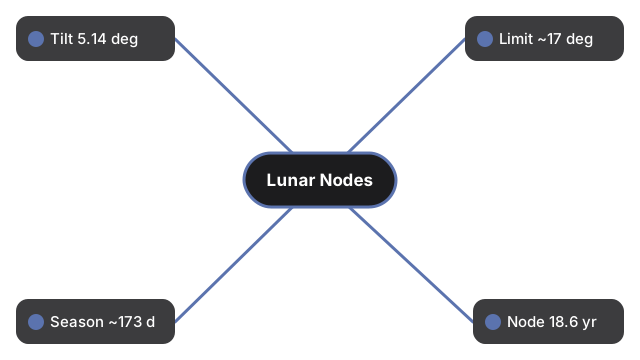
Published literacy: the Moon orbit is inclined 5.14 degrees to the ecliptic, so eclipses need a New or Full Moon within about 17 degrees of a node. The line of nodes drifts westward once around in 18.6 years, which spaces the eclipse seasons about 173 days apart - a little under half a year.
Drag to orbit and scroll or pinch to zoom. Change the speed, hide the red eclipse zones, or pause the motion.
Lunar Nodes and Eclipse Seasons 3D Explorer
If the Moon circles Earth every month and passes between us and the Sun at every New Moon, why is a solar eclipse such a rare treat? The answer is a small tilt. The Moon orbit is inclined about 5 degrees to the ecliptic - the flat plane of Earth path around the Sun - so on most months the New Moon rides a little high or a little low, and its shadow misses Earth entirely. This explorer draws that tilted orbit, marks the two nodes where it crosses the ecliptic, and lights up the eclipse seasons when an eclipse becomes possible.
An eclipse can only happen when the Moon is near a node at the same moment the Sun is there too. Because the Sun takes a year to travel the ecliptic, it lines up with the line of nodes just twice a year, opening a roughly month-long window called an eclipse season. To make things drift, the whole line of nodes slowly turns westward, completing one lap in 18.6 years; that steady regression is why the eclipse seasons come about 173 days apart rather than exactly every six months, and it feeds the famous Saros rhythm that repeats similar eclipses every 18 years and 11 days.
- Earth at the centre with the ecliptic drawn as the Sun flat path
- The Moon tilted orbit in blue, crossing the ecliptic at two marked nodes
- Ascending and descending node markers and the line of nodes through Earth
- Red eclipse-zone arcs that brighten when the Sun reaches a node
- A slow westward drift of the nodes and a speed slider to change the pace
- Runs fully in the browser with the vendored three.js engine - no account, no upload
Students see why eclipses skip most months; teachers tie the tilt and the nodes to eclipse seasons and the Saros; eclipse chasers picture the geometry behind the calendar.
| Figure | Value | Source note |
|---|---|---|
| Orbit tilt to ecliptic | 5.14 degrees | Mean inclination |
| Eclipse limit from a node | about 17 degrees | For a solar eclipse |
| Eclipse season spacing | about 173 days | Sun node to node |
| Node regression period | 18.6 years | Westward, retrograde |
Everything renders on your device with WebGL. The 3D engine loads once (about 0.7 MB) and is cached; no scene data is sent to a server.
This is an educational visualization - the 5 degree tilt is drawn steeper (about 18 degrees) and the node drift and Moon speed are sped up so the pattern shows in seconds; angles are illustrative and not to scale.
For a step-by-step walkthrough, read the Lunar Nodes and Eclipse Seasons 3D Explorer step-by-step guide. The Space 3D collection also includes Solar Eclipse 3D and Lunar Eclipse 3D.
Frequently Asked Questions
Why is there not an eclipse every month?
The Moon orbit is tilted about 5 degrees to the ecliptic, so at most New Moons the Moon passes above or below the Sun and its shadow misses Earth. An eclipse needs the Moon near a node.
What are the lunar nodes?
They are the two points where the tilted Moon orbit crosses the ecliptic. The ascending node is where the Moon moves north; the descending node is where it moves south.
What is an eclipse season?
It is the roughly month-long window when the Sun sits near a node, so a New or Full Moon can line up and eclipse. Eclipse seasons come about every 173 days, so twice a year.
How close to a node must the Moon be?
For a solar eclipse the New Moon must fall within about 17 degrees of a node. That defines the eclipse zone drawn in red around each node.
Why do eclipse seasons drift through the year?
The line of nodes slowly turns westward, one full lap in 18.6 years. That regression makes the seasons arrive about 173 days apart, a little under half a year, so they shift earlier over time.
Is this scene to scale?
No. The 5 degree tilt is drawn steeper (about 18 degrees) and the node drift and Moon speed are sped up so the pattern shows in seconds. The angles are illustrative.