
When a star strays inside a supermassive black hole tidal radius, the tide overwhelms its own gravity: it is spaghettified into a debris stream, and about half the mass falls back to form an accretion disk whose flare fades as t^-5/3.
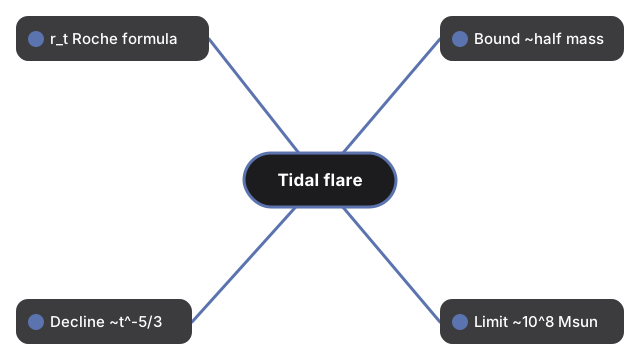
Published literacy: the tidal radius is r_t = R_star x (M_BH / M_star)^(1/3); about half the star mass stays bound and accretes while about half is ejected; the flare declines as t^-5/3; a Sun-like star is swallowed whole above a black-hole mass of roughly 10^8 solar masses.
Drag to orbit and scroll or pinch to zoom. Pause the animation or toggle the tidal-radius ring.
Tidal Disruption Event 3D Explorer
A tidal disruption event happens when a star wanders too close to a supermassive black hole. Inside the tidal radius - where the black hole tide exceeds the star own gravity - the star is stretched and torn apart, a process nicknamed spaghettification. This explorer animates the whole sequence: approach, disruption into a debris stream, fallback, and the fading flare.
The tidal radius is r_t = R_star x (M_BH / M_star)^(1/3). After disruption, about half the stellar debris stays gravitationally bound and returns to form a hot accretion disk, while about half is flung away (Martin Rees, 1988). The returning material powers a bright flare whose luminosity declines roughly as t^-5/3 over months to years. There is an upper limit: for a Sun-like star, if the black hole is more massive than about 10^8 solar masses, the tidal radius shrinks inside the event horizon and the star is swallowed whole with no visible flare.
- Animated sequence: approach, spaghettification, fallback disk, and t^-5/3 fade
- Tidal-radius ring you can toggle - the star holds together outside it, tears apart inside
- An accretion disk that brightens with the flare and then fades
- Facts panel with the tidal-radius formula, the half-bound rule, and the 10^8 solar-mass limit
- Runs fully in the browser with the vendored three.js engine - no account, no upload
Students see why only some stars near black holes produce flares; teachers connect the tidal radius to the black-hole and stellar masses; curious readers meet a real, observed phenomenon (the nearest example, AT2019qiz, involved a black hole about a million times the mass of the Sun).
| Figure | Value | Source note |
|---|---|---|
| Tidal radius | r_t = R_star x (M_BH / M_star)^(1/3) | Standard tidal-radius relation |
| Bound fraction | about half the star mass | Rees 1988 |
| Flare decline | proportional to t^-5/3 | Full disruption (t^-9/4 if a core survives) |
| Swallowed-whole limit | ~10^8 solar masses | For a Sun-like star |
Everything renders on your device with WebGL. The 3D engine loads once (about 0.7 MB) and is cached; no scene data is sent to a server.
This is an educational visualization - sizes are illustrative and the months-to-years timeline is compressed to a few seconds so the sequence is watchable.
For a step-by-step walkthrough, read the Tidal Disruption Event 3D Explorer step-by-step guide. The Space 3D collection also includes Black Hole 3D and Roche Limit 3D.
Frequently Asked Questions
What is a tidal disruption event?
It is what happens when a star passes so close to a supermassive black hole that the black hole tide tears it apart. The star is spaghettified into a debris stream, and about half of it falls back to form a bright, fading accretion flare.
What is spaghettification?
It is the stretching of an object by a strong tidal force - the near side is pulled much harder than the far side, drawing the star out into a long thin stream.
What is the tidal radius?
The distance r_t = R_star x (M_BH / M_star)^(1/3) inside which the black hole tide overcomes the star own gravity. Outside it the star holds together; inside it the star is disrupted.
Why does the flare fade as t^-5/3?
After disruption, the bound debris returns at a rate set by orbital mechanics, which declines as t^-5/3 for a full disruption. The accretion flare tracks that fallback rate, so it fades the same way.
Can any black hole make a visible flare?
No. The tidal radius must lie outside the event horizon. For a Sun-like star, black holes above about 100 million solar masses swallow the star whole, with no visible disruption.
Is this a real observed thing?
Yes. Tidal disruption events are observed as bright flares from galaxy centers. AT2019qiz is the nearest one found, around a black hole about a million times the mass of the Sun.