
Phobos is Mars's larger moon - only about 27 by 22 by 18 kilometers across - yet nearly half of one face is carved by Stickney, a crater about 9 kilometers wide. Press play to spin the potato-shaped moon, highlight the Stickney bowl, and toggle the groove network that streaks across the surface.
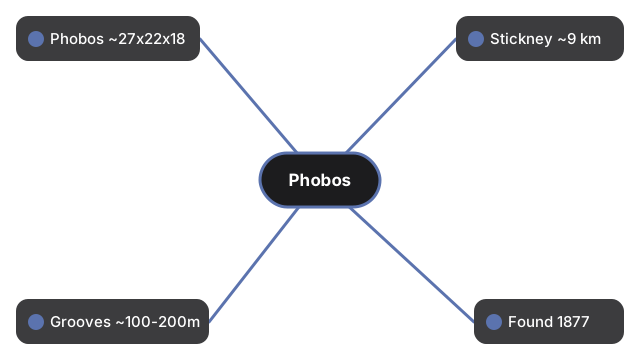
Published figures: Phobos ~27 x 22 x 18 km; Stickney ~9 km across; grooves typically 100-200 m wide and ~20 m deep; discovered 1877 by Asaph Hall (NASA / LPI).
Drag to orbit and scroll or pinch to zoom. Press Play or toggle Grooves.
Phobos Stickney Crater 3D Explorer
Phobos is the larger of Mars's two moons: an irregular body about 27 by 22 by 18 kilometers across that races around the planet three times each Martian day. Its most famous scar is Stickney crater - roughly 9 kilometers wide - named for Chloe Angeline Stickney Hall, mathematician and wife of Asaph Hall, who discovered both Martian moons in 1877. Stickney takes up a huge fraction of one face; Mars Global Surveyor later showed fine dust and landslide textures on its walls.
Across Phobos runs a network of grooves and crater chains, typically 100 to 200 meters wide and about 20 meters deep. Early ideas linked them to Stickney's impact stresses; later work also points to ejecta from Mars impacts or tidal stretching. This explorer does not pick a single origin story - it shows the crater bowl and a schematic groove network so you can see the scale relationship.
- Potato-shaped Phobos with a giant Stickney crater bowl
- Toggleable groove streaks across the surface
- Mars in the background for orbital context
- Speed slider and Play/Pause rotation
- Runs fully in the browser with the vendored three.js engine - no account, no upload
Anyone comparing tiny moons to giant impacts gets a concrete sense of how large Stickney is relative to Phobos itself.
| Figure | Value | Source note |
|---|---|---|
| Phobos size | ~27 x 22 x 18 km | NASA Mars moons page |
| Stickney diameter | ~9 km | NASA (also cited ~9.7 km) |
| Groove width / depth | ~100-200 m / ~20 m | LPI / Mars Express era summaries |
| Discovery | 1877 | Asaph Hall |
| Orbital cadence | ~3 orbits per Mars day | NASA |
| Orbit decay note | ~1.8 m closer per 100 years | NASA in-depth |
Everything renders on your device with WebGL. The 3D engine loads once (about 0.7 MB) and is cached; no scene data is sent to a server.
This is an educational visualization - Phobos is smoothed into an ellipsoid, Stickney is a schematic bowl, and grooves are exaggerated lines rather than meter-accurate topography. Groove origin remains debated in the literature.
For a step-by-step walkthrough, read the Phobos Stickney Crater 3D Explorer step-by-step guide. The Space 3D collection also includes Mars Terrain 3D Explorer and Tidal Locking 3D Explorer for related Mars-system context.
Frequently Asked Questions
How big is Stickney compared with Phobos?
Stickney is about 9 kilometers across on a moon only about 27 by 22 by 18 kilometers, so the crater spans a large fraction of one face.
Who was Stickney named for?
Chloe Angeline Stickney Hall, mathematician and wife of Asaph Hall, who discovered Phobos and Deimos in 1877.
What are the grooves?
Long troughs and crater chains typically 100-200 meters wide and about 20 meters deep. Hypotheses include Stickney impact stress, ejecta from Mars impacts, and tidal forces - this page does not pick one.
Is Phobos falling toward Mars?
Yes, slowly - NASA cites roughly 1.8 meters closer every hundred years; in tens of millions of years it may hit Mars or break into a ring.
Is the shape exact?
No. The real body is more irregular; the scene uses a smooth ellipsoid so Stickney and the grooves stay readable.
Does this include Deimos?
No. This explorer focuses on Phobos and Stickney only.
Is this a physics simulation?
No. It is an educational visualization with compressed scales and schematic grooves, not an impact or tidal solver.