
The Moon is tidally locked, keeping one face toward Earth - yet we see about 59% of its surface over time. Two slow wobbles, libration in longitude (+-7.9 deg) and latitude (+-6.7 deg), let us peek around its edges.
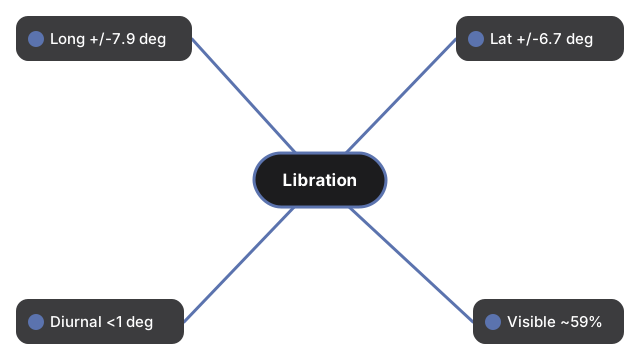
Published literacy: libration in longitude +-7.9 deg (from the elliptical orbit), libration in latitude +-6.7 deg (from axial tilt), diurnal libration under 1 deg; together they reveal about 59% of the Moon over time even though it is tidally locked.
Drag to orbit and scroll or pinch to zoom. Pause the wobble, exaggerate it 5x, or toggle the libration zone near the limb.
Moon Libration 3D Explorer
The Moon is tidally locked to Earth: it rotates once for each orbit, so it keeps the same near side facing us. You might expect that to mean we only ever see 50% of its surface - but we actually see about 59% over time, thanks to two slow wobbles called libration. This explorer shows them with a blue sub-Earth marker whose drift off-centre is the libration itself.
Libration in longitude (an east-west wobble of about 7.9 degrees) happens because the Moon orbit is elliptical: it moves faster near perigee and slower near apogee, while its spin stays steady, so its face rocks east and west. Libration in latitude (a north-south nod of about 6.7 degrees) happens because the Moon axis is tilted relative to its orbit, so we peek over its north pole and later under its south pole. A smaller diurnal libration (under 1 degree) comes from Earth own rotation carrying us to different vantage points.
- A wobbling Moon with a lat/long grid and dark maria so the motion is clear
- Blue sub-Earth marker: its drift off-centre is the libration
- Pause the wobble, exaggerate it 5x, or highlight the libration zone near the limb
- Facts panel lists the longitude, latitude, and diurnal amplitudes and the 59% figure
- Runs fully in the browser with the vendored three.js engine - no account, no upload
Students see why tidal locking does not mean a fixed view; teachers separate the longitude, latitude, and diurnal contributions; curious readers learn how we mapped 59% of the Moon from Earth long before spacecraft saw the far side.
| Figure | Value | Source note |
|---|---|---|
| Libration in longitude | +-7.9 deg | Elliptical orbit (e about 0.055) |
| Libration in latitude | +-6.7 deg | Axial tilt of the Moon |
| Diurnal libration | under 1 deg | Earth rotation / parallax |
| Surface visible over time | about 59% | Versus 50% if perfectly locked |
Everything renders on your device with WebGL. The 3D engine loads once (about 0.7 MB) and is cached; no scene data is sent to a server.
This is an educational visualization - the wobble is time-compressed (and optionally exaggerated 5x) so it is watchable, and the surface features are illustrative markers, not a real lunar map.
For a step-by-step walkthrough, read the Moon Libration 3D Explorer step-by-step guide. The Space 3D collection also includes Moon Phases 3D, Tidal Locking 3D, and Lunar South Pole Ice 3D - the same roughly 1.54-degree axial tilt driving this page's 6.7-degree latitude libration is also why Shackleton crater's floor there stays in permanent shadow.
Frequently Asked Questions
What is lunar libration?
It is the slight wobbling of the Moon as seen from Earth - an east-west rock and a north-south nod - that lets us see around its edges. Over time it reveals about 59% of the Moon surface even though it is tidally locked.
Why do we see more than half the Moon?
Because of libration. Libration in longitude (about 7.9 degrees) comes from the Moon elliptical orbit, and libration in latitude (about 6.7 degrees) comes from its axial tilt. Together they let us peek past the limbs.
Is the Moon not tidally locked then?
It is tidally locked - it rotates once per orbit and keeps the same near side toward Earth. Libration is not a break in that lock; it is a change in our viewing angle plus the uneven orbital speed.
What is the blue dot in the scene?
It is the sub-Earth point - the spot that faces Earth when libration is zero. As the Moon wobbles, the dot drifts off-centre, and that drift is exactly the libration you are seeing.
What is diurnal libration?
A smaller wobble, under 1 degree, caused by Earth own rotation carrying you from one side of Earth to the other during a night, changing your vantage point on the Moon.
Is the wobble shown at real speed?
No. Real libration plays out over a month. This scene compresses it to a few seconds, and offers a 5x exaggeration toggle, so the motion is easy to see.