
In 2011 astronomers confirmed a planet that orbits not one star, but two - the first real-life echo of Luke Skywalker's fictional Tatooine. Kepler-16b circles a pair of stars that orbit each other every 41 days, while the planet itself takes 228.8 days to loop around both. Press play to watch the orange and red stars swing around their shared center while the tan planet orbits farther out, then turn on Orbits to see the paths traced out.
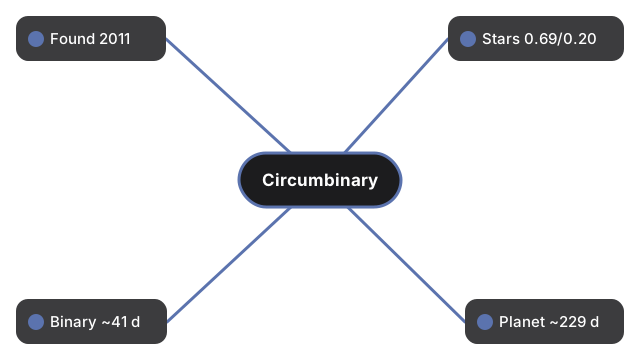
Published figures: Kepler-16b orbits its two stars every 228.8 days at 0.70 AU, about the distance Venus orbits the Sun. The two stars, about 0.69 and 0.20 solar masses, orbit each other every 41 days, roughly 0.23 AU apart.
Drag to orbit and scroll or pinch to zoom. Change the speed, toggle Orbits, or pause the motion.
Circumbinary Planet 3D Explorer
In September 2011, NASA's Kepler space telescope confirmed something science fiction had imagined but nature had never definitively shown: a planet orbiting two stars at once. The planet, Kepler-16b, quickly earned the nickname "Tatooine" after Luke Skywalker's twin-sunned home world in Star Wars, though the real planet is a cold gas giant rather than a desert world. It lies roughly 200 to 245 light-years away, and its discovery was unusually precise - the planet's radius is known to within about 0.3 percent, tighter than most planets beyond our solar system.
The Kepler-16 system has three moving parts, all orbiting nearly in the same flat plane. Two stars - a K-type dwarf about 69 percent the Sun's mass and a much smaller red dwarf about 20 percent the Sun's mass - circle their shared center of mass every 41 days on a noticeably eccentric orbit, about 0.23 AU apart on average. Farther out, the planet itself, about three-quarters Jupiter's radius and a third of its mass, similar in size to Saturn, completes a much wider, nearly circular orbit around that same center every 228.8 days, roughly the distance Venus keeps from the Sun. Kepler found the system by catching the planet crossing in front of both stars in turn, on top of the two stars already eclipsing each other - an unusually rich set of overlapping signals that let astronomers pin down every mass and size with rare precision.
- Two stars, a K dwarf and a smaller red dwarf, orbiting their shared center every 41 days
- A Saturn-sized planet circling both stars every 228.8 days
- An Orbits toggle that traces out all three real orbital paths
- A speed slider and Play and Pause control over the motion
- Runs fully in the browser with the vendored three.js engine - no account, no upload
Science-fiction fans get to compare the real system to the movie; students see how three-body orbital mechanics can still be stable and nearly flat; anyone who has heard the word "Tatooine" in the news can see the actual planet behind the headline.
| Figure | Value | Source note |
|---|---|---|
| Discovered | 2011 | NASA Kepler space telescope |
| Star masses | about 0.69 and 0.20 solar masses | Doyle et al. 2011, Science |
| Binary orbit | about 41 days, 0.23 AU apart | Eccentric, e is about 0.16 |
| Planet orbit | 228.776 days, 0.7048 AU | Nearly circular, e is about 0.007 |
| Planet size and mass | 0.75 Jupiter radii, 0.33 Jupiter masses | Comparable to Saturn |
Everything renders on your device with WebGL. The 3D engine loads once (about 0.7 MB) and is cached; no scene data is sent to a server.
This is an educational visualization, not a real ephemeris - star and planet sizes are enlarged relative to their orbits for visibility, and the motion is heavily sped up; the real system is not to scale here, and Kepler-16b is a gas giant with no solid surface, unlike its fictional desert-world namesake.
For a step-by-step walkthrough, read the Circumbinary Planet 3D Explorer step-by-step guide. The Space 3D collection also includes Binary Star System 3D and Exoplanet Transit 3D, which cover a simple two-star pair and the detection method on a single star.
Frequently Asked Questions
What is a circumbinary planet?
A planet that orbits both stars of a binary system at once, rather than orbiting just one of them.
Is Kepler-16b really like Tatooine?
It really does orbit two stars, but it is a cold gas giant with no solid surface, unlike the fictional desert world - so there is no ground to stand on and watch the double sunset.
How was Kepler-16b discovered?
NASA's Kepler space telescope, confirmed in 2011, caught the planet transiting both stars in turn on top of the two stars already eclipsing each other, giving unusually precise measurements of every body's size and mass.
How far apart are the two stars?
About 0.23 AU on average, orbiting each other every 41 days on a noticeably eccentric path.
How far out does the planet orbit?
About 0.70 AU from the stars' shared center of mass, completing one orbit every 228.8 days, similar to Venus's distance from the Sun.
How big is Kepler-16b?
About three-quarters of Jupiter's radius and a third of its mass, making it comparable in size to Saturn.
Is this scene to scale?
No. Star and planet sizes are enlarged relative to their orbits for visibility, and the motion is heavily sped up.