
Drag the time slider (or press Play) to scrub through the S2 star's real 16-year orbit around Sagittarius A*, the black hole at the center of the Milky Way - watch S2 whip through its closest approach in seconds of screen time and read the published figures that let astronomers weigh the black hole directly.
Near pericenter, S2 covers hundreds of AU in a few seconds of screen time; near apocenter, it barely seems to move - the same real physics (Kepler's second law: equal areas in equal times) that lets the closest-approach speed reach about 2.5-3% of the speed of light.
Drag to orbit and scroll or pinch to zoom. Drag the slider or press Play to move S2 along its real ellipse and watch the facts panel update.
Related orbit and gravity explorers: Black Hole 3D Explorer (the artistic render of the black hole itself), Kepler Orbits 3D Explorer (why any orbit is an ellipse in the first place), and Gravitational Redshift 3D Explorer (a relativistic effect GRAVITY also measured on S2). Walk the step-by-step guide.
Sagittarius A* Star Orbit 3D Explorer
freetoolonline.com editorial team
This explorer renders the S2 star's real, measured orbit around Sagittarius A*, the black hole at the Milky Way's center - the same orbit astronomers used to weigh the black hole directly from Kepler's laws, independent of any assumption that it is actually a black hole.
The Black Hole 3D Explorer renders the black hole itself, artistically. This page renders the orbital proof of its mass instead: S2 sweeps through a 16.05-year ellipse so eccentric that its speed at closest approach reaches roughly 2.5-3% of the speed of light, then crawls near its farthest point - Kepler's second law made visible on a real, measured orbit rather than a teaching example.
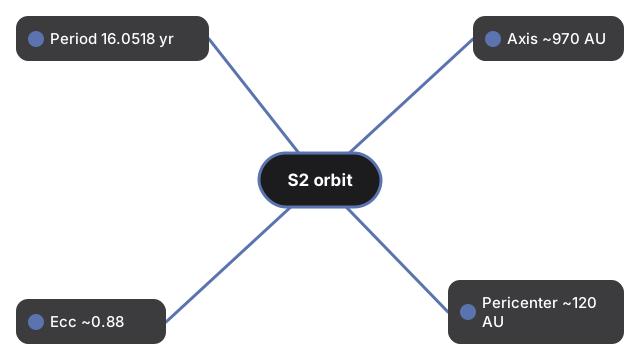
- S2's real orbital ellipse (semi-major axis 970 AU, eccentricity ~0.88, period 16.0518 years) built from its actual published orbital elements
- Time-scrub slider sets S2's position anywhere in the 16-year orbit; Play auto-advances it (about 1 second on screen per year, disclosed)
- Facts panel shows the current phase and distance from Sagittarius A*, plus the anchoring published figures
- Sagittarius A* sits at the ellipse's real focus, not its center - the same geometry that let the GRAVITY Collaboration measure the black hole's mass
- Runs in-browser with three.js - no account, no upload
Scrub to pericenter and the star's marker visibly accelerates through the closest few AU of the pass; scrub to apocenter and it barely creeps - exactly the tradeoff Kepler's second law predicts for an orbit this elongated, and exactly why the 2018 pericenter passage was the observation astronomers had waited 16 years to catch.
| Quantity | Published value |
|---|---|
| Orbital period | 16.0518 years |
| Semi-major axis | ~970 AU |
| Eccentricity | ~0.88 |
| Pericenter distance | ~120 AU (~17 light-hours) |
| Pericenter speed | ~7,650-7,700 km/s (~2.5-3% of light speed) |
| Sagittarius A* mass (from this orbit) | ~4.3 x 10^6 solar masses |
| Distance to the Galactic Center | ~8.3 kpc (~27,000 light-years) |
| Most recent / next pericenter passage | May 2018 / 2034 |
This is an educational visualization of a real, published orbit - not a live tracker of S2's actual current position, and not a general-relativity simulator. S2's real orbit also shows a small relativistic precession per pass (the Schwarzschild precession GRAVITY detected) that this scene does not render; only the plain Newtonian ellipse is shown. Sagittarius A* and S2 are both drawn far larger than their real size so they stay visible - the true black hole and star are both far too small to see next to an orbit hundreds of AU wide.
Renders on-device with WebGL - loads once (about 0.7 MB), cached by the browser, no data sent to a server.
Sagittarius A* itself emits no visible light and cannot be observed directly with ordinary telescopes, which is exactly why the mass measurement has to come from watching something that orbits it. S2 was chosen because its orbit is short enough (16 years, versus centuries for most stars near the center) to track through a full pericenter passage within one human career, making it the star that first pinned down the black hole's mass and distance with high precision.
For the walkthrough, see the step-by-step guide. The Space 3D collection also includes Black Hole 3D Explorer and Kepler Orbits 3D Explorer.
Frequently Asked Questions
What does the Sagittarius A* Star Orbit 3D Explorer show?
The S2 star's real, published 16.05-year orbit around Sagittarius A*, the black hole at the Milky Way's center. Drag the time slider or press Play to move S2 along its real ellipse and read the published figures in the facts panel.
How is this different from the Black Hole 3D Explorer?
Black Hole 3D Explorer renders the black hole itself, artistically. This page renders the orbital proof of its mass instead - a real star's measured path around it, which is how astronomers actually weighed the black hole.
How did astronomers measure the mass of something they cannot see?
By tracking S2's position year after year and fitting its path to Kepler's laws. A star's orbital period and size depend only on the mass it is orbiting, so a precise orbit gives a precise mass - about 4.3 million times the mass of the Sun - without ever needing to see the black hole directly.
Why does S2 speed up so much near Sagittarius A*?
S2's orbit is highly elongated (eccentricity ~0.88), so its distance from Sagittarius A* varies enormously. Kepler's second law - equal areas swept in equal times - means it must move fastest where it is closest, reaching about 2.5-3% of the speed of light at its ~120 AU closest approach.
Is this a real-time tracker of where S2 actually is right now?
No. The scene is driven by the time slider or the Play button, not by S2's real current position. It renders S2's real, published orbital shape and period, not a live feed.
Does this scene include general relativity effects?
No. It renders the plain Newtonian ellipse from S2's published orbital elements. S2's real orbit also shows a small relativistic precession per pass (the Schwarzschild precession the GRAVITY Collaboration detected), which this scene does not render.
Is Sagittarius A* drawn to scale?
No. A real supermassive black hole and a real star are both far too small to see next to an orbit hundreds of AU wide, so both markers are enlarged for visibility - disclosed in the facts panel and the page text above.