
On 15 August 1977, the Big Ear radio telescope in Ohio picked up a strong burst of radio energy near the frequency hydrogen atoms naturally emit. It rose and fell over 72 seconds, exactly the shape expected of something fixed on the sky drifting through the telescope's beam. Astronomer Jerry Ehman circled six readings on the printout the next morning and wrote "Wow!" beside them - and despite decades of searching, it has never been seen again. Press play to watch the real recorded intensity rise and fall for yourself.
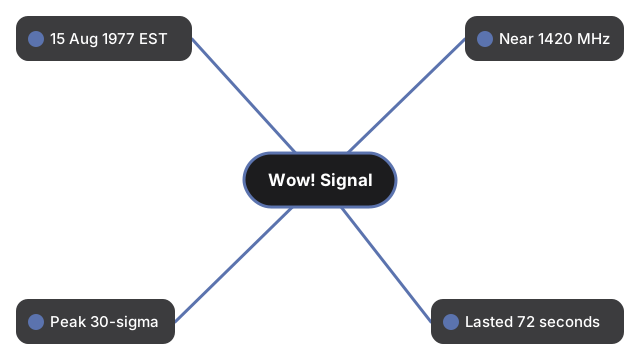
Published figures: detected 15 August 1977 at 22:16 EST near 1420 MHz (the hydrogen line), peaking at 30-sigma over a 72-second window. The recorded code, "6EQUJ5," decodes to real intensity values 6, 14, 26, 30, 19, and 5.
Drag to orbit and scroll or pinch to zoom. Press Play or change the speed to watch the code build.
Wow! Signal 3D Explorer
On the night of 15 August 1977, at 22:16 EST, Ohio State University's Big Ear radio telescope was running a routine sky survey for the Search for Extraterrestrial Intelligence, or SETI, when it recorded something unusual: a strong, narrowband burst of radio energy near 1420 MHz - the frequency hydrogen atoms naturally emit, and a band internationally protected specifically for this kind of listening. The signal lasted the full 72 seconds Big Ear could observe any point in the sky, rising for the first half and fading for the second - precisely the shape expected of a real, fixed source in the sky drifting through the telescope's beam as the Earth turned underneath it.
Nobody noticed until the next morning, when astronomer Jerry Ehman sat down to review the previous day's printouts. Six consecutive readings caught his eye - so unusual that he circled them and wrote "Wow!" in red ink beside them. Those six characters, "6EQUJ5," recorded on a real intensity scale, decode to the numbers 6, 14, 26, 30, 19, and 5 - a signal that peaked at 30 times the background noise. In the six weeks that followed, that patch of sky was checked more than 30 times. It has been checked many times since. The signal has never returned, and to this day, no explanation - natural or artificial - has been confirmed.
- The real recorded "6EQUJ5" intensity code, building up live as you watch
- A simplified Big Ear telescope with its fixed beam, and a source drifting through it as Earth turns
- A live readout of the exact intensity value at every moment
- A speed slider and Play/Pause over the full 72-second sequence
- Runs fully in the browser with the vendored three.js engine - no account, no upload
Anyone who has heard of the Wow! signal gets to see the actual recorded numbers behind the legend; students get a concrete example of how a telescope's fixed beam and Earth's rotation combine to produce a very specific, predictable signal shape - one the real data matched closely.
| Figure | Value | Source note |
|---|---|---|
| Date | 15 August 1977, 22:16 EST | Big Ear, Ohio State University |
| Frequency | near 1420 MHz | The hydrogen line |
| Peak strength | 30-sigma | 30 times the background noise |
| Duration | 72 seconds | The telescope's full observing window |
| Recorded code | 6EQUJ5 | Decodes to 6, 14, 26, 30, 19, 5 |
| Repeated since? | never | Despite 30+ follow-up searches within six weeks |
Everything renders on your device with WebGL. The 3D engine loads once (about 0.7 MB) and is cached; no scene data is sent to a server.
This is an educational visualization, not a radio-telescope simulation - the dish, beam, and source are simplified and enlarged for visibility. Recent research increasingly favors a rare natural cause, such as a hydrogen maser flare, over an artificial signal - the case remains genuinely open, not a confirmed message from elsewhere.
For a step-by-step walkthrough, read the Wow! Signal 3D Explorer step-by-step guide. The Space 3D collection also includes Tabby's Star 3D Explorer and 'Oumuamua 3D Explorer, two more real cases where speculation and evidence diverged.
Frequently Asked Questions
What was the Wow! signal?
A strong, narrowband radio burst recorded by the Big Ear telescope in Ohio on 15 August 1977, during a SETI sky survey.
Why is it called the Wow! signal?
Astronomer Jerry Ehman circled six unusual readings on the printout and wrote "Wow!" beside them in red ink.
What does "6EQUJ5" mean?
It is the real recorded intensity code for the signal, on a scale where letters represent higher values than digits. Decoded, it reads 6, 14, 26, 30, 19, 5.
Was it aliens?
Not confirmed. Recent research increasingly favors a rare natural cause, such as a hydrogen maser flare, though the case remains genuinely open.
Has the signal ever repeated?
No. Despite more than 30 follow-up observations within six weeks, and many more since, it has never been seen again.
Why did the signal rise and fall over 72 seconds?
Big Ear could not track a point in the sky - it held a fixed position while Earth's rotation carried the sky past its beam, producing exactly this shape for a genuine fixed source.
Is this scene to scale?
No. The dish, beam, and source are simplified and enlarged for visibility, not a precise recreation of the real telescope or sky geometry.