
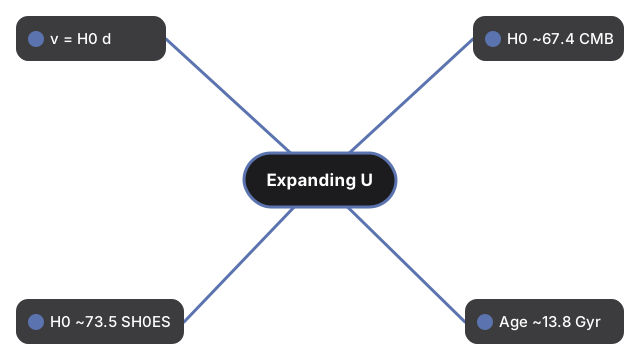
Watch the expanding universe as a stretching grid of galaxy markers, with real Hubble Law literacy: v = H0 d, H0 about 67.4 to 73.5 km/s/Mpc (the Hubble tension), age about 13.8 billion years.
Published literacy: Hubble Law v = H0 d; H0 ~67.4 km/s/Mpc (Planck CMB) to ~73.5 km/s/Mpc (SH0ES distance ladder); age of the universe ~13.8 billion years (Planck).
Drag to orbit and scroll or pinch to zoom. Play or Pause the stretch, Reset the grid, or toggle recession vectors.
Expanding Universe 3D Explorer
freetoolonline.com editorial team
This browser explorer shows the expanding universe as a uniformly stretching grid of galaxy markers, with real Hubble Law literacy: v = H0 d, H0 about 67.4 km/s/Mpc (Planck CMB, early-universe) to about 73.5 km/s/Mpc (SH0ES distance ladder, late-universe) - the Hubble tension - and an age of about 13.8 billion years.
Redshift Doppler 3D teaches one light source wavelength-shifting as it moves through space. This page teaches the opposite mechanism: space itself stretches, so every marker recedes from every other marker with speed proportional to distance - no motion through space is required.
- A 3D grid of galaxy markers that stretches uniformly over time
- Near (blue) and far (orange) sample markers with live recession speed readouts
- Recession vectors from the observer to sample markers
- Facts panel lists the Hubble Law formula, the H0 tension range, and the age of the universe
- Distinct from redshift-doppler (single-source Doppler shift) and cosmic-distance-ladder (names Cepheids and parallax rungs)
- Runs fully in the browser with the vendored three.js engine - no account, no upload
Students see why farther markers move faster without invoking Doppler motion; teachers connect the grid-stretch analogy to Hubble Law; curious readers learn there is a real, unresolved tension between two ways of measuring H0.
| Figure | Value | Source note |
|---|---|---|
| Hubble Law formula | v = H0 d | Recession speed proportional to distance |
| H0 (Planck CMB) | ~67.4 km/s/Mpc | Early-universe measurement |
| H0 (SH0ES distance ladder) | ~73.5 km/s/Mpc | Late-universe measurement, the Hubble tension |
| Age of the universe | ~13.8 billion years | Planck 2018 |
Everything renders on your device with WebGL. The 3D engine loads once (about 0.7 MB) and is cached; no scene data is sent to a server.
This is an educational grid-stretch schematic - not a Friedmann-equation solver and not a single-source Doppler shift. Distances and speeds are compressed for legibility.
For a step-by-step walkthrough, read the Expanding Universe 3D Explorer step-by-step guide. The Space 3D collection also includes Redshift Doppler 3D and Cosmic Distance Ladder 3D.
Frequently Asked Questions
What does the Expanding Universe 3D Explorer show?
A 3D grid of galaxy markers stretching uniformly, with a live facts panel computing recession speed via the Hubble Law v = H0 d. Far markers move faster than near ones.
How is this different from Redshift Doppler 3D?
Redshift Doppler 3D teaches one light source wavelength-shifting as it moves through space. This page teaches space itself stretching, so every marker recedes from every other without motion through space.
How is this different from Cosmic Distance Ladder 3D?
Cosmic Distance Ladder 3D scrubs a log-scale AU-to-parsec ladder and names Cepheids as one rung. This page focuses on the expansion mechanism and the Hubble Law itself.
What is the Hubble tension?
A real, unresolved discrepancy between two ways of measuring H0: about 67.4 km/s/Mpc from the early-universe Planck CMB, and about 73.5 km/s/Mpc from the late-universe distance ladder.
Is this a Friedmann-equation simulator?
No. It is an educational grid-stretch schematic - not a full cosmological expansion-history solver.
How old is the universe?
About 13.8 billion years, per the Planck 2018 estimate.