
See why Mars appears to loop on the sky - Earth overtakes on the inside track, the yellow line of sight sweeps, and the panel lists Mars synodic period about 779.9 d with a typical retrograde arc near 72 d every ~26 months.
Play walks Earth past Mars so the line of sight reverses against the sky trail for a stretch; pause near opposition to read the synodic and arc figures.
Mars synodic period is about 779.9 days (~26 months). A typical retrograde arc lasts about 72 days. Mars never reverses around the Sun - only the Earth-based sky track loops. This is an educational geometry visualization, not a precision ephemeris.
Retrograde Motion 3D Explorer
Mars appears to loop on the sky when Earth overtakes on a faster inside orbit - the yellow line of sight sweeps, the sky trail draws the loop near opposition, and the facts panel lists Mars synodic period about 779.9 d (~26 months) with a typical retrograde arc about 72 d.
Drag to orbit the view, scroll or pinch to zoom, and press Play. Toggle Sky trail and Line of sight, jump Near opposition, and scrub Day across one synodic cycle. The Retrograde / Direct badge follows finite-difference sky elongation.
- Sun + Earth + Mars on compressed coplanar orbits
- Yellow Earth-to-Mars line of sight
- Sky trail showing the apparent loop shape
- Play / Pause, Near opposition jump, day scrub
- Published synodic and arc figures in the facts panel
- Runs fully in the browser with the vendored three.js engine - renders on your device with WebGL, no account, no upload; the engine loads once (about 0.7 MB) and is then cached, and no scene data is sent to a server
Reading the scene in three steps
Find the two worlds by color, jump to opposition with the sky trail on, then scrub Day across the synodic cycle to watch direct motion return.
- Find the overtakes: Earth is the blue inner world, Mars the red outer one, and the yellow line is the Earth-to-Mars line of sight.
- Click Near opposition and leave Sky trail on, so the purple path draws the loop stretch while the badge flips to Retrograde.
- Drag Day across hundreds of days to see direct motion return. Fullscreen targets the scene wrapper, so the controls stay visible while you orbit the view.
Teachers use it to demystify retrograde as a viewpoint effect, and students scrub through opposition to catch the reverse stretch.
| Quantity | Value | Source |
|---|---|---|
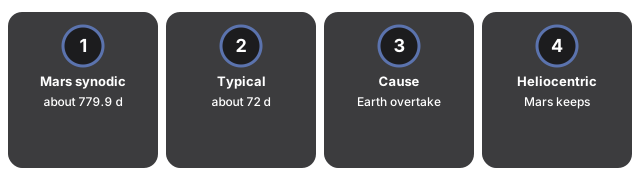
| Mars synodic period | about 779.9 d (~26 months) | Planetary ephemeris / textbooks |
| Typical retrograde arc | about 72 d | Order-of-magnitude teaching value |
| Cause | Earth overtakes on a faster inside orbit | Standard astronomy literacy |
| Heliocentric truth | Mars keeps direct solar orbit | Keplerian outer planet |
Retrograde Motion 3D Explorer next to the usual alternatives
Learning why Mars loops on the sky takes one page load here: 0 MB installed, USD 0, no account.
| Aspect | Retrograde Motion 3D Explorer | Typical alternative |
|---|---|---|
| Install size | 0 MB - runs in the browser | App or textbook install varies |
| Price | USD 0 | Often paid or account-gated |
| Time to first view | Seconds - one page load | Minutes to set up offline tools |
Solar System 3D Explorer is a heliocentric neighborhood tour of all the planets; Retrograde Motion 3D Explorer isolates the viewpoint illusion that a quiet top-down planet parade hides. A textbook prints one static zig-zag, while this page adds play, line of sight, and a live sky trail in a browser-only 3D view. Kepler Orbits 3D Explorer teaches the ellipse laws rather than Earth-Mars overtakes.
The scene is an educational visualization of relative geometry - orbit sizes and trail angles are compressed. It is not a precision ephemeris, not a dated opposition calendar, not a constellation chart for tonight, and not an N-body gravity model.
For session fit and limits, see when to use Retrograde Motion 3D Explorer, or browse the full Space 3D collection.
Frequently Asked Questions
What does Retrograde Motion 3D Explorer show?
Earth and Mars orbiting the Sun with a line of sight and sky trail that reveal why Mars appears to loop near opposition, plus synodic ~779.9 d and arc ~72 d figures.
How is this different from Solar System 3D Explorer?
Solar System 3D Explorer shows all planets orbiting. Retrograde Motion 3D Explorer focuses on the Earth-Mars overtakes that create the sky-path illusion a top-down planet tour often hides.
Does Mars really reverse around the Sun?
No. Mars keeps a direct heliocentric orbit. Only the Earth-based sky track goes retrograde for a stretch near opposition.
What is the Mars synodic period?
About 779.9 days (~26 months) - how long it takes successive oppositions (or conjunctions) to repeat for Earth and Mars.
How long does a typical retrograde arc last?
About 72 days as an order-of-magnitude teaching value shown in the facts table - real arcs vary slightly by opposition geometry.
Is this an ephemeris for tonight's sky?
No. The scene is an educational geometry visualization with compressed orbits. It does not predict dated sky positions.