
Inside a dying massive star, elements are forged in concentric onion shells - hydrogen on the outside down to an inert iron core. Each inner shell is hotter and burns faster, until fusion stops at iron-56, the peak of binding energy.
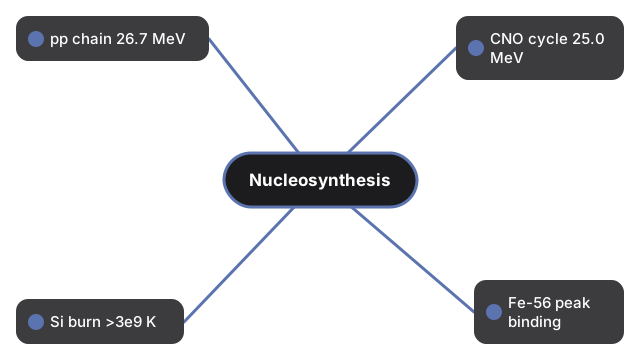
Published literacy: hydrogen burning releases 26.7 MeV (proton-proton chain) or 25.0 MeV (CNO cycle) per helium nucleus; silicon burning needs above 3 billion K and makes iron-group nuclei; iron-56 is the peak of nuclear binding energy, so fusion stops and the core collapses.
Drag to orbit and scroll or pinch to zoom. Click any shell for its reaction and temperature, jump to the iron core, or pause the spin.
Stellar Nucleosynthesis 3D Explorer
This browser explorer is a cutaway of a massive star near the end of its life, showing the onion-shell structure where the elements are forged. From the surface inward the star burns heavier and heavier fuels in concentric shells: a hydrogen envelope, then helium, carbon, neon, oxygen, silicon, and finally an inert iron core. Click any shell to read its fusion reaction and ignition temperature.
Hydrogen fuses to helium releasing 26.7 MeV per helium nucleus via the proton-proton chain (dominant in the Sun), or 25.0 MeV via the CNO cycle (dominant above about 1.3 solar masses). Each successive stage needs a higher temperature and lasts a shorter time - silicon burning, above 3 billion K, produces iron-group nuclei in just days. Because iron-56 sits at the peak of binding energy per nucleon, fusing it would absorb energy rather than release it, so the iron core cannot support the star and collapses, triggering a core-collapse supernova.
- Cutaway onion shells: H, He, C, Ne, O, Si, and the inert Fe core
- Click a shell for its fusion reaction and ignition temperature
- Jump straight to the iron core, or return to the overview
- Pausable rotation of the cutaway
- Facts panel lists the p-p chain, CNO cycle, silicon burning, and the iron peak
- Runs fully in the browser with the vendored three.js engine - no account, no upload
Students see why stars make elements only up to iron; teachers connect each shell to a temperature and a reaction; curious readers learn that the calcium in their bones and the oxygen they breathe were forged in shells like these.
| Figure | Value | Source note |
|---|---|---|
| Proton-proton chain energy | 26.7 MeV per He-4 | Dominant in the Sun and lower-mass stars |
| CNO cycle energy | 25.0 MeV per He-4 | Dominant above about 1.3 solar masses |
| Silicon burning | above 3 billion K | Produces iron-group nuclei (mostly Fe-56) |
| Iron-56 | peak binding energy per nucleon | Fusion beyond iron is endothermic |
Everything renders on your device with WebGL. The 3D engine loads once (about 0.7 MB) and is cached; no scene data is sent to a server.
This is an educational cutaway - shell sizes are illustrative (real shells differ by orders of magnitude in mass) and elements heavier than iron form in supernovae and neutron-star mergers, not in this hydrostatic fusion.
For a step-by-step walkthrough, read the Stellar Nucleosynthesis 3D Explorer step-by-step guide. The Space 3D collection also includes Star Lifecycle 3D and Sun Structure 3D.
Frequently Asked Questions
What is stellar nucleosynthesis?
It is the fusion of light elements into heavier ones inside stars. A massive star burns hydrogen, then helium, carbon, neon, oxygen, and silicon in concentric shells, building elements up to iron.
Why does fusion stop at iron?
Iron-56 sits at the peak of binding energy per nucleon. Fusing iron would absorb energy instead of releasing it, so the iron core cannot support the star and collapses, triggering a supernova.
What is the difference between the p-p chain and the CNO cycle?
Both fuse hydrogen to helium. The proton-proton chain releases 26.7 MeV and dominates in the Sun; the CNO cycle releases 25.0 MeV, uses carbon, nitrogen, and oxygen as catalysts, and dominates above about 1.3 solar masses.
Why is the star drawn as an onion?
Each fusion stage needs a higher temperature, so it happens deeper in the star. The result is concentric shells of different elements - an onion structure - with the heaviest at the center.
Where do elements heavier than iron come from?
Not from this hydrostatic fusion. Elements beyond iron form mainly in supernova explosions and neutron-star mergers, through rapid neutron capture.
Are the shell sizes to scale?
No. The shells are drawn at readable sizes; in a real star they differ by orders of magnitude in mass, with the burning core a tiny fraction of the whole.