
Play timeline auto-advances stages in about 15 seconds at 1x; pause and scrub 0 to 100 percent to inspect nebula collapse, main sequence, red giant expansion, or the massive-star supernova branch.
The panel reports each published value as you scrub the evolutionary track. Timeline pacing is educational only - not time-accurate across billions of years.
Star Lifecycle 3D Explorer
Scrub a star from molecular cloud through main sequence, giant phase, and remnant - toggle solar-mass versus massive-star endings and read published lifetime, temperature, and mass-limit figures in the panel.
Drag to orbit the view, scroll or pinch to zoom, and press Play timeline to walk the track. Toggle Solar mass for the white-dwarf ending capped by the Chandrasekhar limit, or Massive star for the supernova branch above the core-collapse threshold.
- Stage timeline with nebula, protostar, main sequence, giant, and remnant nodes
- Solar-mass path ending in white dwarf versus massive-star supernova branch
- Central star sphere scales and recolors per stage with nebula particle backdrop
- Play timeline / Pause timeline plus progress slider 0 to 100 percent
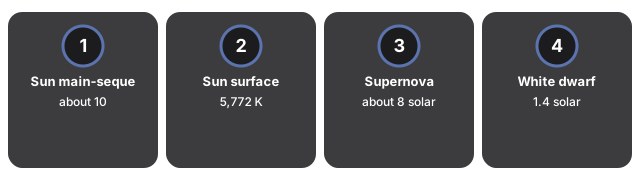
- Published figures table: 10 Gyr, 5,772 K, 8 Msun, 1.4 Msun Chandrasekhar limit
- Runs fully in the browser with the vendored three.js engine - no account, no upload
Teachers use it to connect main-sequence lifetime to stellar mass, students compare solar versus massive endings, and curious readers pause on red giant expansion before the remnant phase.
| Quantity | Published value | Source |
|---|---|---|
| Sun main-sequence lifetime | about 10 billion years | NASA Sun fact sheet |
| Sun surface temperature | 5,772 K | NASA Sun fact sheet |
| Supernova threshold | about 8 solar masses | Stellar evolution references |
| White dwarf limit | 1.4 solar masses | Chandrasekhar limit |
Everything renders on your device with WebGL. The 3D engine loads once (about 0.7 MB) and is cached; no scene data is sent to a server.
The scene is an educational stage visualization - scrubbing is not time-accurate billions-of-years pacing. It does not solve stellar structure or nucleosynthesis, and it is not live sky or exoplanet-transit data.
For a step-by-step walkthrough, read the Star Lifecycle 3D Explorer step-by-step guide. When you need session fit and limits, see when to use Star Lifecycle 3D Explorer. The Space 3D collection also includes a Black Hole 3D Explorer for collapse endpoint geometry and a Stellar Magnitude Scale Explorer for brightness scales.
Frequently Asked Questions
What does Star Lifecycle 3D Explorer show?
A star evolution timeline from molecular cloud through protostar, main sequence, giant phase, and remnant. A central sphere changes size and color while the panel names each stage and lists Sun lifetime about 10 billion years, temperature 5,772 K, supernova threshold 8 solar masses, and white-dwarf limit 1.4 solar masses.
How is this different from Black Hole 3D Explorer?
Black Hole 3D Explorer focuses on the collapse endpoint and accretion-disk geometry. Star Lifecycle 3D Explorer walks the full evolutionary track from nebula through main sequence and giant phases to white dwarf or supernova remnant - the path that can lead to a black hole for the most massive stars.
What does solar mass versus massive star do?
Solar mass follows a Sun-like track ending in a white dwarf capped by the 1.4 solar mass Chandrasekhar limit. Massive star adds a supernova stage for cores at or above about 8 solar masses and ends on a compact remnant node.
What real figures does the panel include?
Sun main-sequence lifetime about 10 billion years, surface temperature 5,772 K, core-collapse supernova threshold about 8 solar masses, and white-dwarf Chandrasekhar limit 1.4 solar masses - from NASA Sun fact sheets and standard stellar-evolution references.
Does Play timeline run in real billions of years?
No. Scrubbing compresses billions of years into seconds for classroom pacing. The published lifetime numbers appear in the facts table; the animation is an educational visualization, not time-accurate evolution.
Is this a stellar structure simulation?
No. The scene does not solve hydrostatic equilibrium, fusion rates, or nucleosynthesis. It is a stage-based teaching visualization with honest approximation disclosure in the panel.