
Between the biggest gas-giant planets and the smallest true stars sits a strange middle category: the brown dwarf. Drag the mass slider below and watch the object cross two real physical lines - one where deuterium fusion switches on, and a much higher one where ordinary hydrogen fusion finally starts and it becomes a real star. Watch the size, too: it barely changes, even as the mass climbs by more than six times.
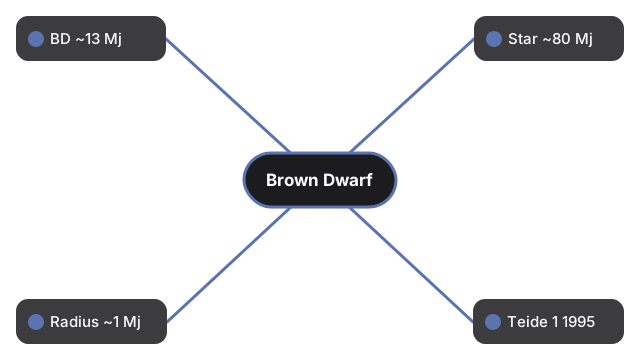
Published figures: the deuterium-fusion (planet / brown dwarf) line sits at about 13 Jupiter masses; the hydrogen-fusion (brown dwarf / star) line sits at about 80 Jupiter masses. Across nearly that whole range, radius stays within about 30% of Jupiter's own, because electron-degeneracy pressure resists the usual more-mass-means-bigger rule.
Drag the mass slider, press Play to auto-sweep, or toggle Realistic dim to see how faint a brown dwarf really looks in visible light.
Brown Dwarf 3D Explorer
For most of the twentieth century, objects between planets and stars were only theory. Two astrophysicists, Shiv Kumar and, separately, Chushiro Hayashi and Minoru Nakano, predicted them in the early 1960s: bodies too light to sustain the hydrogen fusion that powers ordinary stars, yet heavy enough to fuse a rarer, heavier form of hydrogen called deuterium. In 1975, astronomer Jill Tarter needed a name for them and picked brown dwarf - by her own account, simply a color "somewhere between red and black," a placeholder for something dim and dull rather than a literal description.
The theory waited twenty more years for proof. In January 1994, a team using the IAC 80 telescope at Teide Observatory photographed a faint, unusually red object in the Pleiades, the well-known naked-eye star group; a spectrum taken that December confirmed it was too cool and too faint to be a normal star. Published in Nature in September 1995 and named Teide 1 after the observatory, it became the first confirmed brown dwarf, with an estimated mass of about 55 Jupiter masses. The very same year, a second kind of discovery arrived: Gliese 229B, the first brown dwarf found orbiting another star, directly imaged with methane absorption bands in its spectrum - a feature never seen in a true star.
- A single sphere whose mass you control directly, from gas-giant to brown-dwarf to star
- The real 13-Jupiter-mass (deuterium) and 80-Jupiter-mass (hydrogen) lines marked on a literal ruler
- A fixed Jupiter-sized reference sphere, so the radius story reads at a glance
- The real 1995 Teide 1 estimate marked on the same ruler
- A "Realistic dim" toggle contrasting the enhanced default glow with how faint a real brown dwarf looks
- Runs fully in the browser with the vendored three.js engine - no account, no upload
Students see exactly where the textbook mass lines actually sit; anyone confused about "why doesn't a heavier brown dwarf just look bigger" gets the degeneracy-pressure answer in one glance at the barely-changing sphere.
| Figure | Value | Source note |
|---|---|---|
| Planet / brown dwarf line | about 13 Jupiter masses | Deuterium-fusion mass limit |
| Brown dwarf / star line | about 80 Jupiter masses | Hydrogen-fusion mass limit |
| Radius across that range | within about 30% of Jupiter's | Electron-degeneracy pressure |
| First confirmed brown dwarf | Teide 1, 1995, about 55 Jupiter masses | Rebolo, Zapatero Osorio and Martin, Nature |
| First brown dwarf around a star | Gliese 229B, 1995 | Direct imaging, methane spectrum |
Everything renders on your device with WebGL. The 3D engine loads once (about 0.7 MB) and is cached; no scene data is sent to a server.
This is an educational visualization, not an atmosphere or interior model - the default glow is brightened for visibility (toggle Realistic dim to see the real, much fainter appearance), and the reference sphere and ruler are illustrative, not to orbital scale. The color story is a simplified stand-in for a real one: to the human eye most brown dwarfs would actually look magenta, purple, or nearly black, not brown.
For a step-by-step walkthrough, read the Brown Dwarf 3D Explorer step-by-step guide. The Space 3D collection also includes HR Diagram 3D for how stars themselves are classified once they cross that hydrogen-fusion line.
Frequently Asked Questions
What exactly is a brown dwarf?
An object massive enough to fuse deuterium (a heavier form of hydrogen) but not massive enough to fuse ordinary hydrogen the way real stars do - roughly 13 to 80 Jupiter masses.
Why doesn't it get much bigger as I add mass?
Electron-degeneracy pressure. Across most of the brown-dwarf range, radius stays within about 30% of Jupiter's own, even though mass keeps climbing.
What was the first confirmed brown dwarf?
Teide 1, found in images of the Pleiades star group in 1994 and published in 1995, with an estimated mass around 55 Jupiter masses.
Are brown dwarfs actually brown?
No. The name is a 1975 placeholder (astronomer Jill Tarter's choice) for "a color between red and black" - to the human eye most would actually look magenta, purple, or nearly black.
Where is the line between a brown dwarf and a real star?
About 80 Jupiter masses, where sustained hydrogen fusion finally begins.
Is the glow in this scene realistic?
It is brightened for visibility by default. Toggle Realistic dim to see how much fainter a real brown dwarf actually looks.
Is this scene to scale?
The Jupiter reference sphere and the mass ruler are illustrative comparison aids, not an orbital or distance scale.