
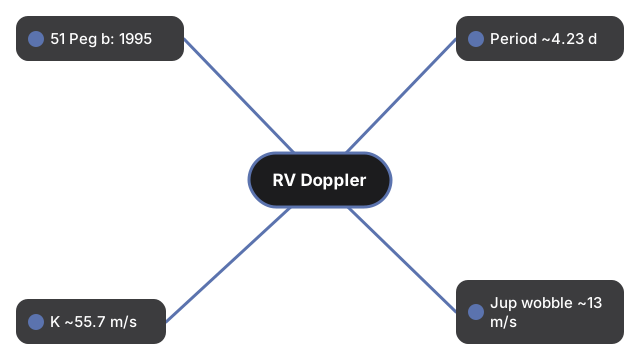
Watch an unseen planet tug its star into a small wobble orbit and read the real numbers: 51 Pegasi b (1995) - period ~4.23 days, velocity semi-amplitude K ~55.7 m/s; Jupiter induces ~13 m/s on the Sun.
Published literacy: 51 Pegasi b period ~4.23 days, semi-amplitude K ~55.7 m/s (Mayor and Queloz, 1995); Jupiter induces ~13 m/s on the Sun.
Drag to orbit and scroll or pinch to zoom. Switch 51 Pegasi b or Jupiter-Sun presets, or Play/Pause the wobble.
Doppler Radial Velocity 3D Explorer
This browser explorer shows the radial velocity exoplanet-detection method: an unseen planet tugs its star into a small wobble around the shared barycenter, and that wobble shows up as a periodic Doppler shift in the starlight. Real literacy: 51 Pegasi b (Mayor and Queloz, 1995, 2019 Nobel Prize) - period ~4.23 days, velocity semi-amplitude K ~55.7 m/s. Jupiter induces ~13 m/s on the Sun.
Exoplanet Transit 3D owns the brightness-dip detection method. Redshift Doppler 3D owns the general wavelength-shift mechanism for a single moving source. This page owns the star-wobble radial-velocity method itself, with a scrolling velocity strip.
- A star that wobbles around the barycenter while an unseen planet orbits opposite it
- A scrolling radial-velocity strip that traces approach and recession
- 51 Pegasi b and Jupiter-Sun presets
- Facts panel lists the period, semi-amplitude K, and discovery history
- Distinct from exoplanet-transit and redshift-doppler
- Runs fully in the browser with the vendored three.js engine - no account, no upload
Students see how astronomers found the first exoplanet around a Sun-like star without ever seeing it directly; teachers contrast this wobble method with the transit-dimming method; curious readers learn who discovered 51 Pegasi b and when.
| Figure | Value | Source note |
|---|---|---|
| 51 Pegasi b discovery | 1995 (Mayor and Queloz) | 2019 Nobel Prize in Physics |
| 51 Pegasi b period | ~4.23 days | Published literacy |
| 51 Pegasi b semi-amplitude K | ~55.7 m/s | Published literacy |
| Jupiter reflex wobble on Sun | ~13 m/s | Mayor and Queloz 1995 |
Everything renders on your device with WebGL. The 3D engine loads once (about 0.7 MB) and is cached; no scene data is sent to a server.
This is an educational wobble schematic - not a spectrograph or line-profile simulator. Star wobble radius is exaggerated for legibility.
For a step-by-step walkthrough, read the Doppler Radial Velocity 3D Explorer step-by-step guide. The Space 3D collection also includes Exoplanet Transit 3D and Redshift Doppler 3D.
Frequently Asked Questions
What does the Doppler Radial Velocity 3D Explorer show?
A star wobbling around its barycenter while an unseen planet orbits opposite it, plus a scrolling velocity strip. Presets show 51 Pegasi b (period 4.23 days, K about 55.7 m/s) and the Jupiter-Sun case (K about 13 m/s).
How is this different from Exoplanet Transit 3D?
Exoplanet Transit 3D teaches the brightness-dip detection method as a planet crosses its star. This page teaches the star-wobble radial-velocity method instead.
How is this different from Redshift Doppler 3D?
Redshift Doppler 3D teaches the general wavelength-shift mechanism for one moving source. This page applies that mechanism specifically to the star-wobble exoplanet-detection method.
What is 51 Pegasi b?
The first exoplanet found orbiting a Sun-like star, discovered in 1995 by Michel Mayor and Didier Queloz, who won the 2019 Nobel Prize in Physics for the discovery.
Is this a spectrograph simulator?
No. It is an educational wobble schematic - not a line-profile or spectrograph solver. The star wobble radius is exaggerated for legibility.
How big is the wobble Jupiter causes on the Sun?
About 13 meters per second, much smaller than the roughly 55.7 m/s wobble 51 Pegasi b causes on its star.