
In 1958 a Geiger counter aboard America's first satellite went quiet above 900 miles, not from a lack of radiation but from too much of it. That accident revealed two donut-shaped belts of particles trapped by Earth's magnetic field - the Van Allen belts. Press play to watch the orange inner belt (protons) and blue outer belt (electrons) drift around Earth in opposite directions, then turn on the South Atlantic Anomaly marker to see where the inner belt dips closest to the ground.
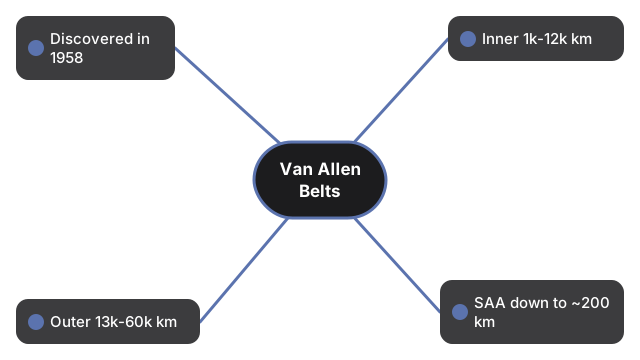
Published figures: the inner belt runs about 1,000 to 12,000 km up (mostly protons); the outer belt runs about 13,000 to 60,000 km up (mostly electrons). Discovered in 1958 by James Van Allen's team using Explorer 1 and Explorer 3.
Drag to orbit and scroll or pinch to zoom. Change the speed, toggle the SAA marker, or pause the motion.
Van Allen Belts 3D Explorer
On January 31, 1958, the United States launched its first satellite, Explorer 1, carrying a Geiger counter designed by physicist James Van Allen. As the satellite climbed above roughly 900 miles, the counter's clicking stopped - not because the radiation had vanished, but because there was so much of it that the instrument had saturated. That accidental discovery, confirmed weeks later by Explorer 3, revealed two donut-shaped belts of energetic particles held in place by Earth's own magnetic field. They were named the Van Allen belts, and finding them was the first major scientific discovery of the Space Age.
The two belts are made of different particles moving in different directions. The inner belt, roughly 1,000 to 12,000 kilometers above Earth, is dominated by high-energy protons. The outer belt, roughly 13,000 to 60,000 kilometers up, is dominated by electrons and is far more variable, swelling and shrinking with solar activity. Protons in the inner belt drift slowly westward around Earth while electrons in the outer belt drift eastward - two rivers of charged particles flowing in opposite directions. Because the belts are centered on Earth's magnetic axis rather than its geometric center, the inner belt dips unusually close to the surface over the South Atlantic, a region called the South Atlantic Anomaly where satellites and the International Space Station experience extra radiation exposure.
- A model Earth surrounded by two particle belts colored by population
- Protons (inner, orange) and electrons (outer, blue) drifting in opposite directions
- A South Atlantic Anomaly toggle marking the inner belt's closest approach to Earth
- A speed slider and Play and Pause control over the drift motion
- Runs fully in the browser with the vendored three.js engine - no account, no upload
Students see why satellites need radiation shielding; space-history readers connect a Cold War-era rocket launch to modern spacecraft design; anyone curious about "what a Geiger counter found in space" can see the two belts it revealed.
| Figure | Value | Source note |
|---|---|---|
| Discovered | 1958 | Explorer 1 and Explorer 3, James Van Allen |
| Inner belt altitude | about 1,000-12,000 km (1.2-3 Earth radii) | Mostly protons over 100 MeV |
| Outer belt altitude | about 13,000-60,000 km (3-10 Earth radii) | Mostly electrons, 0.1-10 MeV |
| South Atlantic Anomaly | inner belt down to about 200 km | Belts offset from Earth's geometric center |
Everything renders on your device with WebGL. The 3D engine loads once (about 0.7 MB) and is cached; no scene data is sent to a server.
This is an educational visualization, not a particle-physics simulation - real particles also bounce rapidly between the poles and spiral tightly around field lines, which this scene does not animate; belt sizes, particle counts, and drift speed are illustrative and compressed, and the South Atlantic Anomaly marker sits at a fixed illustrative longitude, not a live model.
For a step-by-step walkthrough, read the Van Allen Belts 3D Explorer step-by-step guide. The Space 3D collection also includes Earth Magnetosphere 3D and Aurora 3D, which cover the field shape and the light show the same particles help create.
Frequently Asked Questions
What are the Van Allen belts?
Two donut-shaped zones of energetic charged particles trapped by Earth's magnetic field, named after physicist James Van Allen, who led the team that discovered them in 1958.
How were they discovered?
A Geiger counter aboard Explorer 1, America's first satellite, went quiet above about 900 miles because it was saturated by unexpectedly intense radiation. Explorer 3 confirmed the finding weeks later.
How far up are the two belts?
The inner belt runs roughly 1,000 to 12,000 kilometers above Earth; the outer belt runs roughly 13,000 to 60,000 kilometers up.
What particles are in each belt?
The inner belt is dominated by high-energy protons; the outer belt is dominated by electrons and is far more variable with solar activity.
Why do the two belts drift in opposite directions?
Protons in the inner belt drift westward around Earth while electrons in the outer belt drift eastward, a consequence of their opposite electric charge moving through Earth's magnetic field.
What is the South Atlantic Anomaly?
A region where the inner Van Allen belt dips unusually close to Earth, down to about 200 kilometers, because the belts are centered on Earth's magnetic axis rather than its geometric center. Satellites and the International Space Station get extra radiation exposure there.
Is this scene to scale?
No. Belt sizes, particle counts, and drift speed are illustrative and compressed, real particles also bounce between the poles and spiral around field lines in ways this scene does not animate, and the South Atlantic Anomaly marker sits at a fixed illustrative longitude.