
Compare a mean sidereal day (~23h 56m 04s) with a mean solar day (24h) - the ~3m 56s gap - by watching Earth spin against a distant star while it also orbits the Sun.
Blue sightline points at a distant star (sidereal); gold points at the Sun (solar). Because Earth advances in its orbit, noon-to-noon needs a little more spin than star-to-star.
Distinct from Seasons Earth 3D Explorer: that page teaches axial tilt and seasons; this page isolates day-length definitions.
Sidereal vs Solar Day 3D Explorer
freetoolonline.com editorial teamA mean sidereal day is about 23h 56m 04.09s (86164.0905 s) while a mean solar day is 24h (86400 s) - a gap of about 3m 56s (~235.91 s) - because Earth spins against a distant star while also orbiting the Sun.
Drag to orbit the view, play or step through one solar day, and toggle both / star-only / Sun-only sightlines. The orange mark is a teaching observer on Earth.
The facts panel cites published mean day lengths so the about 3m 56s difference stays the reliable takeaway - orbit scale is compressed for readability.
- Mean sidereal day about 23h 56m 04.09s (86164.0905 s)
- Mean solar day 24h 00m 00s (86400 s)
- Difference about 3m 56s (~235.91 s)
- Star vs Sun sightlines on a teaching orbit
- Distinct from Seasons Earth 3D Explorer and Earth 3D Globe
- Runs fully in the browser with the vendored three.js engine - no account, no upload
Teachers use it to separate star time from clock noon, students see why astronomy prefers sidereal spin, and curious readers connect the extra roughly 1 deg of daily spin to Earth orbit.
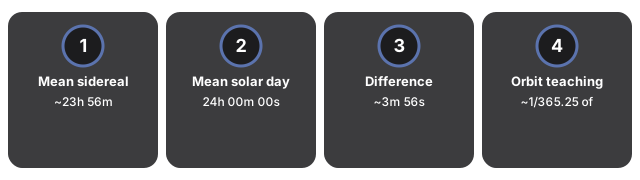
| Quantity | Value | Source |
|---|---|---|
| Mean sidereal day | ~23h 56m 04.09s (86164.0905 s) | Standard Earth rotation (IAU / USNO mean sidereal day) |
| Mean solar day | 24h 00m 00s (86400 s) | Civil mean solar day |
| Difference | ~3m 56s (~235.91 s) | 86400 - 86164.0905 |
| Orbit teaching | ~1/365.25 of a year per solar day | Mean tropical year literacy |
Walking the controls, one solar day at a time
Five moves cover the whole scene. Work them in order the first time and the ~3m 56s gap lands without any narration.
- Open the explorer and wait for Earth, the Sun, and the distant star to paint.
- Drag to orbit the view and keep the facts panel visible so both mean day lengths stay on screen.
- Use Pause and +5% day to scrub through one solar day of teaching time.
- Press Star only, then Sun only, then Both lines to isolate each definition.
- Press Reset and repeat, or press Fullscreen for a classroom projector.
How this explorer compares with the alternatives
The Sidereal vs Solar Day 3D Explorer is the free in-browser demo of mean sidereal against mean solar day length. A desktop planetarium models far more, at the cost of an install and usually an account.
| Option | Sidereal vs solar day | Install | Best for |
|---|---|---|---|
| Sidereal vs Solar Day 3D Explorer | Yes - orbit + spin teaching demo | None (browser) | Fast day-length literacy |
| Seasons Earth 3D Explorer | Tilt / seasons, not day definitions | None | Season lessons |
| Earth 3D Globe | Globe view, not day-length compare | None | Geography / lighting |
| Desktop planetariums | Full sky + time systems | Install / account | Observing plans |
Where the scene stops
Everything renders on your device with WebGL. The 3D engine loads once (about 0.7 MB) and is cached; no scene data is sent to a server.
The scene teaches mean day lengths only - it does not model the equation of time or eccentricity seasonality of the true solar day, and it is not a chronometer or full ephemeris. For axial-tilt seasons, use Seasons Earth 3D Explorer instead.
When you need session fit and limits, see when to use Sidereal vs Solar Day 3D Explorer. The Space 3D collection also includes Seasons Earth 3D Explorer and Earth 3D Globe.
Frequently Asked Questions
What does Sidereal vs Solar Day 3D Explorer show?
Earth spinning and orbiting so you can compare a mean sidereal day (~23h 56m 04s) with a mean solar day (24h) and see the ~3m 56s gap.
Why is a sidereal day shorter?
Distant stars are a nearly fixed background. The Sun direction changes as Earth orbits, so returning to solar noon needs a little extra spin - about 3m 56s more than a star-to-star rotation.
Is this the same as Seasons Earth 3D Explorer?
No. Seasons Earth focuses on axial tilt and seasons. This page isolates how day length is defined versus stars versus the Sun.
What numbers does the panel use?
Mean sidereal day about 86164.0905 s (~23h 56m 04.09s), mean solar day 86400 s, difference about 235.91 s (~3m 56s).
Is the orbit to scale?
No. Sizes and distances are compressed for readability. The copy states that honesty so the mean day lengths stay the reliable takeaway.
Does any data leave my device?
No uploads and no login. The vendored three.js engine renders on your device; status and facts stay in the browser.