
Blue and green sight lines run from opposite ends of Earth's orbit to the star. Star depth scales with 1/p so a larger parallax pulls the star closer on the teaching stage.
Angles are exaggerated for the camera - real stellar parallaxes sit below one arcsecond. This isolates the measurement triangle Solar System 3D Explorer does not teach.
Parallax Distance 3D Explorer
freetoolonline.com editorial team
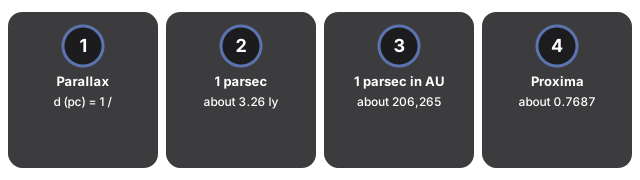
See how Earth's 1 AU orbit baseline turns a tiny parallax angle into stellar distance - d (pc) = 1/p (arcsec), with 1 pc about 3.26 ly (about 206,265 AU) and Proxima Centauri at about 0.7687 arcsec, which the panel resolves to about 1.30 pc. Nothing installs and no account is needed.
- Sun plus Earth at opposite orbit ends as the teaching baseline
- Sight lines to a distant star that move with parallax presets
- Runs fully in the browser with the vendored three.js engine - no account, no upload
Teachers use it to show why one arcsecond defines one parsec, students scrub Proxima versus 1 arcsec, and curious readers connect a tiny angle on the sky to a light-year distance without opening a catalog alone.
| Quantity | Value | Source |
|---|---|---|
| Parallax distance | d (pc) = 1 / p (arcsec) | Definition of the parsec |
| 1 parsec | about 3.26 ly | Standard conversion |
| 1 parsec in AU | about 206,265 AU | 1 / tan(1") geometry |
| Proxima Centauri parallax | about 0.7687 arcsec | Published Proxima p (Hipparcos/Gaia era summary) |
| Proxima Centauri distance | about 1.30 pc | d = 1/p applied to p = 0.7687 |
Walking the controls, preset by preset
Five moves cover the whole scene. Run them in order and the baseline, the Proxima reading, and the definition of the parsec each land on their own.
- Press Earth baseline to see the opposite-orbit ends that form the 2 AU teaching base of the triangle.
- Press Proxima 0.7687" and read the panel distance of about 1.30 pc that d = 1/p produces.
- Press 1 arcsec = 1 pc, the case that defines the parsec, then 0.5 arcsec to double the distance to 2 pc.
- Press d = 1/p to fill the facts panel with the formula and the standard conversions.
- Drag to orbit, scroll or pinch to zoom, and press Fullscreen to keep the controls visible on a projector.
How this explorer compares with the sibling scenes
The Parallax Distance 3D Explorer keeps the Earth-baseline triangle as the teaching focus. Stellar Magnitude Scale Explorer sizes spheres by Pogson flux instead, and Milky Way Map 3D Explorer teaches galactic structure rather than parallax geometry. A textbook can print one static triangle; this scene moves the star as p changes.
| Option | Strength | Access | Trade-off |
|---|---|---|---|
| Parallax Distance 3D (this page) | Earth-baseline triangle plus d = 1/p presets | USD 0, 0 MB to install, seconds to first view | Exaggerated sight-line angles |
| Stellar Magnitude Scale Explorer | Brightness by Pogson flux | Free web | Not distance geometry |
| Milky Way Map 3D Explorer | Galactic structure | Free web | Not parallax geometry |
Where the schematic stops
Everything renders on your device with WebGL. The 3D engine loads once (about 0.7 MB) and is cached; no scene data is sent to a server.
The scene is an educational visualization - sight-line angles are exaggerated so the triangle stays readable. It is not a Hipparcos or Gaia reduction pipeline or a precise ephemeris. Proxima Centauri at about 0.7687 arcsec is a teaching preset, not a live catalog query. Catalog reductions, true-to-scale sub-arcsecond geometry, magnitude scales, and galactic-arm tours all sit outside it.
When you need session fit and limits, see when to use Parallax Distance 3D Explorer. The Space 3D collection also includes a Stellar Magnitude Scale Explorer for brightness scales, a Milky Way Map 3D Explorer for galactic structure, and a Solar System 3D Explorer for orbital layout.
Frequently Asked Questions
What does Parallax Distance 3D Explorer show?
Earth at opposite ends of a 1 AU orbit, sight lines to a star, and how changing parallax in arcseconds moves the star with distance d = 1/p in parsecs.
What is the parallax distance formula?
d (pc) = 1 / p (arcsec). A star with parallax 1 arcsec sits at 1 parsec; 0.5 arcsec sits at 2 pc.
How far is one parsec?
About 3.26 light-years, or about 206,265 AU - the distance where Earth's orbit subtends one arcsecond.
What about Proxima Centauri?
Its published parallax is about 0.7687 arcsec, which implies about 1.30 pc (~4.24 ly) with d = 1/p.
How is this different from Stellar Magnitude Scale Explorer?
Stellar Magnitude Scale Explorer teaches apparent vs absolute brightness. Parallax Distance 3D Explorer isolates the Earth-baseline triangle that measures distance.
Are the on-screen angles true to scale?
No. Real stellar parallaxes are below one arcsecond, so the teaching stage exaggerates the triangle so the geometry stays readable.