
KIC 8462852 - nicknamed Tabby's Star - once dimmed by up to about 20% in a single irregular dip, far deeper than any known planet transit. A 2015 paper mentioned an artificial megastructure as one possible explanation worth checking, and media coverage ran with it. Watch the transit below, then toggle between what a dust cloud predicts and what a solid megastructure would predict instead - the live blue and red brightness readouts show you the real deciding evidence.
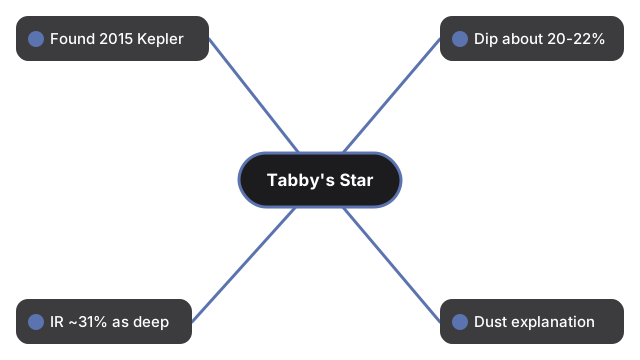
Published figures: the deepest Kepler-era dips reached about 20-22%. Measured dimming in infrared light was only about 31% as deep as in blue light - the chromatic signature of fine dust, not a solid occulter.
Drag to orbit and scroll or pinch to zoom. Press Play, change the speed, or toggle the Megastructure comparison.
Tabby's Star 3D Explorer
In 2015, citizen scientists sifting through NASA Kepler telescope data as part of the Planet Hunters project flagged something strange: a star, catalogued as KIC 8462852, that dimmed by up to about 20% in single, irregular events - far too deep for any known planet to cause, and with no repeating pattern at all. The paper announcing the discovery, led by astronomer Tabetha Boyajian and subtitled "Where's the Flux?", considered many possible explanations. One of them, listed among several others worth investigating, was an artificial megastructure built by an advanced civilization. Media coverage seized on that single possibility, and the star became briefly famous as the "alien megastructure star."
The actual science moved differently. Follow-up observations found that the dimming is chromatic - it cuts far deeper in blue light than in red or infrared light, by a measured factor of roughly 0.31 in the infrared compared to blue. A solid object blocking a star - a planet, a ring system, or a megastructure - blocks every wavelength equally. Only fine, sub-micron dust particles dim a star's light unevenly like this. That single piece of evidence is why astronomers rule out solid occulters and instead point to a cloud of circumstellar dust, quite possibly debris left over from a shattered comet. As of the most recent research, no single explanation yet accounts for every detail of the star's behavior - the puzzle is not entirely closed, but the aliens explanation specifically has essentially been ruled out.
- A live blue-channel and red-channel brightness readout during each transit
- A Megastructure toggle showing what a solid occulter would predict instead
- The real measured 0.31 infrared-to-blue dimming ratio built directly into the numbers
- A speed slider and Play/Pause over the whole transit cycle
- Runs fully in the browser with the vendored three.js engine - no account, no upload
Anyone who remembers the "alien megastructure" headlines gets the real, specific evidence that settled it; students see exactly what "chromatic dimming" looks like and why it matters.
| Figure | Value | Source note |
|---|---|---|
| Discovery | 2015, Kepler data | Planet Hunters citizen-science project |
| Deepest dip | about 20-22% | Far deeper than any known planet transit |
| Infrared vs blue dimming | only about 31% as deep | The chromatic dust signature |
| Leading explanation | circumstellar dust | Possibly comet debris |
| Megastructure hypothesis | essentially ruled out | Would dim all colors equally |
Everything renders on your device with WebGL. The 3D engine loads once (about 0.7 MB) and is cached; no scene data is sent to a server.
This is an educational visualization, not a light-curve simulation - the transit repeats on a fixed loop for clarity, while the real dips are irregular and unpredictable, not periodic. The star and dust cloud are enlarged for visibility.
For a step-by-step walkthrough, read the Tabby's Star 3D Explorer step-by-step guide. The Space 3D collection also includes Exoplanet Transit 3D for how a normal, much shallower planet transit looks by comparison.
Frequently Asked Questions
What is Tabby's Star?
KIC 8462852, a star that showed unusually deep, irregular dimming events - up to about 20% - discovered by citizen scientists in NASA Kepler data in 2015.
Is it really an alien megastructure?
Essentially ruled out. A 2015 paper mentioned it as one of several possibilities worth checking, and media coverage exaggerated its likelihood. The real evidence points elsewhere.
What is the real deciding evidence?
The dimming is chromatic - measured about 31% as deep in infrared light as in blue light. A solid object like a megastructure would dim every color equally; fine dust does not.
What is the leading explanation now?
A cloud of fine circumstellar dust, quite possibly debris from a broken-up comet. As of the latest research, no single explanation yet accounts for every detail.
Why was a planet ruled out?
The dips are far too deep - up to about 20% - for any known planet transit, and they show no repeating orbital pattern.
Where does the nickname come from?
From Tabetha Boyajian, the lead author of the paper that announced the star's unusual behavior.
Is this scene to scale?
No. The transit repeats on a fixed loop for clarity - the real dips are irregular and unpredictable - and the star and dust cloud are enlarged for visibility.